
Is a CNC Machine Operator Job a Good Career Move?
This page explains what an operator actually does on the floor, which skills drive pay, and where the role stops being a good fit. It is written for engineers, shop supervisors, and career changers who want a straight answer instead of a recruitment pitch.
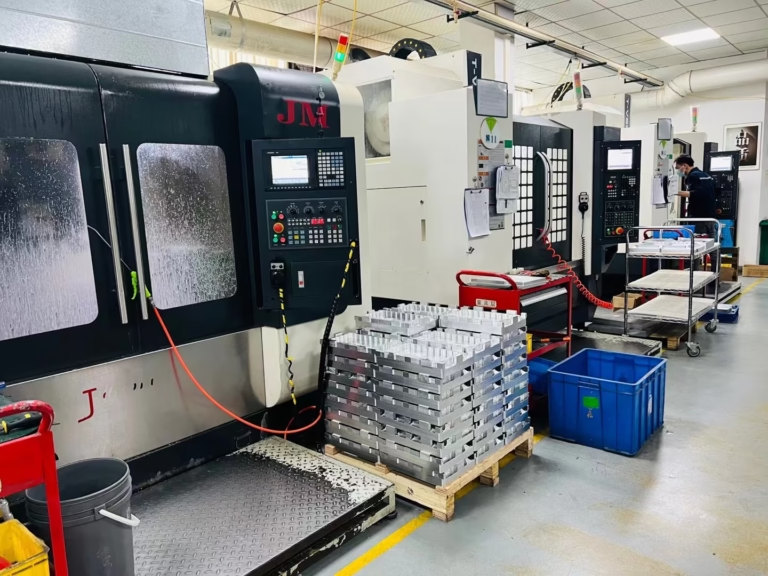
What a CNC Machine Operator Job Looks Like at the Machine
An operator runs a machine that someone else has programmed. The shift starts with the setup sheet and the drawing: load the fixture, touch off the tools, confirm the work offset, run a dry pass, then cut the first part and check it. On a 3-axis mill that might be one vise and six tools. On a 5-axis center it can be a tombstone fixture, 20 tools, and a probing cycle before the spindle ever touches metal.
The core loop is short. Load a part, close the door, watch the load meter and the chip color, swap a worn insert, measure the first-off part, log the result, repeat. A good operator notices the sound change when a 6 mm end mill starts rubbing instead of cutting. That is the skill most job descriptions never mention.
This is not a button-pushing role in a shop that holds ±0.005 mm. At that tolerance, tool wear moves the cut within a few dozen parts. The operator decides when to offset the tool and when to stop and call the programmer. That judgment is the difference between a scrap bin and a shipped lot.
In our plants, a machine running unattended is rare. Someone has to watch the load, the coolant flow, and the chip evacuation. That attention is what the job pays for.
Three Levels That Decide the Pay
Shops rarely pay one rate for the title. There are usually three practical levels. The first is load-and-go: the operator loads parts, presses cycle start, and checks a few dimensions with calipers. The second is setup-capable: the operator changes fixtures, sets tool offsets, adjusts work coordinates, and can run a first article without help. The third is process-capable: the operator reads the program, catches a feed or speed problem, and suggests a fix to the programmer.
The pay gap between level one and level three is real, and it tracks what the operator can do when something goes wrong. A load-and-go operator stops the machine and waits. A process-capable operator knows whether the problem is a worn tool, a loose fixture, or a bad offset, and keeps the spindle turning.
This is why the same title can mean very different work. Two people can both say they run a CNC machine, and one of them cannot set a tool offset. When you compare offers, ask what happens on a crashed tool or a drifting dimension. The answer tells you which level the shop is hiring for.
Certifications help here. They do not replace floor time, but they shorten the path from level one to level two, because setup and inspection follow documented steps.
- 1Load-and-goRuns a proven setup, checks a few dimensions, flags problems upward.
- 2Setup-capableBuilds fixtures, sets offsets, runs first articles on its own.
- 3Process-capableReads the program, diagnoses drift and tool wear, proposes fixes.
Pay Drivers and the Limits of the Role
Pay follows capability, shift, and industry. A 5-axis operator who can set up and prove out a complex part earns more than a 3-axis operator running a simple cycle, because the risk is higher. A medical or aerospace job pays more than general job-shop work, because the documentation and traceability demands are heavier.
Shift matters too. Second and third shift usually carry a premium, and weekend coverage carries more. That is not a trick; it reflects the cost of staying on the machine when the rest of the world is asleep.
The limits are worth stating plainly. A pure load-and-go role can flatten out after a year. If nobody trains you to set offsets or read programs, your pay stops moving. The role is a good job when the shop lets you climb. It is a dead end when the shop only needs hands.
The second limit is physical. Standing for a full shift, lifting fixtures, and handling coolant is real work. Shops that rotate tasks and provide good lighting and ventilation keep operators longer.
Where the Role Leads Next
The operator seat is a common entry point to programming, quality, and supervision. The move to programming is the most direct: once you understand offsets, tool wear, and workholding, learning CAM and G-code is a smaller step. The move to quality runs through inspection, first articles, and reading reports. The move to supervision runs through setup ownership and training new hires.
None of these moves happen automatically. They happen when the shop gives you the next task before you ask for the title. If you are choosing between two offers, ask which one rotates you through setup, inspection, and programming. That rotation is worth more than a small hourly difference.
Automation changes the work but does not remove it. A pallet changer or a bar feeder still needs someone to load tools, check the first part, and respond when a tool breaks. The operator role shifts toward monitoring and setup, which is usually better paid than pure loading.
In our own plants, operators who learn 5-axis setup and probing carry more of the process, and that shows up in what we trust them to run.
When a CNC Machine Operator Job Fits
Use this table to compare the role against other manufacturing jobs on the same criteria.
| Factor | Operator role | Programming role | Inspection role |
|---|---|---|---|
| Entry path | Open with basic training | Needs CAM or G-code study | Needs metrology training |
| Hands-on time | High, every shift | Low, mostly desk | High, every lot |
| Tolerance pressure | Medium to high | High at proof-out | High at first article |
| Shift work | Common, with premiums | Usually day shift | Often day shift |
| Tightest parts | 5-axis, ±0.005 mm | Complex geometry | GD&T heavy work |
| Pay ceiling | Rises with setup skill | Higher, longer path | Steady, certification-led |
| Automation effect | Shifts to monitoring | Grows with tooling | Grows with CMM work |
| Best for | Learning the floor | Geometry thinkers | Detail and records |
The Short Answer
Take a CNC machine operator job if the shop trains you to set offsets and read programs; skip it if the seat is load-and-go with no path to setup. The role is only as good as the training behind it.
Frequently Asked Questions
Do I need a degree to start?
No. Most operators start with a high school diploma and on-the-job training. A certificate program helps you reach setup-capable faster, because it covers offsets, inspection, and shop math in a structured way.
What matters more is whether the shop lets you touch the offsets and the fixtures. A certificate without floor time leaves you at load-and-go.
How long before the pay moves?
That depends on the shop, not the calendar. If you are setting tools and running first articles within a year, pay usually moves with that skill. If you are still only loading parts after two years, the bottleneck is the shop.
Ask in the interview what the last three people in this seat moved into.
Is the work repetitive?
The loop is repetitive: load, run, measure, repeat. The variation comes from the parts and the problems. A drifting dimension or a broken tool breaks the loop and tests what you know.
Shops that rotate operators across machines and parts reduce the monotony and build wider skill.
Will automation replace the role?
Pallet changers and bar feeders reduce the loading work, not the monitoring and setup work. Someone still checks the first part, watches tool wear, and responds to a failure.
The role moves toward setup and process control, which is usually the better-paid end of the job.
What should I ask before accepting an offer?
Ask which machines you will run, whether you will set your own offsets, and who trains you. Ask what tolerances the shop holds and which industries it serves.
Those answers tell you the level you are being hired for and whether the path upward is real.
Does the role travel well between countries?
The skills do. Offsets, tool wear, and workholding are the same language in any shop. Certifications and documented training make the move easier.
What changes is the pay scale and the shift culture, which vary by region and industry.
Talk to the People Who Run the Machines
Send us your part and we will quote it with a free DFM review, so you can see the tolerances and setups behind the work.
12-hour quote100% inspectionNo minimum order
More from the Shop Floor
We publish setup notes, tooling trials and inspection data from the factory floor.











