
Is It Hard to Operate a CNC Machine?
Is it hard to operate a CNC machine? It depends on three things: how many axes the machine has, how tight the tolerance is, and whether you are cutting one prototype or a production run. This page breaks down what actually happens at the control panel and where the real difficulty sits.
Key takeaways
Why is it hard to operate a cnc machine?
People ask whether it is hard to operate a cnc machine because the job looks like one skill. It is not. Operation splits into programming, setup, running and inspection, and each one has its own learning curve. A person can be fast at loading parts and hopeless at dialing in a fixture.
Programming means turning a drawing into a toolpath and then into G-code. Modern CAM software does most of the math, but the operator still picks tool sizes, stepdown, stepover and feed rates. Those choices decide whether the part comes out at size or comes out scrap.
Setup is the physical half. You clamp the stock, touch off the tools, set work offsets and prove the program with the spindle in the air. A missed offset of 0.5 mm is enough to break a tap or drive a face mill into a vise.
Running is the easiest part once the first article passes. The operator watches load, coolant, chip evacuation and tool wear, then swaps inserts on schedule. Inspection closes the loop: measure, compare to the drawing, adjust the offset, cut again.
- 1ProgrammingCAM output plus feed, speed and tool selection
- 2SetupFixture, tool offsets, work offsets, dry run
- 3RunningLoad, coolant, chip control, tool wear
- 4InspectionMeasure, adjust offset, re-cut
Axis count: the clearest difficulty marker
A 3-axis machine moves in X, Y and Z only. The part sits still. Pockets, slots, faces and drilled holes are all reachable in a few setups. This is the machine most people learn on, and most operators are productive on it within a few weeks of supervised practice.
Add a fourth axis and the part rotates while the tool cuts. Now the operator has to think about the rotary position, the work offset in the rotary frame, and whether the tailstock or chuck will hit the tool. The math is not harder, but the failure modes multiply.
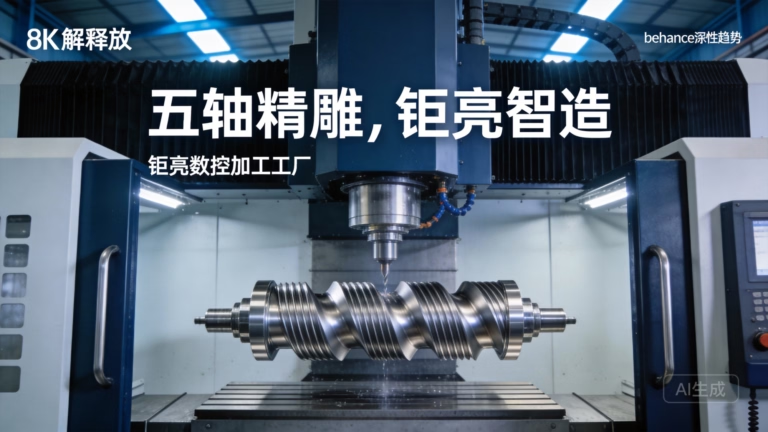
A 5-axis machining center moves three linear axes and two rotary axes at the same time. The controller handles the coordinate transformation, so the operator is not doing trigonometry by hand. The risk shifts to collisions, post-processor errors and stock left in unexpected places.
This is why two shops with the same 16 simultaneous 5-axis machining centers can have very different first-pass yields. The machine is identical. The difference is how well the team understands the setup and the verification routine.
Material and tolerance change the answer
Cutting 6061 aluminium is forgiving. Chips clear easily, the material conducts heat, and a small feed error usually shows up as a cosmetic mark rather than a scrapped part. Machining 17-4PH stainless or Ti-6Al-4V is the opposite: heat stays at the edge, tools wear fast, and the window between a good cut and a broken tool is narrow.
Tolerance is the other lever. General machining at ±0.1 mm is routine for a trained operator. Holding ±0.005 mm on a production run is a process problem, not an operator problem. It needs a temperature-stable room, sharp tooling, machine calibration and a metrology routine.
Surface finish follows the same logic. Ra 1.6–3.2 μm is as-machined and easy to hit. Ra 0.8–1.6 μm is a high-finish target that usually needs a finishing pass with a fresh insert. Ra 0.2–0.8 μm often means a separate finishing operation or a different process entirely.
So the honest answer to whether it is hard to operate a cnc machine is: it depends on the part. A flat bracket in aluminium is a training exercise. A thin-wall titanium housing at ±0.005 mm is a specialty.
How modern controls lower the barrier
Twenty years ago an operator wrote G-code by hand at the machine. A wrong sign or a missing decimal point meant a crash. Today CAM software generates the code, simulates the toolpath and flags gouges before the spindle turns.
Controls now ship with conversational programming, tool libraries, and graphic simulation of the stock removal. That removes a lot of the fear, but it does not remove the need to understand what the machine is doing. Simulation is only as good as the model you feed it.
The bigger shift is in verification. A first-article inspection report catches a wrong offset before a full run. In-process probing on the machine can measure a feature and update the offset automatically. These tools turn a risky operation into a repeatable one.
The setup sequence we follow in the shop
Same order whether the run is one part or ten thousand.
- 1Read the drawing for critical featuresList the tolerances tighter than ±0.05 mm and the surface finishes below Ra 1.6 μm. Those drive tooling and setup, not the overall shape.
- 2Choose stock and workholdingPick the smallest stock that still cleans up. Soft jaws for round parts, a vise or fixture plate for prismatic parts, and enough clamp force to survive the roughing pass.
- 3Set tool offsets and work offsetsTouch off every tool, then set the work offset from a known datum. Verify with a dry run at a raised Z height before the first cut.
- 4Prove the program on scrapRun the first article in aluminium or a scrap block when the geometry allows. Check the critical features before committing the real material.
- 5Inspect the first articleMeasure every critical feature with a calibrated instrument. Record the actual values, not just pass or fail.
- 6Adjust offsets and lock the processCorrect the offset from the measured deviation, re-cut, and record the settings so the next run starts from a known state.
Machine type and what it demands from the operator
Difficulty is measured by time to first good part, not by machine price.
| Machine type | Typical parts | Hardest part of the job | Realistic ramp-up |
|---|---|---|---|
| 3-axis mill | Plates, brackets, simple pockets | Fixture and work offsets | 2–6 weeks supervised |
| 4-axis mill | Shafts, flats on round parts | Rotary offsets and clearance | 1–3 months |
| 5-axis machining center | Impellers, housings, medical parts | Collision avoidance and verification | 6–18 months |
| Mill-turn center | Turned parts with milled features | One-setup planning and tool reach | 3–12 months |
| CNC lathe | Round parts, threads, bores | Tool wear and chip control | 1–4 weeks |
Run it in-house or send it out?
If you cut the same family of parts every week, invest in the machine and train one operator properly. If you need a small batch, a tight tolerance, or a material your team has not run before, outsourcing is cheaper and faster than learning on the job.
Frequently asked questions
Do I need to read G-code to operate a CNC machine?
You do not need to write it by hand. CAM software generates it.
You do need to read it well enough to spot a wrong feed, a missing tool change or an offset that looks off. That skill is what separates an operator from a button pusher.
How long does it take to become competent?
On a 3-axis mill, a careful trainee can run supervised first articles in two to six weeks. Full independence on unfamiliar parts takes longer.
On 5-axis work, expect six months to a year and a half before the operator can set up complex parts without help.
What causes most first-article failures?
Wrong work offset, wrong tool offset, or a tool that is not the one the program expects. These three account for most scrap on simple parts.
On complex parts, add collision and unexpected stock condition to the list.
Can one person run several machines at once?
Yes, if cycle times are long enough and the machines have good chip control and tool-life monitoring.
That works best on stable production runs. It is a poor fit for first articles or tight-tolerance work that needs the operator at the panel.
Does a tighter tolerance always mean a harder job?
Not in the way people expect. The cutting is often similar. What changes is the measurement, the temperature control and the number of adjustments.
Holding ±0.005 mm is a process discipline problem more than a machining skill problem.
Send the drawing, get a real answer
Upload your part and our engineers will tell you whether it is a straightforward job or one that needs a 5-axis setup. Quotation and free DFM analysis within 12 hours.
12-hour quote100% inspectionNo minimum order quantity
More machining notes
We publish setup notes, tooling trials and inspection data from the factory floor.











