
Knowledge that circuit factory sellers must know
A purchasing checklist for teams that buy machined parts, housings and hardware from circuit factory sellers and their sub-suppliers. It covers the checks that decide whether a quote is usable: tolerance, lead time, MOQ, certifications and how the shop reports inspection data. Read it before you send the next RFQ.
In this article
- 1
- 2
- 3
- 4
- 5
- 6
- 7
Key takeaways for buyers
What to check before you place an order
Use the middle column as your baseline when you compare circuit factory sellers.
| Check | Baseline to ask for | Red flag |
|---|---|---|
| Tolerance | ±0.005 mm on critical features only | Blanket ±0.005 mm on every dimension |
| Finish | Ra 0.8–1.6 μm on sealing faces | Ra value quoted with no measurement method |
| Quote turnaround | Quotation and DFM notes within 12 hours | Price with no machining feedback |
| First article | Inspection report on request | Verbal 'it is fine' only |
| Minimum order | No MOQ, one part to 10,000+ | MOQ pushed up after tooling starts |
| Certifications | ISO 9001:2015, IATF 16949:2016 on scope | Certificate with no scope statement |
| Data handling | NDA on request, secure uploads | Drawing sent over plain email |
| Late delivery | Historical late rate below 2% | No delivery history shared |
Tolerance and surface finish: what a quote should state
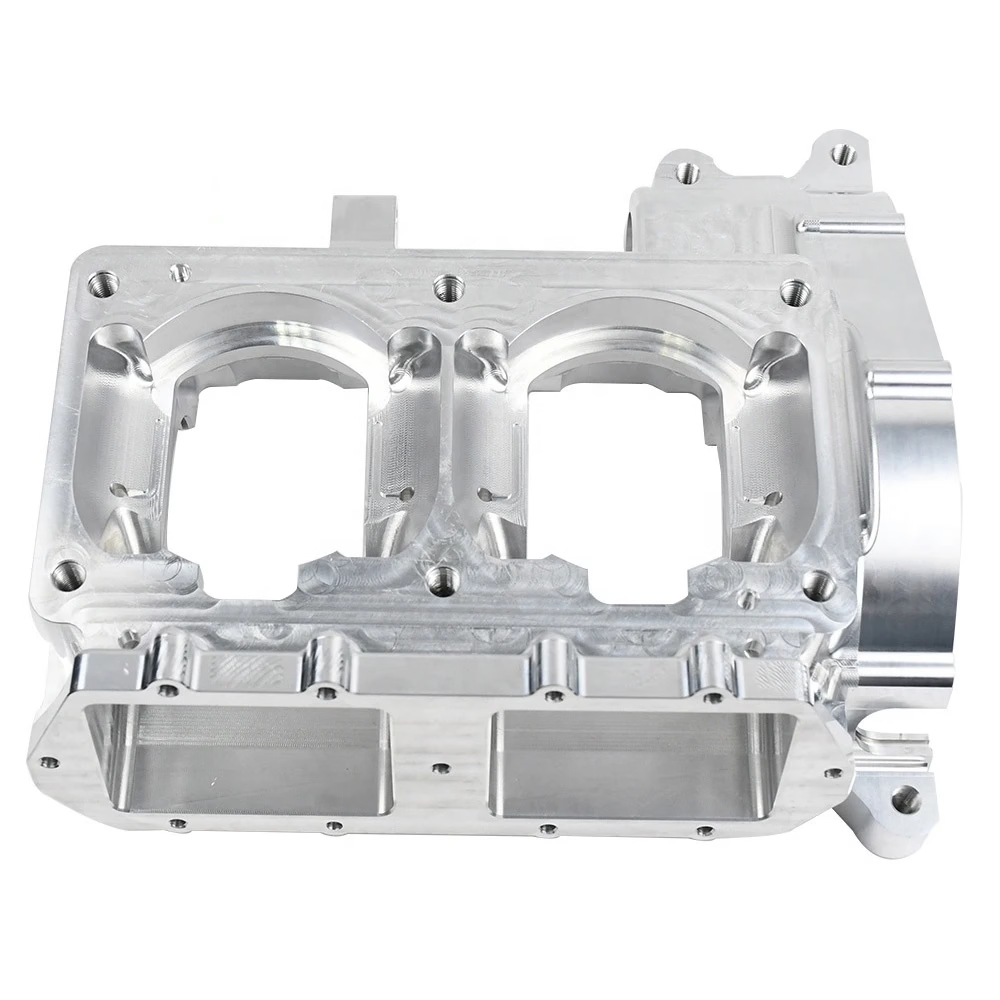
A tolerance number on its own tells you little. The useful question is which features carry it. On a milled aluminium housing, a bearing bore at ±0.005 mm and a clearance hole at ±0.2 mm cost very different amounts of machine time. When circuit factory sellers quote a single blanket tolerance across the whole drawing, they are either padding the price or they have not read the drawing. Ask them to mark the tight features.
Finish follows the same rule. Ra 0.2–0.8 μm is a fine finish that usually needs a separate operation after milling. Ra 0.8–1.6 μm comes off a good finishing pass on a 5-axis machine and covers most sealing faces and sliding surfaces. Ra 1.6–3.2 μm is as-machined and fine for brackets, covers and internal structure. Paying for a fine finish on a non-functional face is one of the easiest ways to overspend on a machined part.
Material choice moves the tolerance you can hold. Aluminium 6061-T6 and 7075 hold tight bores well because they are stable after stress relief. Stainless 304 and 316 work-harden, so deep pockets and small bores need slower feeds and more tool changes. Titanium TC4 (Ti-6Al-4V) and Inconel hold tolerance but cut slowly, and thin walls below 1 mm will deflect no matter how good the machine is.
- 1Send a marked-up drawingHighlight the two or three features that carry the real tolerance.
- 2State the finish per faceNot one Ra value for the whole part.
- 3Flag thin wallsBelow 1 mm on titanium or stainless, expect a design conversation.
Lead time, MOQ and the numbers behind them
Lead time claims are easy to make and hard to verify. At GreatLight, quotation and free DFM analysis come back within 12 hours, production can start within 24 hours, and parts ship in 3–5 days for most machined work. The historical late-delivery probability is below 2%. Those numbers rest on 127 high-precision CNC machines across three wholly-owned plants, so a job does not sit in a queue behind one bottleneck machine.
Ask how a shop handles a schedule slip before you award the order. A useful answer names the alternate machine or the second shift. A useless answer promises it will not happen. For circuit factory sellers buying machined enclosures on a build schedule, a two-day slip on a housing can stall an assembly line, so the recovery plan matters more than the original date.
Minimum order quantity is the other quiet cost. No minimum order quantity means you can run one prototype and then a 10,000+ part run from the same process, so the parts you validate are the parts you ship. When a shop quotes low on the first part and then raises the price at volume, the prototype was never representative. Ask for the price at one, one hundred and one thousand pieces in the same quote.
- 1Ask for the price ladderOne, 100 and 1,000+ pieces in one document.
- 2Ask what happens on a slipAlternate machine, second shift, or partial shipment.
- 3Check the prototype processSame machine type as production, not a different route.
Certifications and inspection: read the scope
Certificates are scope documents, not badges. ISO 9001:2015 covers a quality management system. IATF 16949:2016 adds automotive-specific requirements around traceability and change control. ISO 13485:2016 is the medical device standard. ISO 27001:2022 covers information security, which matters when you send confidential drawings. A shop can hold all four and still not have applied them to your part family, so ask which certificate covers the process that will run your job.
Inspection is where the certificate becomes real. A 100% inspection before shipment, with raw material check, in-process monitoring and final inspection, is the baseline worth paying for. Reports on request are the second half of that sentence. If a supplier will not send dimensional data on the first article, the certificate is decoration. For a housing with a sealing face, one CMM report on the first part prevents a full batch rework.
Confidentiality belongs in the same conversation. Uploads should be secure and confidential, and an NDA should be available on request rather than treated as a special favor. For circuit factory sellers handling customer designs, a supplier who resists an NDA is telling you how they treat drawings in general.
- 1Match certificate to part familyAutomotive work needs IATF 16949:2016 in scope.
- 2Ask for a first article reportDimensional data, not a pass or fail stamp.
- 3Put the NDA in place earlyBefore drawings leave your side.
Matching the part to the machine
Most quoting errors come from a part being sent to the wrong machine class. A single-setup 5-axis job suits a part with features on five faces, angled holes, or a complex contour that would need three fixtures otherwise. A 3-axis job with two setups is often cheaper for a simple plate. A mill-turn center makes sense when a part has turned and milled features and concentricity between them matters.
Size sets the ceiling. GreatLight runs a 4,000 mm maximum processing size, with travels of 4,000 × 400 × 150 mm for long parts, 750 × 1,150 × 550 mm and 600 × 600 × 600 mm for mid-size work, and 500 × 500 × 450 mm plus 500 × 310 × 200 mm for compact parts. A Ø400 mm rotary table covers most round work that needs indexing. If your part is longer than the travel on the machine class being quoted, the shop will split it into setups and the tolerance will suffer.
Volume changes the answer again. Below a few hundred parts, machining is usually the right call. Above that, die casting or vacuum casting can win on unit cost, with machining left for the critical faces. The mistake is choosing a process by unit price alone and ignoring the tooling cost and the lead time it adds.
- 1Count the faces with featuresMore than two sides usually favors 5-axis.
- 2Check travel against part lengthA split setup costs tolerance.
- 3Compare total cost, not unit costInclude tooling and the added lead time.
Step by step: qualifying a supplier
- 1Send a complete data pack3D model in STEP, 2D drawing with tolerances and finish per face, material grade, quantity at one and at volume. Missing finish callouts are the most common reason a quote comes back vague.
- 2Ask for the DFM notesA real shop returns comments within 12 hours: thin walls, tool reach, features that need a tighter tolerance than the function requires. No comments on a complex part is a warning.
- 3Confirm which certificate covers your processName your industry. Automotive work goes under IATF 16949:2016, medical under ISO 13485:2016, and confidential designs under ISO 27001:2022.
- 4Agree the inspection planState which features get measured, at what frequency, and in what format the report arrives. First article plus in-process checks plus final inspection is the baseline.
- 5Lock the price ladder and MOQOne, 100 and 1,000+ pieces in writing. Confirm there is no minimum order quantity and no price step that appears only after tooling starts.
- 6Agree the schedule and the recovery ruleConfirm the ship window and ask what happens on a slip. Get the answer in the same email as the price.
- 7Place a small first orderRun one or two parts, measure them yourself, then release the volume. A prototype that matches production is the point of the exercise.
Questions buyers ask
What tolerance can a machined housing realistically hold?
±0.005 mm is achievable on critical features such as bearing bores and sealing faces, measured on a CMM. It is not realistic as a blanket tolerance across every dimension on the drawing, and asking for it that way raises the price without improving the part.
Finish runs alongside tolerance. Ra 0.8–1.6 μm suits most sealing and sliding faces, while Ra 0.2–0.8 μm needs an extra operation and should be reserved for the faces that need it.
How fast should a quote come back?
A quotation and free DFM analysis within 12 hours is a reasonable benchmark for a machined part, and production can start within 24 hours once the order is released. A price that arrives in minutes with no engineering comments usually means nobody opened the model.
For repeat work, ask for the price ladder in the same document: one piece, 100 pieces and 1,000+ pieces. That makes the volume step visible before you commit.
Is no minimum order quantity realistic?
Yes, when the shop runs the prototype and the production parts on the same machine class. GreatLight quotes from one prototype to 10,000+ part runs with no minimum order quantity, which lets you validate the exact process you will scale.
Watch for the opposite pattern: a cheap single part on one route and a different production route at volume. The prototype then proves nothing about the shipped parts.
Which certification do I actually need?
Match the certificate to your industry and your part. ISO 9001:2015 is the general quality baseline. IATF 16949:2016 covers automotive work. ISO 13485:2016 covers medical devices. ISO 27001:2022 covers information security and matters when drawings are confidential.
Then ask for the scope statement and the first article inspection report. A certificate without a report is a document, not evidence.
How do I keep drawings confidential?
Send them through a secure upload channel, put an NDA in place before the first file moves, and confirm who inside the shop can see the model. Uploads should be secure and confidential, and an NDA should be available on request.
If a supplier treats an NDA as an unusual request, treat that as information about how the drawings will be handled later.
What size part can be machined in one setup?
It depends on the machine class. Long parts run up to 4,000 mm maximum processing size on travels of 4,000 × 400 × 150 mm. Mid-size work sits at 750 × 1,150 × 550 mm or 600 × 600 × 600 mm. Compact parts run on 500 × 500 × 450 mm and 500 × 310 × 200 mm travels, with a Ø400 mm rotary table for indexed round work.
If the part exceeds the travel, the shop splits it into setups. That adds cost and usually loosens the tolerance between features.
Send the drawing, get a usable quote
Upload your model and drawing. We return a quotation and DFM notes within 12 hours, with the tolerance and finish per face stated in writing.
12-hour quote100% inspectionNo minimum order quantity
More machining notes
We publish setup notes, tooling trials and inspection data from the factory floor.











