
7 Essential Benefits of Automatic CNC Machining Every Factory Owner Must Know
A shop-floor view of what automation actually changes: how repeatability, lights-out running, per-part cost, geometry, surface finish, traceability and material range shift when the machine runs the cycle instead of the operator. Written for engineers and plant owners deciding where automation pays back and where it does not.
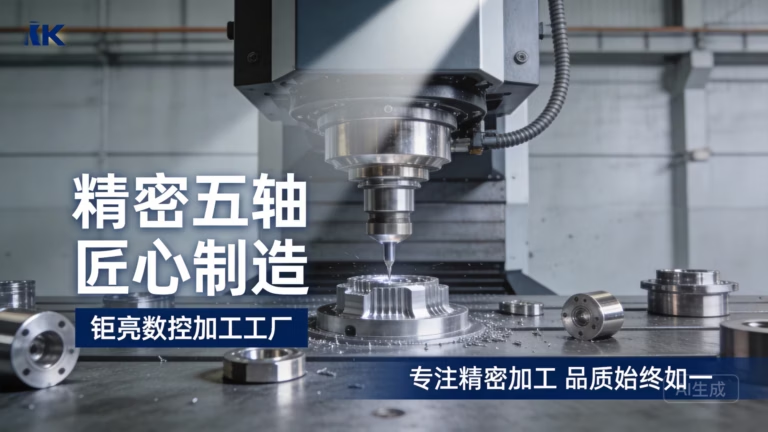
What Automation Changes on the Floor
Automation does not make a bad process good. It removes the operator variable from a process that is already understood.
Precision and Repeatability Without Operator Drift
Manual machining accuracy depends on the person at the panel. Cycle ten parts and the tenth carries every small correction the operator made along the way. Automatic CNC machining removes that path. Tool offsets, work offsets and thermal compensation are held in the control, so part one and part five hundred are cut from the same numbers. At GreatLight we hold ±0.005 mm (±0.0002 in) on production runs, which is the tolerance band most aerospace and medical drawings actually call out.
Repeatability matters more than a single tight dimension. A bore that measures 12.002 mm on the first part and 12.009 mm on the last is still inside a ±0.005 mm window, but it will change how the mating pin fits. Programs that hold the same nominal value across a batch let you set assembly clearances once and stop chasing them.
This is also why automation and probing belong together. In-process probing checks a critical feature before the tool wears past its limit, and the control adjusts the offset automatically. On a 16-station five-axis cell, that check adds seconds per part and removes an entire class of scrap.
Where it does not help: one-off parts with hand-fitted geometry. If the drawing is still changing every hour, a manual setup can be faster than reprogramming a cell.
Lights-Out Running and Shorter Lead Times
An automatic machine keeps cutting after the shift ends. Automatic tool changers, bar feeders, pallet pools and chip conveyors let a cell run unattended through the night. The operator loads stock and walks away. In the morning the parts are on the pallet and the spindle has been working for eight more hours than a manual mill could.
That extra time compresses lead time in a way that headcount cannot. Adding a second shift adds cost and coordination. Running the same spindle through the night adds output for the price of the stock and the wear parts. For a factory owner, the useful question is not how many machines you own but how many spindle hours per week you actually sell.
At our Dongguan plants we run three wholly-owned facilities with 127 high-precision CNC machines, including 16 simultaneous 5-axis machining centers, 12 four-axis mills, 27 three-axis machines and 16 mill-turn centers. Production can start within 24 hours of a released drawing, and parts ship in 3–5 days. Those numbers come from keeping spindles loaded, not from rushing a single job.
Lights-out only works when the process is stable. If chips pile up, coolant runs dry or a tap breaks at hour three, unattended running just makes scrap faster. Automate the jobs you have already proven.
Per-Part Cost Falls Even at Low Volume
The old rule said automation only pays on high volume. That rule came from transfer lines, where the fixture cost had to be spread over millions of parts. A modern CNC cell is reprogrammable in minutes, so the break-even sits far lower. Setup is amortized over the run, not over the machine's lifetime.
The savings come from four places. First, less setup time per batch because fixtures and offsets are stored. Second, less scrap because the process does not drift with operator fatigue. Third, fewer secondary operations when the machine finishes a feature in the same setup. Fourth, less inspection labor when probing and reports are built into the cycle.
Volume still matters, but differently. A 50-part run of a complex housing can be cheaper on an automated 5-axis cell than on three manual setups, because every extra setup is another chance to lose a datum. With no minimum order quantity, we quote from one prototype to 10,000+ part runs on the same process, so the cost curve does not jump when the order grows.
The honest limit is fixture cost. If a part needs a dedicated hydraulic fixture and you only need three of them, the fixture may cost more than the machining. In that case, a visor-and-soft-jaw setup on a 3-axis machine is the cheaper route.
When Automatic CNC Machining Pays Off
A rough guide to matching the process to the job.
| Job type | Better choice | Why |
|---|---|---|
| 1–5 prototypes, drawing still changing | 3-axis or manual support | Reprogramming cost outweighs automation gain |
| 50–5,000 parts, stable drawing | Automatic 3- or 4-axis cell | Setup amortized, offsets stored, low scrap |
| Undercuts and freeform surfaces | 5-axis simultaneous | Fewer setups, one datum, better blend |
| Long slender turned parts | Swiss-type lathe | Bar feeder runs unattended, tight concentricity |
| Deep cavities, hard tool steel | EDM and milling combo | Automation handles the roughing, EDM the detail |
| Large frames over 2,000 mm | Gantry or large-travel mill | Part must fit the work envelope, not the reverse |
Complex Geometry and Surface Finish in Fewer Setups
Manual machining struggles with undercuts, deep pockets and organic surfaces. Each new angle needs a new setup, and every setup adds a small position error. Simultaneous 5-axis interpolation tilts the tool and the table together, reaching the back of a part without unclamping it. The datum never moves, so the blend between features stays clean.
This matters most where parts are light and stiff at the same time. Humanoid robotics arms, EV brackets and drone frames often use thin ribs and curved webs that would be split into four parts and welded under a manual process. Cut in one 5-axis cycle, they come out as a single piece with no weld distortion.
Finish is the second half of the same argument. A rigid setup with constant chip load leaves a predictable surface. We hold Ra 0.8–1.6 μm as a standard machined finish, and Ra 0.2–0.8 μm where a sealing face or bearing bore needs it. As-machined surfaces run Ra 1.6–3.2 μm and often need no further work.
When a finish callout goes below Ra 0.2 μm, milling is usually the wrong tool. That is a polishing or lapping operation, and pretending the mill will get there adds cost without adding quality.
Traceability and Material Range
An automated machine logs what it did. Spindle load, tool number, feed override and probe results are stored against the program and the pallet. If a customer asks which tool cut a bore on a given lot, the data exists. That is the practical meaning of data-driven quality: not a dashboard, but a record you can hand to an auditor.
We inspect 100% of parts before shipment, covering raw material check, in-process monitoring and final inspection. Reports are available on request. Our quality system is certified to ISO 9001:2015, IATF 16949:2016, ISO 13485:2016 and ISO 27001:2022, which is what lets medical and automotive buyers accept the same process.
Material range is the last benefit and an easy one to underestimate. A flexible cell cuts aluminium, stainless, steel, copper alloys, titanium and engineering plastics on the same floor. We machine 6061 and 7075 aluminium, 304 and 17-4PH stainless, 4140 and 4340 steel, C36000 brass, Ti-6Al-4V, Inconel, magnesium and plastics from POM to PEEK.
Each family needs its own feeds, coolant strategy and tool coating. Automation helps because the proven recipe is stored and reused, not re-learned by whoever is on shift.
Confidentiality runs alongside this. Uploads are secure and confidential, and we sign an NDA on request before drawings are shared.
Questions Engineers Ask About Automatic CNC
Does automatic CNC machining make sense for a 20-part order?
Often yes, if the geometry needs more than two setups or the tolerance is tight. The stored offsets and probing do the work that a skilled operator would otherwise repeat on every part.
It makes less sense when the part is simple, the drawing is still moving, and a 3-axis setup with soft jaws will do. We quote both routes when the choice is close.
What actually limits unattended running?
Chip evacuation, tool life and stock supply. If chips pack into a pocket or a drill wears out at hour two, the cell stops being unattended.
We plan tool life from the material and the feature, and use chip conveyors and through-spindle coolant on deep pockets. Proven jobs run lights-out; new geometry gets a supervised first run.
How tight a tolerance can you hold in production?
±0.005 mm (±0.0002 in) on production runs, verified with in-process probing and final inspection.
Tighter than that on a single feature is possible with a dedicated process, but it should be a drawing requirement, not a habit. Every extra decimal adds cost.
Which materials are the hardest to automate?
Titanium and Inconel, because of heat and tool wear, and magnesium, because of chip handling. Each needs its own speeds, coolant and tool coating.
Aluminium, brass and most stainless grades are straightforward on a modern cell. Plastics like PEEK need sharp tooling and controlled coolant to avoid melting.
How do you prove a batch met the drawing?
Raw material certificates, in-process probe data and a final inspection record tied to the lot. 100% of parts are inspected before shipment.
Inspection reports, first article reports and material certs are available on request. We can also hold parts for your own inspection before they ship.
Can you keep a design confidential before we place an order?
Yes. Uploads are secure and confidential, and we sign an NDA on request before any drawing is shared.
The same applies to DFM feedback. We can review a model and return manufacturability notes within 12 hours without circulating it outside the project team.
Send a Drawing and Get a Process Recommendation
Upload your files for a quotation and free DFM analysis within 12 hours. An engineer will tell you whether the part belongs on an automated cell or a simpler setup.
12-hour quote100% inspectionNDA on request









