
Low Cost Chinese 3 Axis CNC Machining Wholesale
This page is for engineers and sourcing staff comparing Chinese 3-axis suppliers for volume runs. We cover the checks that separate a low unit price from a low total cost, with the tolerance, MOQ, and inspection numbers you should demand before releasing a PO.
In this article
- 1
- 2
- 3
- 4
- 5
- 6
- 7
- 8
- 9
Key takeaways
Which supplier profile fits your order
Match the order profile to the shop type before you compare prices.
| Order profile | What to prioritize | Red flag |
|---|---|---|
| 1–50 prototype parts | DFM feedback speed and no MOQ | Setup fee hidden until invoice |
| 500–5,000 repeat parts | Fixture reuse and in-process SPC | New fixture quoted every run |
| ±0.01 mm general parts | Stable 3-axis capacity | Claims of ±0.002 mm on 3 axes |
| ±0.005 mm tight bands | CMM reports and temperature control | No inspection report offered |
| Automotive PPAP work | IATF 16949 and traceability | Certificate shown but out of scope |
| Medical device housings | ISO 13485 and clean handling | No material certs on request |
| Cosmetic anodized parts | Bead blast and color consistency | Finish quoted without sample photo |
| Large frames to 4,000 mm | Travel and workholding | Part split into welded sections |
Specification checklist before you release a PO
These are the figures we hold on our own 3-axis work. Use them as a benchmark when you compare quotes.
| Item | Benchmark value | How to verify |
|---|---|---|
| General tolerance | ±0.005 mm (±0.0002 in) | First article CMM report |
| As-machined finish | Ra 1.6–3.2 μm | Comparator plate or profilometer |
| Fine finish | Ra 0.2–0.8 μm | Sample part from the same setup |
| Max part size | 4,000 mm | Work envelope photo or video call |
| Quote turnaround | Within 12 hours | Timestamped email reply |
| Production start | Within 24 hours | PO acknowledgement date |
| Ship window | 3–5 days | Past shipping records |
| Inspection | 100% before shipment | Inspection report on request |
The verdict on low cost 3-axis sourcing
Cheap quotes are easy to find. A supplier that holds ±0.005 mm, reuses your fixture, and ships inspection reports is the one that lowers total cost. Send us a drawing and we will tell you within 12 hours whether 3-axis is the right process for it.
What 3-axis work does well, and where it stops
A 3-axis mill moves the tool along X, Y, and Z with the part held still, or the table moving under a fixed spindle. Every feature you can reach from one direction, or from a small number of re-fixtured directions, is fair game. That covers mounting plates, enclosure panels, connector brackets, heat sinks, bus bars, and most brackets on a vehicle or a robot arm.
The advantage is not romance. It is setup count. One or two fixtures, a short program, and a proven tool list. Setup time is often 30 to 60 minutes per operation on a 3-axis machine, and that cost is spread across the whole batch. On a 2,000-part run it nearly disappears. On a 20-part run it can double the price.
The limits are geometric. Deep cavities, undercuts, and blended compound curves need either a 5-axis machine or extra operations with custom tooling. If your part has a 120 mm deep pocket with a 12 mm corner radius, a 3-axis machine needs a long reach tool that will chatter. Better to move that job to 5 axes than to accept a bad surface finish.
A useful rule: if the drawing can be fully dimensioned from three orthogonal views with no projected curves, 3-axis is probably the right call. If three or more views are needed just to describe one surface, look at 5-axis. Getting this wrong is the most common cause of a quote that looks cheap and a part that arrives late.
Where the money actually goes in a wholesale order
Buyers often compare hourly machine rates and stop there. That number is real, but it is rarely the largest line. On a typical aluminum bracket at 500 pieces, the breakdown looks like this: material 25 to 35 percent, machining time 30 to 40 percent, fixturing 10 to 15 percent, finishing 8 to 15 percent, inspection and documentation 3 to 8 percent.
Fixturing is the line that surprises people. A soft jaw set for one part might cost the equivalent of 20 parts. If the supplier quotes a fresh fixture on every repeat order, your unit price never falls. Ask up front whether the fixture is stored and reused, and for how long.
Material choice moves the number more than most engineers expect. Switching from 7075 to 6061 aluminum can cut material cost by roughly a third and machine 20 to 30 percent faster, at the cost of about 40 percent of the yield strength. If the part is not flight hardware or a stressed link, that trade is often worth taking.
Finishing is the quiet cost. Clear anodizing is cheap per part. Hardcoat anodizing, electroless nickel, or selective laser marking with a 1.5 mm minimum character height adds handling steps and inspection. Group the finish into one operation per batch instead of finishing parts as they come off the machine.
- 1Ask for the fixture planStored and reused fixtures are the main reason unit price drops on run two.
- 2Group finishing by batchSplitting a finishing lot doubles handling and rack charges.
- 3Check the tolerance stackOne tight feature forces the whole operation onto a slower machine.
- 4Confirm the material spec6061-T6 and 6061-T651 are not interchangeable on a drawing.
How to qualify a Chinese 3-axis supplier
Start with the certificate scope, not the certificate logo. An ISO 9001:2015 certificate should name the site that will run your parts. If the audit covers a trading office and the machining happens somewhere else, the certificate tells you very little. Ask for the certificate number and the registered address.
For anything that ends up in a vehicle, look for IATF 16949:2016. For medical device components, ISO 13485:2016. For drawings and CAD files handled across borders, ISO 27001:2022 matters more than most buyers realize, because it covers how your intellectual property is stored and who can open it.
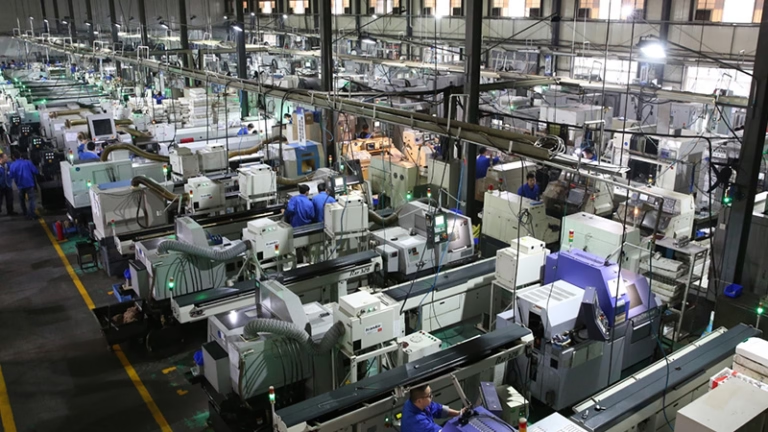
Machine list matters less than machine condition, but it still matters. A shop with 27 three-axis machines can absorb a schedule shock that a shop with three cannot. Ask how many spindles are available for your part size and whether the shop runs lights-out. Capacity claims should match the travel envelope of the actual machines.
Finally, test the communication path. Send a drawing with one deliberate ambiguity and see what comes back. A supplier that returns a DFM note with a specific question inside 12 hours is a supplier that will not go silent when a tool breaks at 2 a.m. your time.
Why Dongguan quotes come in lower
The price gap between a Dongguan quote and a Western quote is not mainly labor. It is supply density. Within a short drive of our plant in Dongguan there are anodizers, heat treaters, material stockholders, and tooling shops. A runner can move material between them the same day. That removes a week of logistics from the schedule.
The second factor is machine utilization. A shop running 127 high-precision CNC machines can keep spindles loaded across many customers. When one program is in setup, another is cutting. That utilization drives the hourly rate down without cutting corners on the cut itself.
The third factor is the workforce. Our 150 technicians include programmers who have run the same family of parts for years. A programmer who has cut 400 aluminum housings knows which tool path will chatter and which will not. That knowledge shows up as fewer broken tools and fewer rework loops.
None of this is a promise about price. It is a description of why a well-run Chinese shop can quote lower and still hold ±0.005 mm. The buyer's job is to confirm the shop is actually well run, not just cheap.
The cheap Chinese CNC myth, tested
The claim is that low cost means low quality. In practice, quality failure in Chinese 3-axis work comes from three specific causes, and none of them is the country of origin. They are: an unclear drawing, a fixture that was never validated, and an inspection step that was skipped to save time.
An unclear drawing is the largest cause. If a ±0.05 mm feature and a ±0.005 mm feature sit on the same face and the drawing does not say which datum controls which, the shop will pick one. It may pick the wrong one. Send a marked-up print with critical features flagged.
Fixture validation is the second. A fixture that holds a part with 0.05 mm of lift will produce a batch with 0.05 mm of variation, no matter how good the machine is. Ask for a first-article report that includes fixture repeatability, not just the first part's dimensions.
Skipped inspection is the third. The fix is contractual, not technical. Require 100% inspection before shipment, with raw material check, in-process monitoring, and a final report on request. A shop that resists this is telling you something.
Step by step: from RFQ to repeat order
This is the sequence we run for wholesale 3-axis orders. Use it as a checklist against any supplier.
- 1Send STEP plus a 2D printInclude the material spec, finish callout, and every critical dimension. A STEP file alone leaves tolerance undefined and invites a wrong quote.
- 2Read the DFM note, not just the priceA good reply flags thin walls under 1 mm, deep pockets over 4× tool diameter, and any feature that needs a second setup.
- 3Freeze the tolerance bandMark which features truly need ±0.005 mm and which can hold ±0.05 mm. Widening one non-critical feature can cut cycle time by 15 to 25 percent.
- 4Approve the fixture conceptAsk how many parts per load and how the datum is located. Zero-point or vise-based workholding is fine; undocumented workholding is not.
- 5Run a first articleInspect the first part off the machine, then the tenth. Drift between them tells you more than the first part alone.
- 6Lock the finish specSend a physical sample or a photo with the target sheen. Anodizing color varies by lot, so agree on a tolerance range, not a word.
- 7Set the shipping and inspection routineConfirm 100% inspection before shipment, packaging method, and whether reports travel with the box or by email.
- 8Store the fixture and reorderOn the repeat run, insist the original fixture and program are reused. That is where wholesale pricing actually comes from.
Questions buyers ask before ordering
What is the smallest order you will run?
There is no minimum order quantity. We run from one prototype part to 10,000+ part runs on the same 3-axis equipment.
For one-off parts the setup cost dominates, so expect a higher unit price. The price curve flattens sharply once the fixture is amortized over 50 to 100 parts.
Can 3-axis machining hold ±0.005 mm on a production run?
Yes, on the right part. The feature must be reachable in one or two setups, the material must be stable, and the fixture must locate the part without lift.
Very tight bands on long, thin parts are a different problem. Thermal growth and tool deflection take over. In those cases we usually recommend a stress-relief step or a design change.
How do you protect our drawings and CAD files?
Uploads are secure and confidential. We work under ISO 27001:2022 controls for information security and sign an NDA on request before files are shared.
If your program requires it, we can restrict access to a named engineering group and remove files from shared drives after the project closes.
Which materials give the best cost per part?
6061-T6 aluminum is the default for structural brackets and housings. It machines fast and takes anodizing well.
Stainless 303 and 304 cut slower and cost more per kilogram. Use them where corrosion resistance or food-contact rules require it, not by habit.
What finish should I specify for a functional part?
As-machined at Ra 1.6–3.2 μm is fine for most internal brackets. Bead blasting followed by clear anodizing is the common choice for visible aluminum parts.
Hardcoat anodizing adds wear resistance but changes dimensions slightly. Call out which surfaces must stay in tolerance after coating.
How fast can a wholesale order start and ship?
Quotation and DFM analysis come back within 12 hours. Production can start within 24 hours of PO release, and parts typically ship in 3–5 days.
Timing depends on finishing and material availability. If a batch needs hardcoat anodizing, add the anodizer's queue to your schedule.
Get a 3-axis quote with DFM notes
Upload your STEP file and 2D print. You get pricing, a DFM note, and a fixture plan back within 12 hours.
12-hour quoteNo MOQ100% inspectionNDA on request
More from the shop floor
We publish setup notes, tooling trials and inspection data from the factory floor.











