
Low Cost CNC Machining Service: What to Check Before You Send the PO
Most price gaps between shops come from quoting conventions, not from cutting speed. This guide shows engineers and sourcing teams which five checks decide whether a low cost cnc machining service is a real bargain or a rework bill. Written from 15 years of job-shop quoting in Dongguan.
In this article
- 1
- 2
- 3
- 4
- 5
- 6
- 7
Key takeaways
What actually moves the unit price
Same part geometry, different shop profiles. Use this to read a quote instead of just comparing the bottom line.
| Factor | Cheaper route | Costlier route | How to check |
|---|---|---|---|
| Tolerance band | ±0.05 mm general | ±0.005 mm critical features | Ask which features need the tight band |
| Surface finish | Ra 1.6–3.2 μm as machined | Ra 0.2–0.8 μm or hand polish | Name the Ra on the drawing |
| Batch size | 1–50 parts, no MOQ | 10,000+ parts, dedicated setup | Compare setup cost per part |
| Axis count | 3-axis with two setups | 5-axis in one setup | Count setups on the print |
| Inspection level | Sample check | 100% inspection + report | Ask for the inspection plan |
| Certification | ISO 9001 only | IATF 16949 / ISO 13485 | Match cert to your industry |
| Material | 6061 aluminium | Inconel, titanium, PEEK | Check scrap and tool wear cost |
Why one low cost cnc machining service quotes 40% less than another
A machined part has four cost pools: material, machine time, setup and inspection, and finishing. Two shops quoting the same drawing rarely split those pools the same way. One may quote as-machined at Ra 3.2 μm and skip deburring. Another may include anodizing, laser marking and a dimensional report. The gap is not always quality. It is scope.
Machine time is the pool buyers underestimate. Roughing a 6061 bracket at 3-axis speeds takes minutes. Cutting the same bracket from 17-4PH stainless at ±0.005 mm takes hours, and the tooling wears faster. If your quote is low, the shop probably assumed a free-machining alloy or a looser band than the drawing states.
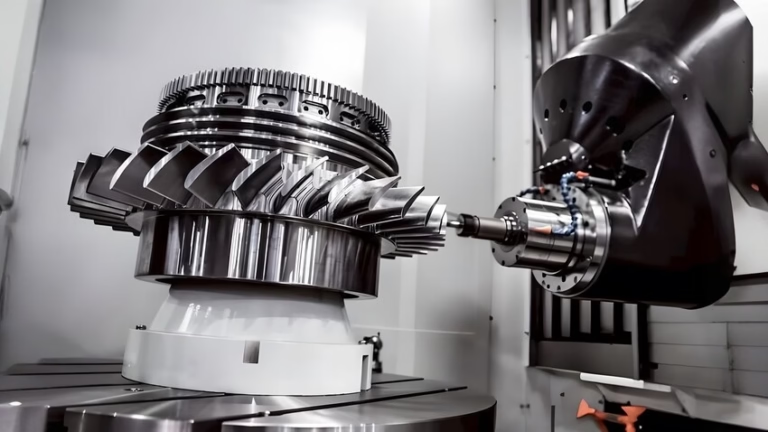
Setup is the second swing factor. A 3-axis part with four faces needs four fixtures and four zeroing steps. A 5-axis center with a Ø400 mm rotary table holds three of those faces in one setup. For runs under 100 parts, setup often costs more than cutting. That is why a shop with 16 simultaneous 5-axis centers can beat a cheaper 3-axis shop on complex geometry.
Inspection is the pool that disappears first in a cheap quote. 100% inspection before shipment with in-process monitoring and a final report costs labor. A supplier that inspects one part per batch is not wrong for every job. It is wrong for a medical housing or a safety bracket, where a single out-of-tolerance bore scraps the assembly.
- 1Rule of thumbCompare quotes only after both list material grade, tolerance band, finish and inspection level.
- 2Red flagA quote with no mention of material certification or finish spec is priced on assumptions.
Which parts suit a low cost cnc machining service, and which do not
Machining wins on geometry freedom and tolerance, not on unit cost at volume. A low cost cnc machining service makes sense from one prototype to a few thousand parts, especially when the design still moves. Change a wall thickness and the shop edits the program. A die casting tool cannot do that without a new mold.
Parts with deep pockets, undercuts, thin ribs or tight true-position callouts on multiple faces are good candidates. Five-axis work removes setups, and fewer setups means fewer datum errors. Parts that are flat, simple and needed in high volume are not good candidates. For those, die casting or sheet metal usually beats machining on price per unit.
Material matters more than most buyers expect. Aluminium 6061 and 6061-T6 cut fast and hold tolerance well. Titanium TC4 (Ti-6Al-4V) and Inconel burn tool life and slow the spindle. If your part is Inconel and the quote looks like aluminium money, the shop has either misread the material or plans to cut it badly.
Size is the last boundary. GreatLight machines parts up to 4,000 mm, with large travels of 4,000 × 400 × 150 mm and medium travels of 750 × 1,150 × 550 mm. If your part exceeds a shop's travel, it becomes two parts and a weld, which changes both cost and strength.
- 1Good fitPrototypes, low-volume runs, complex 5-axis geometry, regulated industries needing certs.
- 2Poor fitHigh-volume simple parts where die casting or stamping already has a tool.
Five checks that separate a real price from a cheap one
Check one: does the quote name the tolerance band per feature? A drawing with a general ±0.1 mm title block and three ±0.005 mm bores is two different jobs. A supplier that quotes one number is guessing. GreatLight holds ±0.005 mm (±0.0002 in) on critical features and states which ones.
Check two: what finish is included? As-machined at Ra 1.6–3.2 μm, high finish at Ra 0.8–1.6 μm and fine finish at Ra 0.2–0.8 μm are separate operations with separate costs. Anodizing, electroless nickel, powder coating, bead blasting and laser marking all add steps. Laser marking has a minimum character height of 1.5 mm, so tiny date codes need another method.
Check three: what is the inspection plan? Raw material check, in-process monitoring and final inspection are the baseline. Reports on request should be a yes, not a favor. If your industry is automotive or medical, match the shop's certification to the requirement: IATF 16949:2016 for automotive, ISO 13485:2016 for medical devices, ISO 9001:2015 as the general floor.
Check four: what is the real lead time? A first article with finishing is not a 3-day job. Ask when production starts and when the parts ship separately. A 12-hour quotation with free DFM analysis is a normal response time for a prepared shop. Same-day shipping promises on new parts are usually optimistic.
Check five: what happens when a dimension is out? Ask about rework policy and how the shop handles non-conformance before you place the order, not after. A supplier with a 99.99% qualification rate still needs a documented path for the 0.01%.
- 1Negotiation leverLoosen non-critical features to ±0.05 mm and spend the savings on the tight ones.
- 2Cost trapTightening every dimension on the print adds cost with no functional gain.
Pitfalls that make a cheap quote expensive
The first pitfall is unstated material substitution. A shop quoting 6061 may cut 6082 or a remelted ADC12 if the grade is not written into the PO. Both machine well. Both may fail a hardness or corrosion spec. Put the alloy and temper on the purchase order and ask for mill certificates.
The second is finishing outside the shop. If the anodizer is a third party, the schedule belongs to someone else. Your parts sit in a queue you cannot see. A supplier that runs machining, finishing and inspection under one roof controls that queue. GreatLight keeps surface finishing in house, which removes a handoff.
The third is packaging. Thin walls and polished faces get damaged in transit more often than they get machined wrong. Ask how parts are separated, wrapped and boxed. For a 10,000-part run, a few cents of foam is cheaper than a returned lot.
The fourth is confidentiality. Drawings and models leave your building. Confirm that uploads are handled securely and that a non-disclosure agreement is available on request. For defense-adjacent or unreleased consumer products, this is a pass or fail item, not a preference.
- 1Write it downAlloy, temper, tolerance per feature, Ra, finish type, marking and packaging.
- 2Ask earlyNDA and secure upload before you send the full 3D model, not after.
How to qualify a supplier in six steps
Run this sequence on any new shop before the first production order.
- 1Send the full drawing packageInclude 2D print with tolerance per feature, 3D model, material grade, finish callout and annual volume. Missing one of these turns a quote into a guess.
- 2Request DFM feedback with the quoteA useful shop flags thin walls, deep pockets and features that need a second setup. Free DFM analysis in the quote response is a good sign.
- 3Order a first article at the real toleranceDo not accept a sample machined to a looser band. Measure the critical features and compare with the drawing, then decide on the run.
- 4Check the inspection documentationAsk for a dimensional report on the first article. If the shop cannot produce one on request, plan for incoming inspection on every lot.
- 5Verify certification scopeConfirm ISO 9001:2015 for general work, IATF 16949:2016 for automotive, ISO 13485:2016 for medical. Ask what the certificate actually covers.
- 6Test the scale-upMove from 1 prototype to 50 parts to 10,000+ parts and watch lead time and scrap. A shop with no minimum order quantity makes this test cheap.
Questions buyers ask before the first order
Is a low cost cnc machining service always lower quality?
No. Cost differences usually come from scope, batch size and quoting assumptions, not from a hidden quality ceiling.
Ask what the price includes: material certificate, tolerance per feature, surface finish, inspection level and packaging. Once two quotes cover the same scope, the comparison is fair.
What is the minimum order quantity?
At GreatLight there is no minimum order quantity. Runs go from one prototype to 10,000+ parts.
For small runs the setup dominates, so a shop built around fast changeover and 5-axis machining is usually cheaper than a high-volume factory.
How tight a tolerance can you hold, and does it change the price?
Critical features can be held to ±0.005 mm (±0.0002 in). General features at ±0.05 mm are much cheaper.
Tightening every dimension on a print adds cycle time and inspection cost without adding function. Mark only the features that matter.
How fast can parts ship?
Quotation and free DFM analysis come back within 12 hours. Production can start within 24 hours, and parts usually ship in 3–5 days.
First articles with finishing and a full report take longer than repeat orders. Build that into your schedule instead of assuming the fastest case.
Which materials and finishes are available?
Aluminium 6061, 6061-T6, 2024, 5052, 5083, 6063, 6082, 7075 and ADC12; stainless 303, 304, 316, 316L, 17-4PH and others; steels including 1018, 1045, 4130, 4140 and 4340; titanium TA1, TA2, TC4; plus copper, brass, Inconel, magnesium and engineering plastics.
Finishes include anodizing, electroless nickel, zinc, silver and gold plating, powder coating, black oxide, bead blasting, tumbling, brushing, polishing and laser marking.
How are drawings kept confidential?
Uploads are handled as secure and confidential, and a non-disclosure agreement is available on request.
Send the NDA before the full model package if the design is unreleased. It costs nothing and removes a later argument.
Get a quote you can compare line by line
Send the print and the volume. We return a quotation with DFM feedback inside 12 hours, and the price lists what is included.
12-hour quoteNo MOQ100% inspectionISO 9001 / IATF 16949 / ISO 13485
More from the shop floor
We publish setup notes, tooling trials and inspection data from the factory floor.











