
Low Price CNC Machining Service: How to Judge Real Value
This guide is for engineers and buyers comparing quotes for a low price CNC machining service. It lists the checks that separate a cheap unit price from a genuinely lower total cost: quote scope, tolerance bands, setup amortization, finishing, MOQ and documentation.
In this article
- 1
- 2
- 3
- 4
- 5
- 6
- 7
- 8
Key takeaways
What changes the price on a CNC quote
Same part geometry, different cost drivers. Read the row that matches your part.
| Cost driver | Cheap quote pattern | Sound quote pattern | What it means for you |
|---|---|---|---|
| Quote scope | Machining only | Machining, deburring, finish, inspection | Add the missing steps before comparing |
| Tolerance | One band, no callout | Bands tied to drawing callouts | Tight features cost more, so name them |
| Setup | Hidden in unit price | Listed as its own line | Low volume favors low setup, not low cycle |
| Finishing | Sent to a third party | Done in-house | One owner when a finish fails |
| MOQ | 500 pieces minimum | No minimum, 1 to 10,000+ | Prototypes and production on one floor |
| Documentation | On request, billed | Inspection reports on request | Ask up front for the report list |
| Lead time | Vague window | 3–5 days shipping stated | Late risk below 2% historically |
Read the quote scope before you read the price
Two quotes for the same bracket can differ by 40% and both be honest. The difference is usually scope. One supplier quotes 12 minutes of spindle time and a raw block. The other quotes the same block plus deburring, anodizing, laser marking, and a dimensional report. The second number looks higher until you price the missing operations at your own labor rate.
Ask for a line-by-line breakdown: material, setup, cycle time, finishing, inspection, packaging. When a low price CNC machining service refuses to break the quote down, you cannot tell which line was trimmed. Trimming inspection or finishing is the most common way a number drops without the process getting faster.
Also check the unit of the quote. Some suppliers quote per piece at a run size you never agreed to, then re-price your actual order. Others quote per batch and bury the setup inside. Neither is wrong, but you need to know which one you are reading before you compare two suppliers.
One more scope item: who supplies the material. If the quote assumes you ship certified bar stock, the price excludes material cost, material certificate review, and the risk of a hardness surprise on the first cut.
- 1Ask for a breakdownMaterial, setup, cycle, finish, inspection, packaging as separate lines.
- 2Confirm the run sizeA per-piece price is meaningless without the quantity it applies to.
- 3Name the material sourceBuyer-supplied stock moves cost and risk back to you.
Tolerance bands decide which machines can run the job
A drawing with ±0.05 mm on every dimension is a different job from one with ±0.005 mm on four bores. The second job needs a machine with the right geometric accuracy, a temperature-stable shop, and a slower finishing pass. If both are quoted from the same generic template, the tight job will be re-quoted after first article.
Useful reference points: ±0.005 mm (±0.0002 in) is achievable on our 5-axis and mill-turn centers; Ra 0.8–1.6 μm is a normal high-finish target; Ra 0.2–0.8 μm is a fine finish that adds polishing or a dedicated finishing pass. As-machined surfaces sit around Ra 1.6–3.2 μm, which is fine for most brackets and housings.
Tolerance also interacts with geometry. A thin wall will move under clamping no matter how good the machine is. A deep pocket with a small corner radius needs a small tool, which deflects. Tell the supplier which dimensions are functional and which are reference. That single clarification often removes more cost than any negotiation.
On our floor, 100% inspection before shipment covers raw material check, in-process monitoring and final inspection. Reports are available on request. If your quality plan requires a first article report, say so in the RFQ, not after the parts ship.
- 1Mark functional dimensionsOnly those need the tight band.
- 2Match finish to functionSealing surfaces need finer Ra than covers.
- 3Flag thin walls earlyClamping strategy changes the quote.
Setup amortization: why small orders behave differently
Setup is a fixed cost. It does not shrink when the order shrinks, so on a 20-piece run it can be half the invoice. That is not a sign of a bad supplier. It is arithmetic. The way to lower it is to reduce the number of setups, not to argue about the hourly rate.
Practical moves: design so the part can be machined from one or two faces, use the 5-axis centers (16 of them) to reach features that would otherwise need a second operation, and accept a slightly looser tolerance on a non-critical face instead of adding a re-fixture. On a 500-piece run, cycle time takes over as the dominant cost, so tool life and chip evacuation matter more than setup.
Ask the supplier where the break-even sits. On typical milled aluminum parts, setup stops dominating somewhere in the low hundreds of pieces. Below that, a cheap quote that hides setup is really a quote for a different quantity.
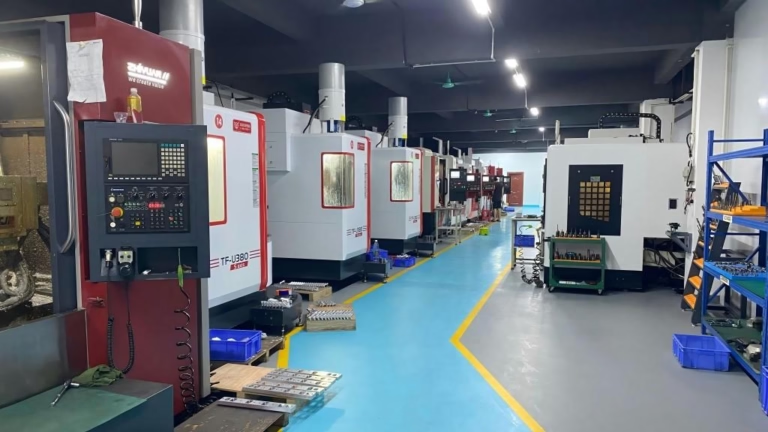
Our 127 high-precision CNC machines include 16 simultaneous 5-axis centers, 12 four-axis mills, 27 three-axis machines and 16 mill-turn centers. That mix matters for cost: a job that needs 5-axis access can be quoted without a second fixture, while a simple plate should not be run on an expensive 5-axis cell.
- 1Count the setupsEach extra face adds fixture time and error stack-up.
- 2Use 5-axis to cut operationsOne setup instead of two fixtures.
- 3Ask for the break-evenThe quantity where cycle time overtakes setup.
Finishing and material choices that quietly add cost
A part is not finished when the spindle stops. Deburring, edge break, anodizing, plating, powder coating, heat treatment and laser marking all sit after machining, and each one can scrap a part. When these steps are outsourced to the cheapest subcontractor, the machining supplier loses control of the schedule and the finish consistency.
Material choice drives cost more than most design changes. Aluminum 6061-T6 machines fast and takes anodizing evenly. 7075 is stronger but harder on tooling. 304 stainless work-hardens, so light passes and sharp tools matter. Titanium TC4 (Ti-6Al-4V) and Inconel run hot and slow. If your part does not need the strength, moving from 17-4PH to 303 stainless can cut cycle time noticeably.
Finishes we run in-house include anodizing (clear, color, hardcoat, conductive), electroless nickel, zinc, silver and gold plating, powder coating, black oxide, bead blasting, tumbling, brushing and polishing, plus laser marking with a minimum character height of 1.5 mm. Keeping these under one roof means one owner when a coating fails adhesion.
Laser marking deserves a design note. If your part number or traceability code is smaller than 1.5 mm character height, the mark will not be legible. Increase the character size or move the mark to a flat area.
- 1Design for the finishSharp inside corners hold less coating and anodize unevenly.
- 2Pick material by functionDo not pay for 7075 where 6061-T6 works.
- 3Keep marking legibleMinimum character height 1.5 mm.
Supplier checks: certifications, MOQ and lead time
Certifications are a filter, not a score. ISO 9001:2015 shows a documented quality system. IATF 16949:2016 is what automotive and EV programs expect. ISO 13485:2016 applies to medical devices. ISO 27001:2022 covers information security, which matters when you send drawings and CAD files. If a supplier cannot show the certificate that your industry requires, price is irrelevant.
MOQ tells you how the supplier is built. A shop with no minimum order quantity can take one prototype and a 10,000+ part run from the same floor, which keeps the process and the inspection method stable from the first article to production. A shop with a 500-piece minimum is telling you its setup economics do not work below that line.
Lead time should come with a number, not a feeling. Ask what happens between PO and shipment. We quote and return free DFM analysis within 12 hours, production can start within 24 hours, and parts ship in 3–5 days. Our historical late-delivery probability is below 2%, which is a record, not a guarantee for your specific part.
Confidentiality is part of the supplier check. Uploads are secure and confidential, and an NDA is available on request. If your drawings carry export-controlled or medical content, settle the NDA before you send files, not after.
- 1Match certificates to industryAutomotive, medical and IT security each have a different one.
- 2Use MOQ as a signalNo minimum means prototypes and production share a process.
- 3Sign the NDA firstBefore files move, not after.
Step by step: how to compare CNC quotes without getting burned
Six steps. Do them in order and the cheapest quote stops being the default answer.
- 11. Fix the drawing revisionSend one PDF plus a 3D file (STEP or IGES) and state the revision. Quotes on different revisions cannot be compared, and re-work from a stale drawing is billed to you.
- 22. List functional tolerancesMark which dimensions carry fit, sealing or wear duty. Put the tight band only on those. ±0.005 mm on a cosmetic edge adds cost with no benefit.
- 33. State the finish and marking specName the finish type and the Ra target, for example Ra 0.8–1.6 μm, and give the laser mark character height. Anything under 1.5 mm will not be legible.
- 44. Give the real annual volume, not the first orderSay 50 now and 3,000 per year if that is true. Suppliers price setup against the annual run, and a prototype price looks very different from a production price.
- 55. Ask for the quote breakdown and the report listMaterial, setup, cycle, finish, inspection, packaging. Confirm whether an inspection report or first article report is included or extra.
- 66. Ask what would make the part cheaperA free DFM review often finds the real saving: a wider corner radius, one less setup, or a material swap. We return DFM analysis with the quote within 12 hours.
Questions buyers ask before ordering
Can a low price CNC machining service still hold ±0.005 mm?
Yes, on the right machines and the right features. ±0.005 mm (±0.0002 in) is achievable on our 5-axis and mill-turn centers, but it depends on geometry, wall thickness and how many faces need to be reached.
The practical question is which dimensions need that band. A quote that applies ±0.005 mm to the whole drawing will be expensive and slow. A quote that applies it to the four functional features is both cheaper and easier to inspect.
Why do two suppliers quote the same part so differently?
Almost always scope. One quote includes deburring, finishing, inspection and packaging; the other is spindle time only. Check the line items before you check the total.
The second cause is run size. A per-piece price at 1,000 pieces is not comparable to a per-piece price at 50 pieces, because setup is spread over a different quantity.
Is there a minimum order quantity?
On our floor there is no minimum order quantity. We run from one prototype to 10,000+ part runs, and the same process and inspection method carries from first article into production.
For very small orders, expect setup to be the largest line on the quote. That is normal and it is cheaper than paying for a fixture you do not need.
What materials and finishes can you run?
Aluminum 6061, 6061-T6, 2024, 5052, 5083, 6063, 6082, 7075 and ADC12; stainless 303, 304, 316, 316L, 420, 430, 431, 440C and 17-4PH; steel 1018, 1045, 4130, 4140, 4340, A36 and tool steel; copper and brass grades including C36000; titanium TA1, TA2, TC4, Inconel and magnesium AZ31B/AZ91D; plus ABS, PC, PMMA, POM, PA, PEEK, PP, HDPE and carbon fibre.
Finishes include anodizing (clear, color, hardcoat, conductive), electroless nickel, zinc, silver and gold plating, powder coating, black oxide, bead blasting, tumbling, brushing and polishing, and laser marking from 1.5 mm character height.
How large a part can you machine?
Maximum processing size is 4,000 mm, with a large travel of 4,000 × 400 × 150 mm. Medium travels cover 750 × 1,150 × 550 mm and 600 × 600 × 600 mm; compact travels cover 500 × 500 × 450 mm and 500 × 310 × 200 mm. A Ø400 mm rotary table handles turned and indexed work.
If your part sits near the top of a travel range, say so in the RFQ. Fixture design and available Z clearance decide whether the price stays where you expect.
How fast can I get parts, and how are files handled?
Quotation and free DFM analysis come back within 12 hours, production can start within 24 hours, and parts ship in 3–5 days. Historical late-delivery probability is below 2%.
Uploads are secure and confidential, and an NDA is available on request. Sign it before sending controlled drawings. Every shipment is inspected 100% before it leaves, and inspection reports are available on request.
Get a quote you can compare line by line
Send your drawing and target volume. You get a broken-down quote, free DFM analysis within 12 hours, and no minimum order quantity.
Quote within 12 hoursFree DFM analysisNo MOQNDA on request
More from GreatLight
We publish setup notes, tooling trials and inspection data from the factory floor.











