
China 4-Axis CNC Machining Factory: What Engineers Should Check
This guide is for engineers and sourcing managers comparing 4-axis CNC suppliers in China. It covers the axis setup, the tolerances a 4-axis mill can hold, MOQ and certification requirements, and the quoting details that decide whether a part ships on time.
In this article
- 1
- 2
- 3
- 4
- 5
- 6
- 7
Key takeaways
4-axis vs 3-axis vs 5-axis: which setup fits the part
Pick the cheapest setup that still reaches every feature in one or two operations.
| Setup | Best for | Watch out for |
|---|---|---|
| 3-axis mill | Flat plates, single-face pockets, tight budgets | Every new face needs a re-fixture and re-datum |
| 4-axis mill | Four-sided pockets, slots and holes on one block | Rotary table swing and part diameter limits |
| 4-axis mill-turn | Shafts and bushings with milled flats or cross holes | Bar size limit; not for large boxy housings |
| 5-axis simultaneous | Curved surfaces, undercuts, deep impellers | Higher hourly rate; only pays off on complex geometry |
Pick the shop that answers the fixture question first
If a supplier quotes your 4-axis part without asking about the rotary table, the datum and the fixture, the price is a guess. Send the drawing and we will come back with a DFM note and a quote within 12 hours.
What a 4-axis CNC machining factory actually adds
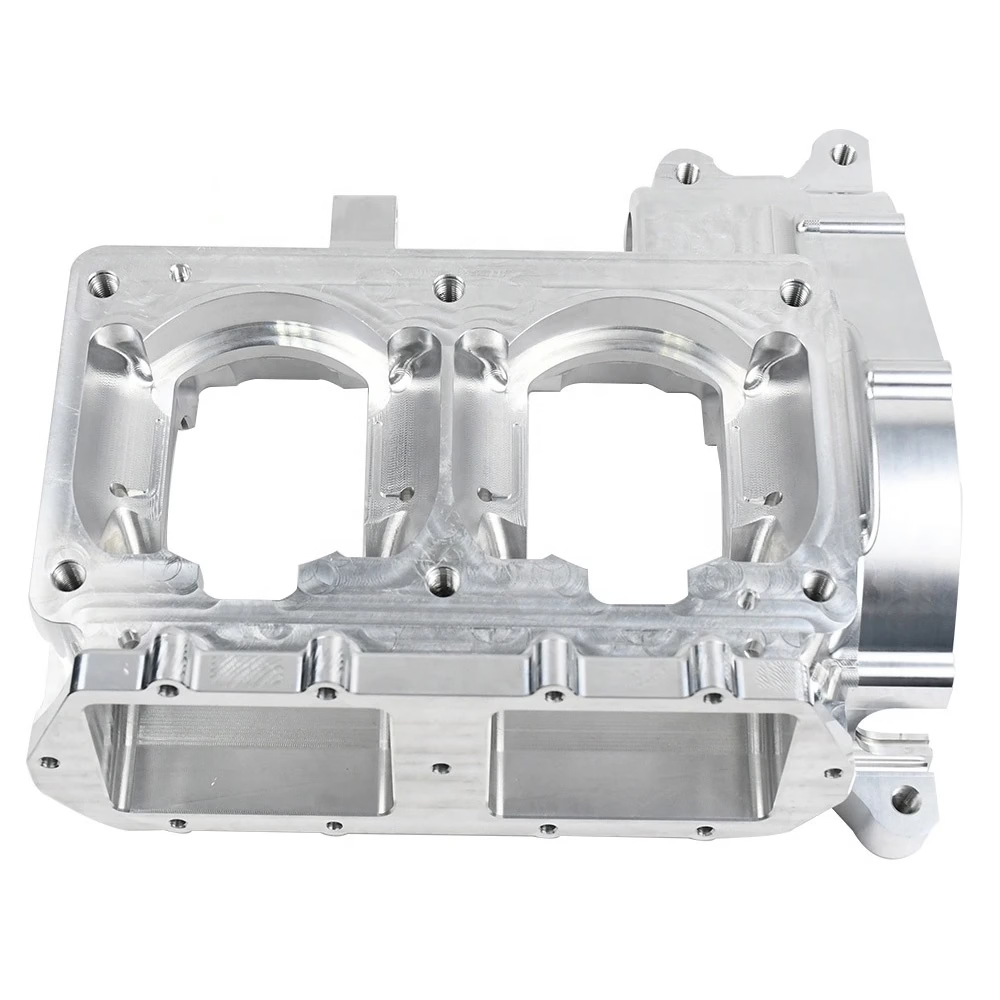
A 4-axis mill takes the standard X, Y and Z linear axes and adds one rotary axis, usually A (rotation around X) or B (rotation around Y). The workpiece turns; the spindle stays put. That single change lets the tool reach four sides of a part in one program, so a housing with pockets on its front, back and two flanks no longer needs three separate fixtures.
The practical gain is positional, not just speed. Every time you unclamp a part and move it to a new fixture, you re-introduce datum error, and that error stacks. On a 4-axis setup the rotary table holds the datum through the whole cycle, which is why shops quote ±0.005 mm on some 4-axis features while a 3-axis part with the same geometry drifts wider.
What 4-axis does not give you is full tool access. The tool still approaches along a fixed spindle direction, so undercuts, deep curved surfaces and impeller blades stay out of reach. That is 5-axis work. When a buyer asks a China 4-axis CNC machining factory to quote a part with a twisted blade profile, a good shop will say so at the DFM stage rather than run it on the wrong machine.
Rotary table size is the first hard limit you should ask about. A Ø400 mm table constrains both part diameter and swing clearance, and a long part hanging off the table needs a tailstock or it will deflect under cutting load. State the part envelope in the RFQ. If the shop has to guess, the quote is worthless.
- 1Rotary axisA or B axis, indexed or continuous, holding datum across faces
- 2Typical fitHousings, manifolds, brackets, shafts with cross features
- 3Not a fitCurved surfaces, undercuts, thin-wall blades
- 4First questionRotary table diameter and maximum part swing
Tolerance, surface finish and machine count in the RFQ
Tolerance claims need a scope. A shop that advertises ±0.005 mm is talking about specific features on specific materials with the right fixture, not about every dimension on your drawing. Aluminum 6061 and 7075 hold that band more easily than 17-4PH or Inconel, which move under heat and tool pressure. Ask which features the shop is willing to guarantee and how it will measure them.
Surface finish follows the same logic. As-machined faces land around Ra 1.6–3.2 μm, a good fine pass gets to Ra 0.8–1.6 μm, and Ra 0.2–0.8 μm usually means a secondary operation. If your drawing calls for a fine finish on one sealing face and a general finish elsewhere, say so. Pricing the whole part at the fine spec is a common way buyers overpay.
Machine count matters less than machine mix. GreatLight runs 127 high-precision CNC machines across three wholly-owned plants in Dongguan and Singapore, including 12 four-axis mills, 16 simultaneous 5-axis centers, 27 three-axis machines and 16 mill-turn centers. A shop with only 3-axis and one old 4-axis machine will subcontract your part or stretch the schedule.
Ask how parts are inspected, not just whether they are. We inspect 100% of parts before shipment, with raw material checks, in-process monitoring and a final inspection, and we send reports on request. If a supplier cannot describe its in-process checks, the final report is a document about one part, not a production process.
- 1Tolerance±0.005 mm on defined features, material-dependent
- 2Finish bandsRa 1.6–3.2 μm as-machined; Ra 0.2–0.8 μm needs a second op
- 3Fleet127 machines, 12 four-axis mills, 16 five-axis centers
- 4Inspection100% before shipment, reports on request
MOQ, certifications and lead time as buying criteria
Minimum order quantity is the fastest filter in a supplier list. Some factories will not quote a single prototype, or they quote a setup fee that makes one part cost ten times the unit price. We have no minimum order quantity and run anything from one prototype to 10,000+ part runs, so a design can be validated before tooling money is committed.
Certifications should be matched to your industry, not collected as badges. ISO 9001:2015 is the baseline quality system. IATF 16949:2016 is what automotive and EV programs expect. ISO 13485:2016 covers medical devices. ISO 27001:2022 matters when you send CAD files and drawings, because it governs how those files are stored and who can open them. A supplier with the wrong certificate set will slow your audit down.
Lead time claims need a definition. Our quotation and free DFM analysis come back within 12 hours, production can start within 24 hours, and parts ship in 3–5 days. That is the quoted window for typical work, not a guarantee for every geometry. Ask what the shop counts as day one: PO receipt, drawing approval, or material arrival.
Late delivery history is worth asking about directly. We track a historical late-delivery probability below 2%. Any supplier should be able to state how it measures on-time performance and what happens when a job slips. Vague answers here usually mean the schedule is managed by memory.
- 1MOQNo minimum, one prototype to 10,000+ parts
- 2CertificatesISO 9001, IATF 16949, ISO 13485, ISO 27001
- 3QuotingQuote and DFM analysis within 12 hours
- 4DeliveryParts ship in 3–5 days; late risk historically below 2%
Material and finishing choices that change the quote
Material selection drives both machinability and cost, and it should be settled before the RFQ goes out. Aluminum grades 6061, 6061-T6, 2024, 5052, 5083, 6063, 6082, 7075 and ADC12 cover most housings and brackets. Stainless 303, 304, 316, 316L, 420, 430, 431, 440C and 17-4PH show up in medical and food-contact parts. Steels 1018, 1045, 4130, 4140, 4340, A36 and tool steel handle structural and wear work.
Titanium and specialty alloys need a slower approach. TA1, TA2, TC4 (Ti-6Al-4V), Inconel and magnesium AZ31B or AZ91D cut hotter and wear tools faster, so cycle times rise and the 4-axis setup must be rigid enough to avoid chatter. Copper and brass grades C101, C103, C110, beryllium copper, C27400, C28000 and C36000 machine easily but move with temperature, which affects hold tolerances.
Finishing is where quotes quietly diverge. Anodizing in clear, color, hardcoat or conductive form, electroless nickel, zinc, silver and gold plating, powder coating and black oxide, plus bead blasting, tumbling, brushing and polishing all sit in the finishing chain. Laser marking and engraving need a minimum character height of 1.5 mm, so plan your part numbers before you finalize the drawing.
Plastics are a separate conversation. ABS, PC, PMMA, POM, PA, PEEK, PP, HDPE and carbon fibre each behave differently on a mill, and some need sharp tooling and air blast rather than coolant. Name the grade in the RFQ. A quote written against generic plastic is a quote you cannot compare.
- 1Aluminum6061, 7075, 2024, 5052, 6082, ADC12 and more
- 2Stainless and steel303/304/316L/17-4PH; 1018, 4140, 4340, tool steel
- 3FinishesAnodizing, plating, powder coat, blasting, laser marking
- 4Laser markingMinimum character height 1.5 mm
How to vet a 4-axis CNC machining factory in 6 steps
Run these in order. Each step filters suppliers before you spend engineering time.
- 1Send a drawing with the part envelopeInclude overall size, rotary table needs, material grade and the faces that must be machined. A Ø400 mm table and a 4,000 mm maximum processing size are different classes of work.
- 2Mark your critical featuresFlag which dimensions need ±0.005 mm and which can hold a general tolerance. Ask the shop to confirm those features in writing, not to repeat your drawing back to you.
- 3Request a DFM note with the quoteA real DFM response points at thin walls, deep pockets, tool reach and datum choices. Our quotation and free DFM analysis come back within 12 hours.
- 4Confirm the fixture planAsk how the part will be held on the rotary table, whether a tailstock is needed, and whether soft jaws or a custom fixture are quoted. This is where hidden cost lives.
- 5Check certificates against your industryISO 9001:2015 as baseline; add IATF 16949:2016 for automotive, ISO 13485:2016 for medical, ISO 27001:2022 when file security is in scope. Ask for the certificate scope, not a logo.
- 6Agree on inspection and reportingDefine what is measured, at which stage, and what report format you want. We run raw material checks, in-process monitoring and final inspection on 100% of parts before shipment.
- 7Sign the NDA before sending CADUploads are secure and confidential, and an NDA is available on request. Do this before the first file transfer, not after the PO.
Questions buyers ask before committing
When is 4-axis cheaper than 5-axis?
When the part has flat faces, pockets and holes on four sides but no curved surfaces or undercuts, 4-axis does the job in one or two operations.
5-axis simultaneous is worth the higher hourly rate only when tool access or surface continuity demands it. A shop that pushes 5-axis for a boxy housing is not optimizing your cost.
Can a 4-axis mill hold ±0.005 mm on a long part?
It can on defined features if the setup is rigid and the material is stable. A long part overhanging the rotary table deflects under cut, so a tailstock or a steady support is usually required.
Material matters too. Aluminum 6061 and 7075 hold that band more comfortably than titanium or Inconel, which move with heat.
What is the minimum order quantity?
There is no minimum order quantity. We run from a single prototype to 10,000+ part runs, which lets you validate a design before committing to production tooling.
Prototype and production parts come off the same inspection routine, so the first article tells you something about the run.
How fast can a quote and first parts come back?
Quotation and free DFM analysis come back within 12 hours. Production can start within 24 hours after that, and parts typically ship in 3–5 days.
The clock depends on drawing approval and material availability. Ask the shop what it counts as the start of the schedule.
Which certifications should I look for?
ISO 9001:2015 is the baseline. Add IATF 16949:2016 for automotive and EV work, ISO 13485:2016 for medical devices, and ISO 27001:2022 when you need file security controls.
Ask for the certificate scope. A logo on a website does not tell you which process or site is covered.
How do I keep my CAD files confidential?
Send files only after an NDA is in place. We offer an NDA on request, and uploads are secure and confidential.
Scope the NDA to cover the drawings, the DFM notes and any fixture design built for your part, since fixtures often reveal part geometry.
Send your 4-axis part for a DFM review
Upload the drawing and get a quotation with free DFM analysis within 12 hours. No minimum order quantity, 100% inspection before shipment, NDA on request.
12-hour quoteNo MOQ100% inspectionNDA on request
More from GreatLight
We publish setup notes, tooling trials and inspection data from the factory floor.











