
POM CNC machining guide for engineers
POM behaves differently from aluminum and from other plastics, so the same feeds and fixtures rarely transfer. This guide explains what happens inside the cut, where the material sets hard limits, and how to tell whether acetal is the right call for your part.
In this article
- 1
- 2
- 3
- 4
- 5
- 6
- 7
Why POM CNC machining is not like cutting aluminum
POM is a semi-crystalline thermoplastic. Homopolymer grades are denser and stiffer; copolymer grades tolerate slightly more heat and moisture. Both cut cleanly, but the cutting mechanism is closer to a controlled shear than the chip formation you get in aluminum. The material has low thermal conductivity, so heat does not leave the cutting zone through the workpiece. It leaves through the chip and the tool.
That single fact drives most of the rules. If the tool dwells, the surface melts, smears, and then cools into a rough patch with a different crystallinity than the core. The dimension you measure an hour later may not match the dimension you measured at the machine. Roughing and finishing should be separated so the part can equalize between passes.
Acetal also has a low coefficient of friction and a tendency to grab. A sharp, polished edge with a high rake angle shears cleanly. A dull edge rubs, generates heat, and pulls the part toward the cutter. On thin walls this pull is often what breaks the part, not the cutting force itself.
Compared with PEEK or PA, POM is more forgiving on moisture but less forgiving on clamping. It machines at high surface speeds with generous chip clearance. The goal is short contact time and a chip that carries heat away.
Heat, crystallinity, and what happens after the cut
POM melts in a narrow band. Homopolymer starts to soften near 175 °C and melts around 175–178 °C; copolymer sits a little lower. Localized temperatures at the tool edge can spike well above that even when the bulk part stays cool. You will not see smoke. You will see a glossy, torn surface and a burr that refuses to break off.
Cooling is not only about the cutter. A part that leaves the machine warm will shrink as it equalizes. For acetal, the coefficient of thermal expansion is roughly 10 to 12 × 10⁻⁵ per °C, an order of magnitude higher than steel. A 100 mm part that cools 20 °C moves about 0.2 mm. That is 40 times the ±0.005 mm tolerance we hold on metals.
The practical answer is to cut near room temperature, use air blast or a light mist rather than flooding, and let the part rest before final inspection. For tight work, rough oversize, stress-relieve, then finish. Annealing at 140–150 °C for a few hours, then slow cooling, relaxes molded-in stresses before the first cut.
Do not assume the blank is stable because it looks flat. Extruded rod and sheet carry residual stress from the extrusion die. Removing material releases that stress unevenly, and the part bows.
Tool geometry and cutting data that hold size
Use sharp, uncoated or diamond-coated carbide. Two flutes for roughing gives chip room; three flutes works for finishing where the radial engagement is light. A high rake angle, around 10–15°, lowers cutting pressure. Polished flutes matter more here than in metal, because a rough flute packs with soft chips.
For a 6 mm cutter in POM, a starting surface speed around 300–500 m/min and a feed per tooth of 0.05–0.15 mm are workable on rigid setups. Axial depth of cut can run deep because the material is soft. Radial engagement should stay light on finishing passes so the tool does not deflect into the wall.
Clamping is where most scrap comes from. POM compresses, so a vise tightened like it would grip steel will distort a thin wall before the cutter touches it. Use soft jaws machined to the part profile, spread the load, and support the underside. Vacuum fixturing works well for flat plates.
Clear chips aggressively. A recirculating air blast is usually enough. Flood coolant can help on deep pockets, but it also drives temperature swings between the wet cut and the dry inspection. Keep the method consistent through the run.
What POM can and cannot hold
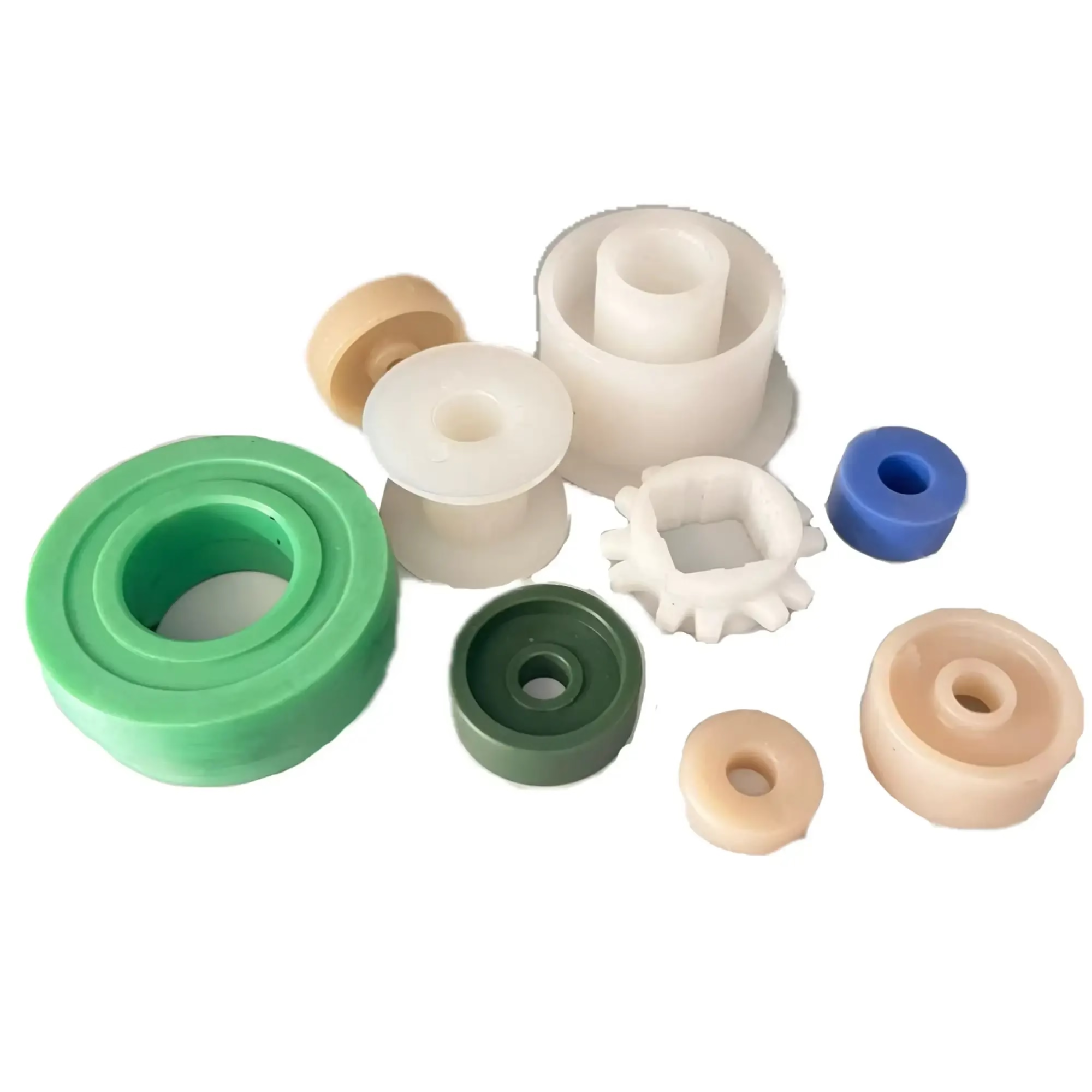
POM is excellent for bushings, gears, rollers, insulators, and wear pads. It holds a thread well, machines to a fine surface, and does not need coating to resist mild chemicals. It is a poor choice when the part must carry high continuous load at elevated temperature, or when it will be repeatedly sterilized with steam.
Wall thickness is the clearest boundary. Below about 1 mm, deflection during cutting becomes the dominant error source, not the machine. If the design needs a 0.5 mm wall, expect to fixture it in a way that supports the wall along its full length, or accept a looser tolerance.
Thin, long parts warp. A 200 mm rod turned down to 8 mm will bow as stress releases. Turning between centers with light passes reduces this, but a straightness callout tighter than 0.05 mm over that length is a fight. Better to design a larger section or a different material.
Five-axis work changes the calculus. Compound angles and contoured ports can be cut in one setup, which removes the re-fixturing error that accumulates when a part is moved three times. That matters more for POM than for metal, because each clamp leaves a mark and each unclamp lets the part move.
Surface finish options and their trade-offs
As-machined POM typically lands around Ra 1.6–3.2 μm with a sharp tool and a clean pass. That is fine for most functional parts. Going finer, into Ra 0.8–1.6 μm or Ra 0.2–0.8 μm, needs a dedicated finishing pass with a fresh edge and light radial engagement.
Bead blasting gives a uniform matte look and hides tool marks. Tumbling deburrs edges in bulk. Polishing brings up a gloss, but heat from the polishing wheel can reflow the surface, so keep the speed down and the contact short.
Laser marking works on POM and is common for part numbers and date codes. Minimum character height is 1.5 mm. Below that, the mark loses contrast and can smear. Engraving cuts a groove that collects debris; for wear surfaces, mark off the functional face.
Do not anodize or plate POM. Those processes are for metals. If the part needs conductivity or a metallic look, choose a different material rather than trying to coat acetal.
When to machine POM and when to mold it
CNC makes sense from one part to a few thousand, and whenever the geometry changes between revisions. No tooling cost, no lead time for a mold, and the first article can be measured the same week. For bridge production and functional prototypes, this is usually the faster path.
Injection molding takes over when the annual volume is high and the design is frozen. The mold cost is real but amortized across the run, and the per-part cost drops. The transition point depends on part size, cycle time, and how many cavities fit the press.
A common mistake is to machine a part with molded-in draft and radii that were designed for a mold. Those features are not needed on a machined part and can add cost. If the part will eventually be molded, design for molding from the start and machine the prototype from the same model.
Machined POM also has an advantage in mechanical properties. The extruded stock has a uniform, oriented structure, and a machined surface does not carry the weld lines that molded parts can show at ribs and bosses.
POM grade and process comparison
Ratings are practical guidance for machined parts, not material datasheet values.
| Option | Best for | Watch out for |
|---|---|---|
| POM homopolymer | Stiffness, wear, tight tolerance | More notch sensitive |
| POM copolymer | Hot water, mild chemical exposure | Slightly softer surface |
| POM-C with glass fill | Higher stiffness, lower creep | Abrasive to tooling |
| CNC machining | Prototypes to a few thousand | Higher per-part cost at volume |
| Injection molding | High annual volume, frozen design | Mold cost and lead time |
| Annealed stock | Tight flatness and bore tolerance | Extra process step |
The call, in one line
If your part is a functional prototype or a low-to-mid volume run with geometry that may still change, machine POM from annealed stock and hold ±0.005 mm where the drawing needs it. If the design is frozen and the annual volume is high, mold it. Do not try to hold metal-level flatness on a thin, unrelieved POM blank.
POM CNC machining questions engineers ask
Does POM need coolant during machining?
Not always. A strong air blast clears chips and limits heat on most jobs. Flood coolant helps in deep pockets and on long roughing passes, but it introduces a wet-dry cycle that can shift dimensions between the machine and the inspection bench.
Pick one method and stay with it through the run. If you use coolant, let the part reach room temperature before the final measurement.
What tolerance can POM CNC machining actually hold?
On a stable, well-fixtured part with a reasonable wall thickness, ±0.005 mm is achievable on critical features. On thin walls, long unsupported sections, or parts cut from unannealed stock, the material movement is larger than the machine error.
Tolerance on POM is usually limited by the workpiece, not the spindle. Call out tight tolerances only where they serve a function.
Is Delrin the same as POM?
Delrin is a brand name for a homopolymer acetal. POM is the generic family, which includes homopolymer and copolymer grades. The machining behavior is similar, but the two differ in stiffness, moisture resistance, and notch sensitivity.
Specify the grade on the drawing rather than a brand name, so the shop can substitute an equivalent without a question.
Can machined POM be glued or welded?
It bonds poorly with most adhesives because of the low surface energy. Surface treatment helps but rarely gives a structural joint. Ultrasonic welding and hot plate welding work better for copolymer grades.
If the assembly must be strong, design a mechanical joint with a press fit, a snap, or a threaded insert instead of relying on adhesive.
How does moisture affect POM parts?
POM absorbs little moisture compared with nylon, and the dimensional change is small. That is one reason it is chosen for close-tolerance parts that see humidity swings.
Long exposure to hot water or steam is a different case. Copolymer grades handle it better than homopolymer, but continuous steam service is outside what acetal does well.
Can I get a prototype without committing to a production run?
Yes. There is no minimum order quantity, so a single prototype and a 10,000-part run go through the same process. Uploads stay confidential, and an NDA is available on request.
Quotation and a free DFM analysis come back within 12 hours, and production can start within 24 hours of approval.
Send your POM part for a free DFM check
Upload the model and drawing. We review wall thickness, tolerance stack, and fixturing risk, then quote with the machining route we would actually use.
12-hour quote100% inspectionNo minimum orderNDA on request
More from the shop floor
We publish setup notes, tooling trials and inspection data from the factory floor.











