
Plates Shear Machine: Principle of Work and Machine Categories
This page explains how a plates shear machine separates sheet metal, what the blade geometry and rake angle actually do to the cut edge, and how the main machine categories differ. Written for engineers and buyers who need to judge whether a part belongs on a shear, a laser, or a mill.
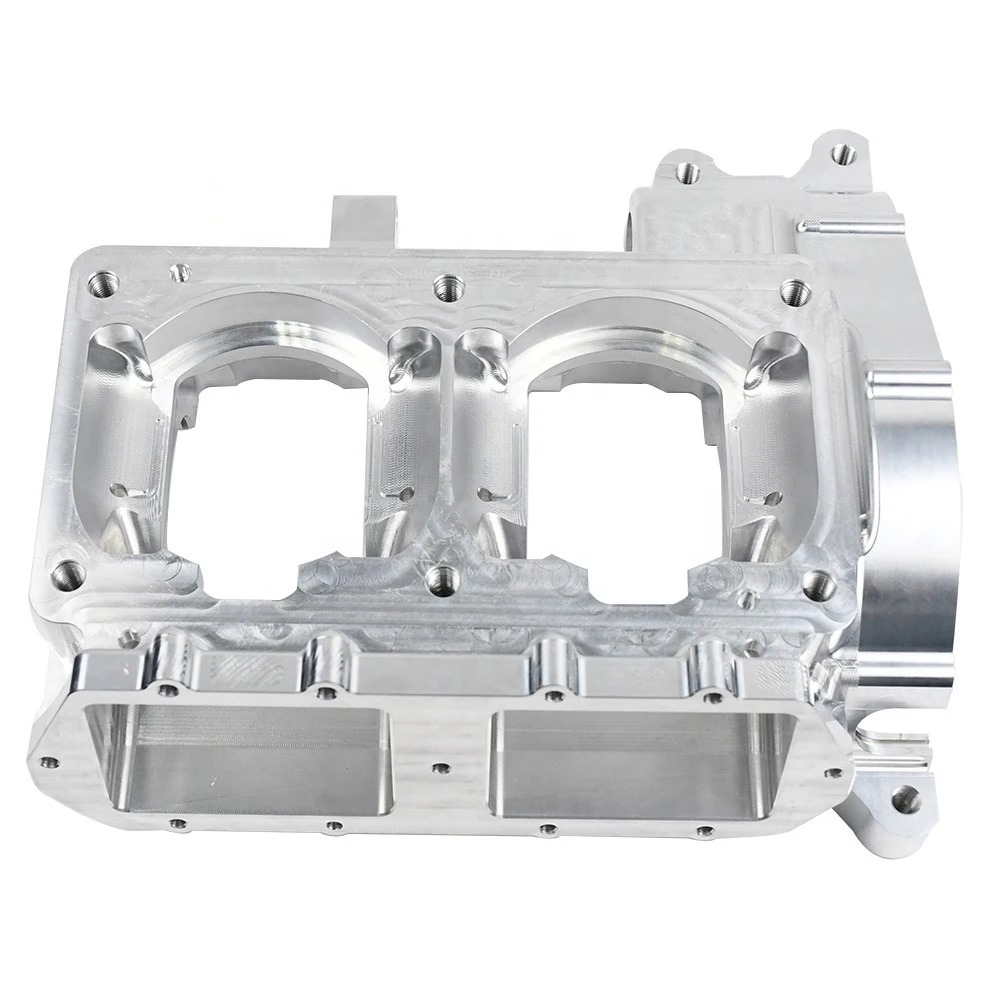
What a plates shear machine actually does to the metal
A plates shear machine does not remove material the way a mill or a laser does. It forces two edges past each other and lets the sheet fracture along a narrow band. One blade is fixed to the bed. The other moves down or across, driven by a hydraulic cylinder or a mechanical crank. The metal between them is squeezed past its yield point in a fraction of a second.
Two forces act at the same time. The blade edges push down with a vertical force, and the gap between the blades creates a bending moment. The sheet cracks from both top and bottom edges inward. If the clearance is right, the two cracks meet and the cut face shows a clean shear zone with only a small rollover at the top.
The blank holder matters as much as the blade. Without downward clamping near the cut line, the sheet lifts and rotates instead of fracturing. The result is a bowed edge, an oversized part, or a blade chip. On thin gauge work the holder force is light. On 6 mm plate it can exceed several tonnes.
Cutting speed on hydraulic shears is usually in the range of 20 to 60 strokes per minute for short beds. The number depends on stroke length and oil flow, not on material hardness. Heavier plate simply needs more tonnage per stroke, not more speed.
- 1Fracture, not cuttingThe edge separates by crack propagation, so clearance controls the edge more than blade sharpness.
- 2Clamping is not optionalBlank holders stop the sheet lifting and keep the cut line straight.
- 3Tonnage scales with thicknessDoubling sheet thickness roughly doubles the required force.
Blade angle, rake, and clearance in the plates shear machine cutting process
The cutting edge itself is ground to a small angle, typically 75° to 85° included. A sharper edge wears faster, so shops running mild steel all day tend to keep the edge blunter than a shop cutting 0.8 mm stainless. Edge radius grows with use, and once it passes roughly 0.05 mm the sheet starts to tear instead of shearing cleanly.
Rake angle is the tilt of the moving blade across the bed. A flat, parallel blade contacts the full sheet length at once, so it needs very high tonnage. Tilting the blade to 1°–3° concentrates the load at one point. A 4,000 mm bed at 2° rake can cut the same sheet with a fraction of the peak force, because only a short section of edge is engaged at any instant.
Clearance is the horizontal gap between the blades. For mild steel the usual value is 5% to 8% of sheet thickness. Stainless and aluminum sit lower, around 4% to 6%, because they work-harden and crack less readily. Too much clearance pulls material into the gap and produces a heavy burr. Too little clearance raises the force and can chip the edge.
Rake has a cost. The blade travels further to finish the cut, so the sheet bends downward more. Long thin parts can come off with a visible bow. If flatness matters more than tonnage, a smaller rake angle is the better trade.
- 1Edge angle 75°–85°Blunter edges last longer on mild steel, sharper edges suit thin stainless.
- 2Rake 1°–3°Lower peak tonnage, but more downward deflection on the offcut.
- 3Clearance 5%–8% of thicknessThe single setting that most affects burr height and edge quality.
The main categories of a plates shear machine
Three categories cover most shop floor work. A guillotine shear uses a straight moving blade and a long bed, and it is the standard machine for straight cuts in sheet from 0.5 mm up to 6 mm or more. Bed lengths commonly run from 2,000 mm to 4,000 mm. It handles mild steel, stainless, and aluminum, and it is the machine most people mean when they say plates shear machine.
A swing beam shear carries the moving blade on two pivoting arms instead of vertical guides. The blade follows an arc, which gives a slight rake through the stroke and a naturally progressive cut. Swing beam machines are common for thinner sheet, and they are cheaper to build because the frame sees less bending load. They cut accurate straight lines but the arc limits how thick the sheet can be.
A variable rake shear lets the operator change the rake angle between jobs. Thin sheet runs at high rake for speed and low tonnage. Thick plate runs at low rake to control bow and keep the edge square. This is the most flexible category and the most expensive. For a shop that moves between 1 mm and 8 mm work on one machine, the variable rake pays for itself.
Other categories exist for specific work. Alligator shears cut bar and scrap. Rotary and disc shears cut circles and curves in thin sheet. None of them replace a guillotine for straight blanking. Plate shears are also distinct from press brakes, which bend rather than cut, and from ironworkers, which punch and shear with separate stations.
- 1GuillotineStraight blade, long bed, thick and thin sheet, the general-purpose choice.
- 2Swing beamPivoting arms, lower cost, best on thin sheet with straight cuts.
- 3Variable rakeAdjustable angle for mixed thickness work, highest cost but widest range.
What the cut edge tells you about the setup
A correct shear cut has four zones on the cut face, read from top to bottom: rollover, shear zone, fracture zone, and burr. Rollover depth is usually 10% to 20% of thickness. A deep shear zone means clearance is on the tight side. A wide fracture zone with a rough surface means clearance is too large. Reading these zones is faster than measuring burr height with a caliper.
Burr height is the practical acceptance criterion for most sheet metal work. On 2 mm mild steel with correct clearance, burr height typically lands between 0.05 mm and 0.15 mm. If it climbs past 0.2 mm, check clearance first, then blade edge condition, then the blank holder force. Changing blade material before checking clearance wastes money.
Squareness is the other limit. A shear cuts a straight line relative to the back gauge, not relative to the sheet edge. If the back gauge is out of square by 0.1 mm over 1,000 mm, every blank inherits that error. Operators should check squareness with a try square on the first part of a run, not halfway through the stack.
Shearing has hard boundaries. It cannot cut curves, holes, or tapers in one pass without a nibbling step. It leaves a work-hardened edge on stainless, which matters if the part is later bent. It also cannot hold the ±0.005 mm tolerance that a mill or a grinder can. For profile accuracy on a finished part, shearing is a blanking step, not a finishing one.
- 1Read the four zonesRollover, shear, fracture, and burr tell you if clearance is right.
- 2Burr 0.05–0.15 mmTypical on 2 mm mild steel with correct clearance.
- 3Square to the back gaugeSheet edge squareness does not carry into the cut line.
Which shear category fits which job
Thickness ranges are typical shop values, not machine limits.
| Category | Best thickness range | Edge quality | When to choose it |
|---|---|---|---|
| Guillotine, low rake | 3–12 mm | Square edge, low bow | Thick plate where flatness matters |
| Guillotine, high rake | 0.5–3 mm | Good, slight rollover | Fast blanking of thin sheet |
| Swing beam | 0.5–4 mm | Straight and consistent | Short beds, thin sheet, lower budget |
| Variable rake | 0.5–8 mm | Adjustable per job | Mixed thickness work on one machine |
| Alligator | Bar and scrap | Rough | Cutting stock and offcuts, not blanks |
| Rotary or disc | 0.3–2 mm | Curved edges | Circles and curved profiles in thin sheet |
When to shear and when to go straight to CNC
If the part is a flat blank with straight edges in sheet up to 12 mm, a plates shear machine is the fastest and cheapest first operation. If the blank needs holes, pockets, tapers, or ±0.005 mm profile tolerance, shear it first for the straight sides and then finish on a 3-axis or 5-axis machining center. Skip the shear only when the part is small enough that a laser or mill can do the whole profile in one setup.
Frequently asked questions
What is the principle of work of a plates shear machine?
Two blade edges pass each other with a controlled gap. The sheet is squeezed past its yield point, cracks start at both edges, and the cracks meet to separate the material.
The gap, called clearance, is set as a percentage of sheet thickness and controls most of the cut edge quality.
How do I set blade clearance for different materials?
Start at 5% to 8% of sheet thickness for mild steel, 4% to 6% for stainless and aluminum, and slightly higher for soft copper alloys.
Cut a test strip and read the fracture zone. A rough, wide fracture means clearance is too large. A high burr with a narrow shear zone means clearance is too tight.
Does rake angle change the flatness of the part?
Yes. Higher rake concentrates the cut but pushes the offcut down more, so long thin blanks can come off bowed.
If flatness is critical, reduce rake or use a machine with a variable rake setting and run thick material at a lower angle.
Can a plates shear machine cut stainless steel?
It can, but stainless work-hardens at the cut edge and needs more tonnage than mild steel of the same thickness.
Use tighter clearance around 4% to 6% and expect faster blade wear. If the edge will be bent afterward, check for cracking at the bend line.
What tolerance can I expect from shearing?
Shearing is a blanking process. Position accuracy is set by the back gauge and is typically measured in tenths of a millimeter, not in microns.
For ±0.005 mm profile tolerance, the blank has to move to a CNC mill or grinder after shearing.
When is shearing the wrong process?
When the part has curves, holes, or tight profile tolerance, or when the material is a thick plate beyond the machine tonnage.
In those cases use laser, waterjet, or CNC milling for the profile, or shear only the straight sides and machine the rest.
Send us the blank, get the finished part
Share your drawing and material. We quote and return a free DFM analysis within 12 hours, then machine the sheared blanks to ±0.005 mm on 5-axis centers.
12-hour quote100% inspectionNo minimum order quantity
More machining notes
We publish setup notes, tooling trials and inspection data from the factory floor.











