
Proficient in 5 Axis CNC Machining: How the Process Works
A practical explanation for engineers who need to judge whether a part belongs on a 5-axis center or a 3-axis mill. We cover the kinematics, the tolerance and surface results you can hold, and the cases where 5-axis is the wrong call.
In this article
- 1
- 2
- 3
- 4
- 5
- 6
- 7
What the two extra axes actually move
A 3-axis mill moves the tool in X, Y and Z. The workpiece stays still. A 5-axis machine adds two rotary motions, and where those rotations sit decides how the machine behaves. On a trunnion layout, the table tilts and rotates the part under a vertical spindle. On a head-table layout, the spindle tilts while the table rotates. Both reach five faces in one setup.
The distinction that matters most is positional versus simultaneous. Positional 5-axis, often called 3+2, indexes the rotary axes to an angle, locks them, then cuts with three linear moves. The controller never moves all five at once. This is the cheaper and stiffer way to use the machine, and it covers most prismatic parts with features on several faces.
Simultaneous 5-axis keeps all five axes interpolating through the cut. The tool tip follows a path while the part or the head keeps turning to hold the cutter normal to the surface. This is what makes undercuts, sculpted blades and deep contoured pockets machinable without a custom form tool.
The mechanical difference shows up in rigidity. A locked rotary axis behaves much like a solid fixture. A rotary axis sweeping through a cut introduces a moving mass, and the servo has to hold position against cutting force. That is why a shop can be perfectly proficient in 5 axis cnc machining and still tell you to use 3+2 for a part that does not need continuous motion.
One setup removes the error stack
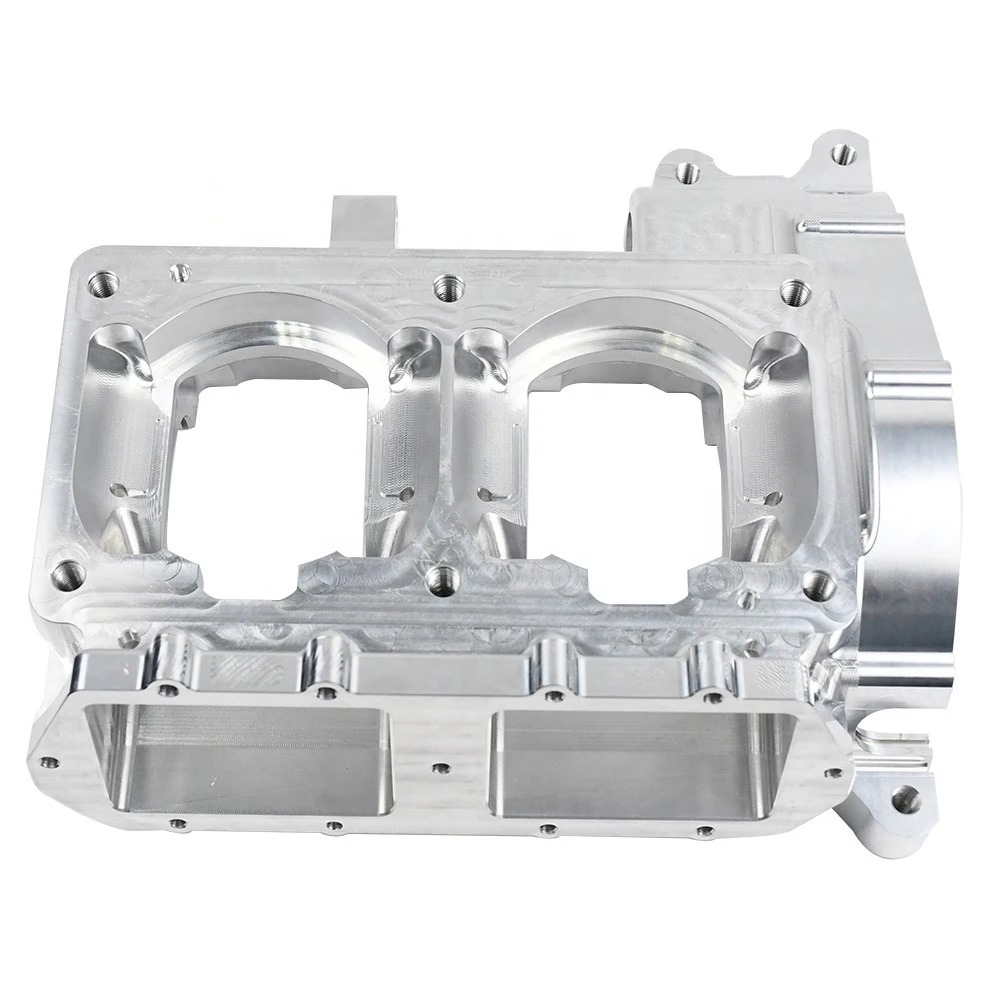
Every time a part moves to a new fixture, you add locating error. On a 3-axis part with features on four sides, that can mean three or four setups, each one a chance to lose 0.02 mm or more. A 5-axis center machines five faces from one workholding position, so the only datum that matters is the one you set at the start.
This is the real reason 5-axis holds tight tolerances on complex parts. It is not that the machine is more accurate than a good 3-axis mill. It is that the part never leaves the fixture. Hole patterns on opposite faces stay concentric because they were bored in the same coordinate frame.
Fewer setups also shorten the calendar. A part that needs four operations on three machines spends time waiting in queue between each one. One 5-axis operation removes three queues and three re-fixturing steps. For a prototype or a bridge build, that is often worth more than the hourly rate difference.
The trade-off is planning time. Fixturing on a trunnion has to clear the table through the full range of tilt. A tall part can crash into the spindle head at 45°. We model the stock, the fixture and the holder before the first cut, and we would rather spend an hour in CAM than scrap a 6061 billet.
Short tools and shallow angles cut better
Five-axis work lets you tilt a short, stiff cutter into a pocket instead of reaching in with a long, thin one. Deflection scales with the cube of the length-to-diameter ratio, so a cutter half as long is roughly eight times stiffer. That is the difference between chatter and a clean wall.
Tilting also lets the flank of a ball cutter do the work rather than the tip. At the very center of a ball nose, surface speed drops to near zero, which smears material and leaves a poor finish. Lean the tool 10° to 20° off normal and the effective cutting speed stays in a healthy range across the whole pass.
The same geometry helps in deep cavities. A Ø6 mm end mill on a 3-axis machine may need a 60 mm reach to clear a wall. On a 5-axis center, the head tilts and the same cutter reaches the floor with 25 mm of gauge length. You get a better finish and you can push the feed.
Tool holding matters as much as the machine. A shrink-fit or hydraulic holder runs truer than a standard collet chuck, and runout shows up directly in wall straightness on deep cuts. For titanium and Inconel we keep separate holders so a worn taper never touches a critical job.
Tolerance, finish and the limits of the process
On a well-maintained 5-axis center, we hold ±0.005 mm on critical features and Ra 0.8–1.6 μm as a standard machined finish. Where a part calls for it, fine finishing reaches Ra 0.2–0.8 μm. Those numbers assume a stable setup, a sharp cutter and a material that does not move after the cut.
Rotary axes add their own error. A trunnion table has a center of rotation that has to be calibrated against the linear axes, and any drift shows up as position error on a tilted face. We probe the table and re-check the pivot point as part of routine maintenance, not only when a part comes out wrong.
Thermal growth is the quiet variable. A spindle running for hours grows a few microns, and a long aluminum part grows more than the machine does. On tight work we let the machine idle to temperature first, and we keep roughing and finishing in the same session so the part and the machine share the same thermal state.
Material choice sets the practical ceiling. Aluminum 6061 and 7075 cut clean and hold tolerance well. 17-4PH stainless and Ti-6Al-4V move more after machining and need stress relief or a finishing pass scheduled after the part settles. Inconel is machinable but eats tool life fast, so we plan shorter passes and more of them.
Where the money goes on a 5-axis job
The machine rate is higher, but that is rarely the whole story. Programming a simultaneous toolpath takes longer than a 3-axis path, and the CAM software that supports full five-axis motion costs more to run. On a single part, programming can be the largest line item.
Against that, you save fixtures. A 3-axis job with four setups may need three custom fixtures, each one designed, cut and inspected. A 5-axis job often runs on a standard vise or a simple tombstone. For low-volume work, the fixture savings frequently cancel the higher hourly rate.
Batch size decides the rest. At one to fifty parts, setup dominates and 5-axis usually wins on total cost. At several thousand simple parts, the 3-axis or mill-turn route spreads setup across enough units that the lower rate takes over. The crossover sits somewhere in the hundreds, and it depends on how many faces the part has.
Scrap risk is a real cost too. A five-axis crash can take out a holder, a cutter and a part in one motion. We simulate the full path including holder and fixture, and we run a first-article check before committing the rest of the batch.
Material behavior on a tilting table
Aluminum is the comfortable case. 6061-T6, 7075 and 2024 all cut fast with good finishes, and the low cutting force means a tilted setup stays stable. Thin aluminum walls still deflect, so we leave support ribs in the stock and take them off in a final light pass.
Stainless 303 and 304 work-harden if the cutter rubs, and a tilted toolpath makes rubbing more likely at low engagement. We keep the feed per tooth high enough to stay under the hardened layer and avoid dwelling in a corner. 17-4PH in the H900 condition is more stable than the annealed state and is often the better choice for a finished part.
Titanium Ti-6Al-4V needs low surface speed, high coolant pressure and a rigid setup. The good news is that 5-axis tilting lets us use a shorter cutter, which is exactly what titanium wants. We plan for more tool changes and a slower cycle than the same part in aluminum.
Inconel and magnesium sit at opposite ends. Inconel kills tools quickly and needs conservative parameters and constant verification. Magnesium AZ31B and AZ91D cut easily but the chips are flammable, so chip clearing and coolant discipline matter more than the toolpath.
When 5-axis earns its rate and when it does not
Judged on part geometry, feature count and batch size.
| Part situation | Recommended setup | Why |
|---|---|---|
| Features on 2 faces, simple pockets | 3-axis | Cheaper rate, faster programming, no tilt clearance risk |
| Features on 4 or 5 faces | 3+2 indexed | One setup, locked axes give full rigidity |
| Undercuts and sculpted surfaces | Simultaneous 5-axis | Only way to reach the geometry with a standard cutter |
| Thin-wall impeller or blade | Simultaneous 5-axis | Short cutters and tilt control reduce deflection |
| One prototype, tight schedule | 5-axis | Removes re-fixturing queues between operations |
| 10,000 simple turned parts | Mill-turn or turning | 5-axis cycle time is wasted on round features |
| Deep cavity, long reach needed | 5-axis | Tilt lets a short cutter reach the floor |
| Large flat plate, 2D profile | 3-axis or router | 4,000 mm travel without rotary setup cost |
The call we would make
If your part has features on four or five faces, or any undercut, use 5-axis. If it is a simple part with features on one or two faces, a 3-axis mill gets you the same part for less money and we will say so.
Questions engineers ask us
Does 5-axis always give a better surface finish?
No. Finish comes from tool condition, stepover, feed and rigidity. A 5-axis machine with a dull cutter and a long reach will finish worse than a 3-axis machine with a sharp cutter and a short one.
Where 5-axis helps is access. It lets you use a shorter, stiffer cutter and tilt the tool so the ball nose is not cutting at its dead center. Those two things raise the achievable finish, but they are not automatic.
How tight a tolerance can a 5-axis center hold?
We hold ±0.005 mm on critical features across our 5-axis work. That figure assumes a stable fixture, a temperature-steady machine and a material that behaves.
On a tilted face, rotary axis calibration adds to the error budget. We probe the rotary center of rotation as part of maintenance so the pivot point stays aligned with the linear axes.
What is the largest part you can machine on five axes?
Our maximum processing size is 4,000 mm. The 5-axis travel envelope includes 4,000 × 400 × 150 mm, 750 × 1,150 × 550 mm, 600 × 600 × 600 mm, 500 × 500 × 450 mm and 500 × 310 × 200 mm depending on the machine.
The Ø400 mm rotary table sets the limit on parts that need to rotate through a full tilt. Long parts that exceed the rotary capacity can still be done on 3+2 with the table indexed.
Is 5-axis worth it for a single prototype?
Often yes, and for a reason that has nothing to do with the machine rate. A complex prototype on a 3-axis mill may need three or four fixtures and four queue waits. One 5-axis setup removes all of that.
We quote no minimum order quantity, so a single prototype is fine. Production can start within 24 hours of an approved quote, and parts typically ship in 3–5 days.
How do you keep a 5-axis toolpath from crashing?
We simulate the full path with the actual holder, the fixture and the stock model. Collision checking covers the rotary table sweep, not just the cutter tip.
Before a batch runs, we cut a first article and inspect it. If the setup has to change, the simulation is redone. That is cheaper than replacing a holder and a part in the same motion.
Can you machine plastic on a 5-axis center?
Yes. POM, PEEK, ABS, PC and PA all run on our 5-axis centers. Plastics cut with low force, so the tilted setup stays stable and the main issue becomes chip evacuation.
PEEK and carbon fiber are abrasive, so we plan for faster tool wear. Carbon fiber also needs dust control, which we handle before the chips reach the general work area.
Send the part, get a process answer
Upload your model and we return a quotation with a free DFM analysis within 12 hours. You will get a straight answer on whether the part belongs on 5 axes or 3, not just a price.
12-hour quote100% inspectionNo minimum order quantity
More process notes
We publish setup notes, tooling trials and inspection data from the factory floor.











