
Protective Hood Made of Ribbed Steel Sheet: How Ribs Carry Load
A protective hood made of ribbed steel sheet is not a flat plate bent into a box. The ribs change how the panel bends, rattles and fails. This page covers rib geometry, gauge selection, stiffness math and the cases where a ribbed hood is the wrong part.
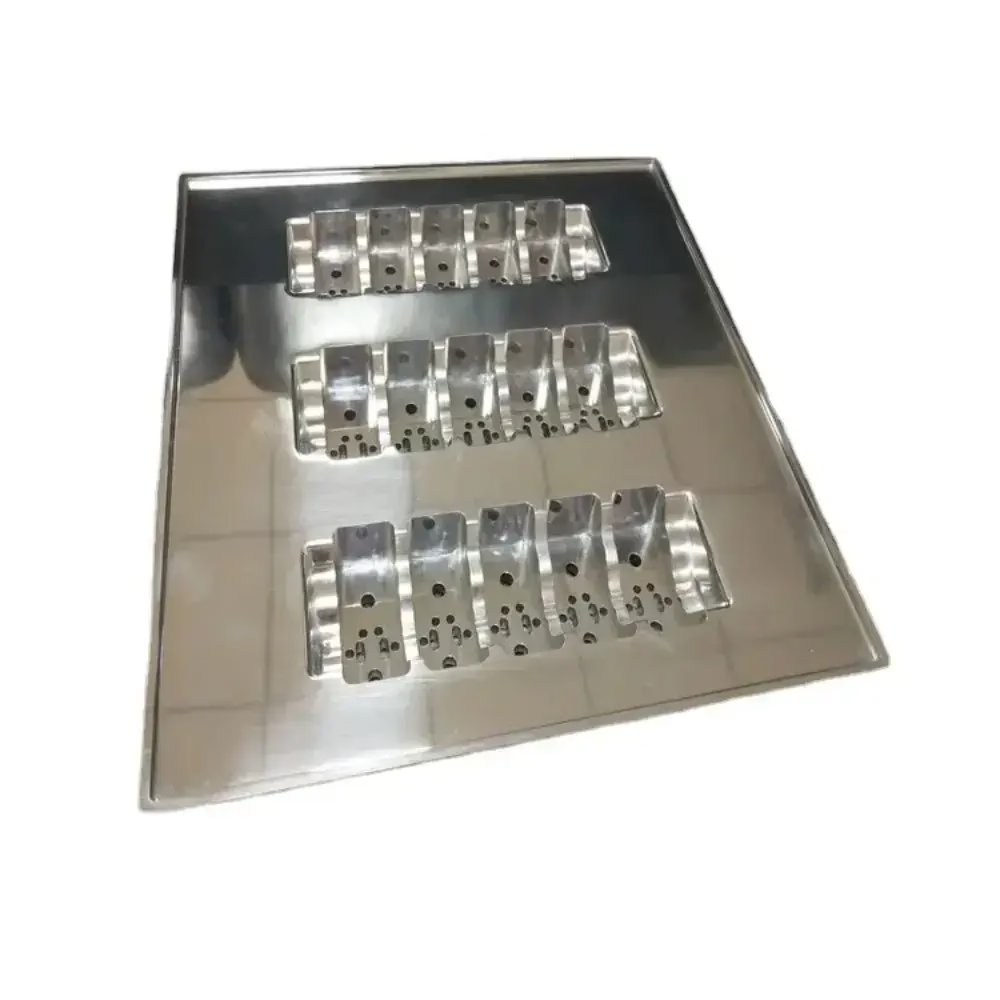
Why a Flat Guard Panel Fails First
A flat steel guard looks strong on paper. In service it is a diaphragm. A 1.5 mm sheet spanning 400 mm deflects visibly under a 200 N push, and every impact from a dropped tool leaves a permanent dent. The dent is the real problem. Once the panel bows, it can touch a rotating coupling or rub a belt, and the guard becomes a wear part instead of a safety part.
Ribs fix this by moving material away from the neutral axis. A rib 12 mm deep turns a thin panel into a shallow beam at that location. Bending stiffness rises roughly with the cube of the depth, so a 12 mm rib on 1.5 mm sheet is far stiffer than 3 mm sheet with no rib. That ratio is what lets a light hood handle a heavy hit.
There is a second failure mode that gets less attention. A flat panel has almost no damping, so it rings at its own frequency. On a machine running at 3,000 rpm, a plain guard can buzz continuously and fatigue its own mounting bolts within a few months. Ribs break the panel into shorter spans, push the natural frequency up and cut the amplitude of that vibration.
So the hood is not just a cover. It is a stiffened shell with a defined load path. Design it as a shell and it survives. Design it as a cover and it gets replaced.
Rib Geometry: Pitch, Depth and Direction
Three numbers control most of the behavior: rib pitch, rib depth and rib direction. Pitch is the centre-to-centre distance between ribs. Depth is how far the rib stands off the base sheet. Direction decides which bending mode the rib resists.
For a typical machine guard, pitch between 40 mm and 150 mm works. Tighter pitch means a stiffer, heavier panel and more press or laser time. Wider pitch saves cost but lets the base sheet oil-can between ribs. As a starting point, keep the unsupported span between ribs under 60 times the sheet thickness. At 1.5 mm sheet that is 90 mm.
Depth is where the stiffness comes from. Going from a 6 mm rib to a 12 mm rib on the same 1.5 mm sheet raises local bending stiffness by roughly a factor of eight. Past about 20 mm the rib starts to twist on its own and you gain much less. Deep ribs also trap chips and coolant, which matters on a hood that sits close to the cut.
Direction follows the load. Ribs should run across the shortest span and along the direction of the expected impact. On a hood over a spindle, that usually means ribs running around the circumference, not along the axis. A rib running the wrong way adds weight and almost no stiffness.
Gauge Selection for Ribbed Steel Sheet Hoods
Thickness is a cost decision more than a stiffness decision once ribs are in place. The ribs do the stiffening. The base sheet only has to resist local dents and carry shear between ribs. That is why a 1.2 mm ribbed hood often outperforms a 3 mm flat one.
Mild steel from 0.9 mm to 2.0 mm covers most guards. Below 0.9 mm the sheet dents from hand pressure during installation and the rib radii become hard to form cleanly. Above 2.0 mm the press force climbs fast and the weight starts to matter on hinged or removable hoods. For hoods that see regular impact, 2.5 mm to 3.0 mm is a reasonable ceiling.
Material choice follows the environment, not the load. A36 or 1018 works indoors. For washdown areas, 304 or 316 stainless resists corrosion but springs back more during forming, so rib radii need to be larger. Aluminum 5052 or 6061 is easy to form and light, but a hood that takes repeated hits will dent where steel would only scratch.
One rule of thumb: if the hood is structural, meaning something mounts to it or it carries a load, treat it as a beam and size the ribs for stress. If it is purely a barrier, size it for dent resistance and let the ribs handle stiffness.
Where Ribs Help and Where They Hurt
Ribs are not free. Every rib is an extra bend, an extra tooling pass and a place for dirt to collect. On a small hood under 150 mm across, a single shallow rib or a simple hemmed edge is usually enough. Adding five ribs to a 100 mm cover raises cost without changing the deflection in any way the operator would notice.
Hoods that need frequent cleaning are a poor fit for deep ribs. Coolant, chips and dust settle in the valleys. If the hood sits over a wet machining zone, either use shallow ribs with a drainage slope or go to a flat panel with a formed edge and a turned-down flange.
Ribs also fight tight tolerances. Forming a rib pulls material from the surrounding sheet, so flat areas next to a deep rib can bow by 0.3 mm to 0.5 mm. If the hood has a machined mounting face or a gasket land, machine those features after forming, not before. We hold ±0.005 mm on machined features and Ra 0.8–1.6 μm on sealing faces, but that only works if the forming is done first.
Finally, ribs change how the hood fits. A ribbed panel is stiffer, so it does not conform to a warped frame. Check the mounting frame for flatness before you commit to a ribbed design.
Forming, Welding and Finishing Notes
Most ribbed hoods are press-braked or roll-formed. Press braking is flexible and suits low to mid volumes, from one prototype to a few thousand parts. Roll forming pays off above roughly 5,000 identical parts because the tooling cost spreads out. For prototype hoods, laser cutting the flat pattern and press braking the ribs keeps lead time short.
Welding is where thin ribbed panels move. The heat pulls the sheet and the ribs distort. Tack in a sequence that alternates ends, keep the weld size small and let the part cool between passes. If the hood has a machined interface, leave 0.5 mm to 1.0 mm of stock and face it after welding.
Finishing follows the environment. Powder coating gives the best chip resistance on mild steel. Black oxide suits parts that need a thin, dimensionally stable finish. Anodizing works on aluminum hoods where weight matters more than impact resistance. Bead blasting before coating improves adhesion and hides forming marks.
Laser marking is useful for safety text, part numbers and inspection stamps. Minimum character height is 1.5 mm, so plan the marking area before the flat pattern is finalized.
Ribbed Hood vs Flat Hood: When Each Wins
Compare by span, load and cleaning needs
| Condition | Ribbed steel sheet hood | Flat hood with formed edge |
|---|---|---|
| Span under 150 mm | Overkill; cost adds up | Usually enough |
| Span 150–600 mm | Stiff and light; best fit | Needs thick gauge to match |
| Repeated impact | Ribs spread the load | Dents between supports |
| Wet, chip-heavy area | Ribs trap debris | Easy to wipe down |
| Machined mounting face | Machine after forming | Simpler flat pattern |
| Volume under 1,000 | Press brake, low tooling | Cheapest option |
| Weight-critical hood | Thin sheet plus ribs wins | Heavier for same stiffness |
| Vibration near 3,000 rpm | Ribs raise natural frequency | Rings and fatigues bolts |
The Verdict
If the hood spans more than 150 mm, takes impacts or sits near a running spindle, use a ribbed steel sheet hood with ribs running across the short span. If it is a small, dry, wipe-down cover under 150 mm, a flat panel with a formed edge is cheaper and just as good.
Ribbed Steel Sheet Hood Questions
How deep should a rib be on a machine guard?
For 1.2 mm to 2.0 mm sheet, 8 mm to 15 mm of rib depth covers most guards. Stiffness climbs quickly up to about 20 mm, then the rib starts to twist and you gain little. Deep ribs also trap chips, so stop at the depth you actually need.
Can a ribbed hood meet a tight tolerance?
Yes, but only if the forming happens first. Ribs pull material from the surrounding sheet, so adjacent flat areas can bow by 0.3 mm to 0.5 mm. Leave stock on any mounting face, then machine it after forming and welding. We hold ±0.005 mm on those machined features.
Which steel should I pick for a hood in a wet machining cell?
Use 304 or 316 stainless if the hood sees washdown or coolant mist. Stainless springs back more during forming, so plan larger rib radii and expect more springback compensation. For dry indoor cells, A36 or 1018 with powder coating is the lower-cost choice.
Do ribs help with noise?
They help, but indirectly. Ribs shorten the free span, which raises the panel natural frequency and cuts vibration amplitude. If the guard buzzes at a specific spindle speed, changing rib pitch by 20 percent to 30 percent often moves the resonance away from the running speed.
When is a flat hood the better choice?
Under about 150 mm of span, with no repeated impact, in an area that needs frequent wiping. A flat panel with a formed edge and a turned-down flange is cheaper to make and easier to clean. Adding ribs there raises cost without a change the operator will feel.
What volume justifies roll forming instead of press braking?
Roll forming usually pays off above roughly 5,000 identical parts, where the dedicated tooling cost spreads thin. Below that, laser cutting the flat pattern and press braking the ribs keeps tooling low and lead time short. Prototype hoods almost always go the press brake route.
Send Us Your Hood Drawing
Upload a drawing or a flat pattern and we will return a quotation with free DFM analysis within 12 hours, plus a note on rib layout and gauge if we see a cheaper way to hit the same stiffness.
12-hour quote100% inspectionNo minimum order quantityNDA on request
More from the Shop Floor
We publish setup notes, tooling trials and inspection data from the factory floor.











