
Quick Turn CNC Machining Services for Custom Parts
This guide is for design engineers and sourcing staff comparing quick turn CNC machining services for custom parts. It covers the checks that decide whether a shop can hold your tolerance, hit your date and quote from a real process plan instead of a guess.
In this article
- 1
- 2
- 3
- 4
- 5
- 6
- 7
- 8
What matters most when you compare suppliers
Quick turn CNC machining services: what to check
Use this table before you send an RFQ. Each row is a claim a supplier makes; the right column is the evidence that backs it.
| Check | Weak answer | Evidence to ask for |
|---|---|---|
| Tolerance | "We hold ±0.01 mm on everything" | Which machine, which setup, which report |
| Lead time | "Fast turnaround" | Quote in 12 hours, ship in 3–5 days |
| Minimum order | "MOQ 50 pcs" | One piece to 10,000+ accepted |
| Certification | "ISO certified" | ISO 9001:2015, IATF 16949:2016, ISO 13485:2016, ISO 27001:2022 |
| Inspection | "We check quality" | 100% before shipment, reports on request |
| Material range | "Most metals" | Specific grades: 6061-T6, 316L, 17-4PH, Ti-6Al-4V, PEEK |
| Confidentiality | "Your data is safe" | Secure upload, NDA available on request |
Pick the supplier whose quote shows its work
A quick turn shop earns the order when it names the machine, the setup, the finish and the inspection route before you ask. If a quote is a single number with no process behind it, you are buying a guess.
Match the tolerance to the feature, not the whole part
A drawing usually shows one general tolerance block and a handful of tight dimensions. The general block may be ±0.1 mm, while a bearing bore or a sealing face needs ±0.005 mm. Suppliers who quote the whole part at ±0.005 mm are either padding the price or not reading the drawing. Ask which features need the tight number and how the shop plans to hold them.
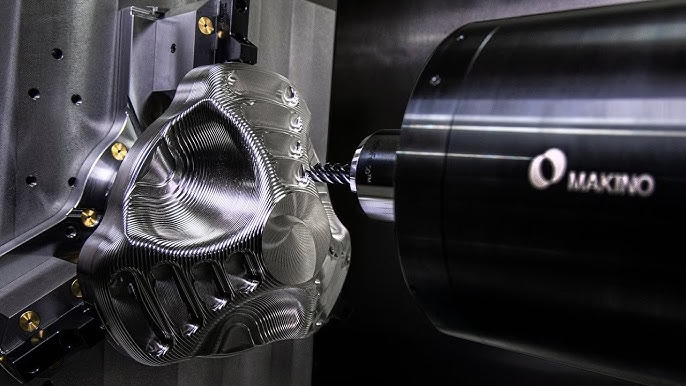
On a 5-axis center, a Ø400 mm rotary table lets the tool reach five faces in one setup. That removes the re-fixturing error you get when a part moves between three machines. For parts with bores on different faces, one setup is often the difference between a usable first article and a rework loop.
Measurement matters as much as machining. A ±0.005 mm callout is meaningless if the shop only has calipers. Ask what measures the tight feature: a coordinate measuring machine, a bore gauge, a surface roughness tester. Reports are available on request, and 100% inspection runs before shipment on every order.
- 1Tight features onlyCall out the two or three dimensions that actually seal, fit or rotate.
- 2One setup beats three5-axis and mill-turn centers cut re-fixturing error.
- 3Finish follows functionRa 0.8–1.6 μm for sealing faces; Ra 1.6–3.2 μm is fine for brackets.
How lead time is built, and where it breaks
Quoted lead time has four parts: quoting, material, machining and inspection. A shop that quotes in 12 hours with a free DFM analysis has already done the first step. Production start within 24 hours means material is on the shelf or on a short call. Parts ship in 3–5 days for most machined work.
Where quick turn jobs slip is usually material, not spindle time. A 7075 or Ti-6Al-4V block may need a day to arrive. Inconel cuts at a fraction of aluminum speed, so a part that runs in two hours in 6061 can take six in Inconel. Tell the shop the alloy before you ask for a date.
Finishing adds a second queue. Anodizing, plating and powder coating are outside processes. If the part needs hardcoat anodizing or electroless nickel, plan the finish as a separate line item on the schedule, not as an afterthought.
- 1Exotic alloys cost daysTitanium and Inconel need longer cutting time and sometimes stock ordering.
- 2Finishing is a second queueAnodizing and plating run outside the machine shop.
No MOQ: what one piece and 10,000 pieces share
No minimum order quantity sounds like a sales line until you look at the setup cost. A single prototype still needs a program, a fixture plan and a first-article check. What changes at volume is how the part is held and how many parts run per cycle. A mill-turn center with a bar feeder and a Ø400 mm rotary table can run a family of turned parts with little operator input.
For prototypes, the goal is information: does the design assemble, does the seal hold, does the bracket survive vibration. For a 10,000-part run, the goal is repeatability. The same shop should be able to show you the inspection route from first article to last part. If the prototype and the production run use different inspection rules, you will find the gap at incoming inspection.
GreatLight runs three wholly-owned plants covering 7,600 m² with 150 technicians and 127 high-precision CNC machines, including 16 simultaneous 5-axis machining centers and 16 mill-turn centers. That mix lets one shop cover a one-off prototype and a 10,000+ part run without handing the job to a second vendor.
- 1Prototype buys informationFit, seal and vibration data before tooling spend.
- 2Production buys repeatabilitySame inspection route from first article to last part.
Which certificate your part actually needs
Certificates are not interchangeable. ISO 9001:2015 is the general quality management standard and applies to almost any machined part. IATF 16949:2016 adds automotive production requirements, so it matters for engine and EV components. ISO 13485:2016 is the medical device standard, and ISO 27001:2022 covers information security for drawings and data you would rather not share publicly.
Ask for the certificate scope, not just the logo. A valid certificate names the site and the processes covered. If your part is machined in Dongguan but the certificate lists only a Singapore address, ask how the two sites share the quality system.
For defense, aerospace and medical programs, paperwork often ships with the part. Material certs, inspection reports and traceability records should be named in the purchase order. Reports are available on request, so put that request in writing early.
- 1General machiningISO 9001:2015 is the baseline.
- 2Automotive and EVIATF 16949:2016 covers engine and hardware parts.
- 3Medical devicesISO 13485:2016 applies to the process, not the product.
- 4Sensitive drawingsISO 27001:2022 and an NDA on request.
Read the quote, not just the price
Two quotes for the same part can differ by 40% because they assume different processes. One shop plans a 3-axis setup with three re-fixtures; another uses a 5-axis center in one setup. The second cuts labor and scrap but may cost more per hour. Neither is wrong. The question is which one fits your tolerance and volume.
Check what the quote includes. Material grade and condition, machining, deburring, surface finish, inspection and packaging should each appear or be explicitly excluded. A low number that omits anodizing is not a low number.
Ask what happens if the first article fails. A shop that inspects 100% before shipment and shares reports will catch it before the parts leave. A shop that ships and waits for your complaint will cost you a week. The historical late-delivery probability at GreatLight is below 2%, which is the kind of number you can ask any supplier to back with records.
- 1Process drives priceOne 5-axis setup versus three 3-axis setups.
- 2Line items, not lump sumsMaterial, finish, inspection and packing listed separately.
- 3First-article planWho checks the first part, and against what report.
Six steps to qualify a quick turn supplier
Run these in order. Each step produces a document or a written answer you can compare across suppliers.
- 1Send a 3D model plus a 2D drawingThe model shows geometry; the drawing carries tolerances, finish and material. A STEP file alone leaves the tight features open to interpretation.
- 2Mark the tight featuresCircle the two or three dimensions that seal, fit or rotate, and state the tolerance. Everything else can stay at the general block.
- 3Ask for a DFM response with the quoteA useful reply names thin walls, deep pockets, tool reach limits and any feature that needs a second setup. Expect it within 12 hours.
- 4Confirm material and finish as line itemsName the alloy and temper, for example 6061-T6 or 17-4PH, and list the finish. Anodizing and plating run on a separate schedule.
- 5Agree the inspection route in writingState which features are measured, with what instrument, and whether reports ship with the parts. 100% inspection before shipment is the baseline.
- 6Set up confidentiality before files moveUse a secure upload link and sign an NDA on request. Do this before the first drawing leaves your system, not after.
Questions buyers ask before the first order
What part size can quick turn CNC machining services handle?
GreatLight machines parts up to 4,000 mm maximum processing size. Large travels include 4,000 × 400 × 150 mm. Medium machines cover 750 × 1,150 × 550 mm and 600 × 600 × 600 mm, and compact machines cover 500 × 500 × 450 mm and 500 × 310 × 200 mm.
Send the model first. If the part fits a smaller envelope, it can often run on a faster machine and ship sooner.
Can you machine one prototype and then the production run?
Yes. There is no minimum order quantity, from one prototype to 10,000+ part runs. The first article and the production parts follow the same inspection route, so the data you collect on the prototype still applies at volume.
Which materials do you stock or machine regularly?
Aluminum grades include 6061, 6061-T6, 2024, 5052, 5083, 6063, 6082, 7075 and ADC12. Stainless covers 303, 304, 316, 316L, 420, 430, 431, 440C and 17-4PH. Steel grades include 1018, 1045, 4130, 4140, 4340 and A36.
Titanium and special alloys include TA1, TA2, TC4 (Ti-6Al-4V), Inconel and magnesium AZ31B / AZ91D. Plastics include ABS, PC, PMMA, POM, PA, PEEK, PP, HDPE and carbon fibre.
How do you protect our drawings and data?
Uploads are secure and confidential, and an NDA is available on request. The information security management system is certified to ISO 27001:2022, which covers how files are stored, accessed and shared.
What surface finishes can be added after machining?
Anodizing in clear, color, hardcoat and conductive types; electroless nickel, zinc, silver and gold plating; powder coating and black oxide; bead blasting, tumbling, brushing and polishing; plus laser marking and engraving with a minimum character height of 1.5 mm.
Finish choice follows function. A sealing face usually needs Ra 0.8–1.6 μm or finer, while a painted bracket can stay as machined at Ra 1.6–3.2 μm.
How fast can parts ship after the order is placed?
Quotation and free DFM analysis come back within 12 hours. Production can start within 24 hours, and parts ship in 3–5 days for most jobs. Exotic alloys and outside finishing processes add time, so flag them in the RFQ.
Send a drawing, get a process plan back
Upload your files and an engineer replies with a quotation and a free DFM analysis within 12 hours. Files stay confidential, and an NDA is available on request.
12-hour quoteFree DFM analysisNo MOQ100% inspection
More machining notes
We publish setup notes, tooling trials and inspection data from the factory floor.











