
Repeated Use of Circular Polarization Reflectors on Laser Cutting Machines
A 50 mm circular polarization reflector fails at the center first, not at the edge. This page explains why, how an eccentric mirror seat steps the damaged spot out of the beam path, and the point where repeated use stops being worth it. Written for maintenance engineers who own that call.
In this article
- 1
- 2
- 3
- 4
- 5
- 6
- 7
Repeated Use of Circular Polarization Reflectors: Key Takeaways
Why a Circular Polarization Reflector Dies in the Middle
A circular polarization reflector on a CO2 laser cutting head does one job: turn linear polarized light into circular polarized light so the cut kerf stays even in every direction. The coating stack sits on a copper or silicon substrate, and it has to survive a focused beam that bounces off it thousands of times a day.
The beam does not hit the full 50 mm face. A typical 810-style generator delivers a beam that lands in a spot a few millimeters wide near the center. That spot carries the full power density. The outer 20 mm of the mirror sees almost nothing. So the coating burns, pits, or delaminates in the middle while the rim stays factory-clean.
This is why the failure looks sudden. Reflectivity at the center drops, the cut edge goes dull, and the machine throws a beam-quality alarm. The part is not worn out. It is worn out in one 6 mm circle.
In our own early builds we ran US-made 810 generators with a 450 circular polarization mirror. The mirrors failed in 6–8 months and were hard to source. That downtime, not the mirror price, was the real cost.
How an Eccentric Mirror Seat Recovers the Clean Annulus
The idea is simple once you see it. If only the center is damaged, the rest of the 50 mm face is still a working optical surface. Move the mirror sideways so the beam lands on clean coating, and the reflector keeps working. The trick is that you cannot just slide the mirror — the seat, the mount, and the optical path all move with it.
On a 50 mm mirror with a 6 mm damaged core, you have roughly 22 mm of clean radius to work with. Stepping the mirror by 6–8 mm per position keeps each new beam spot on virgin coating. Do the math on the annulus and you get about nine usable positions before you run out of clean surface.
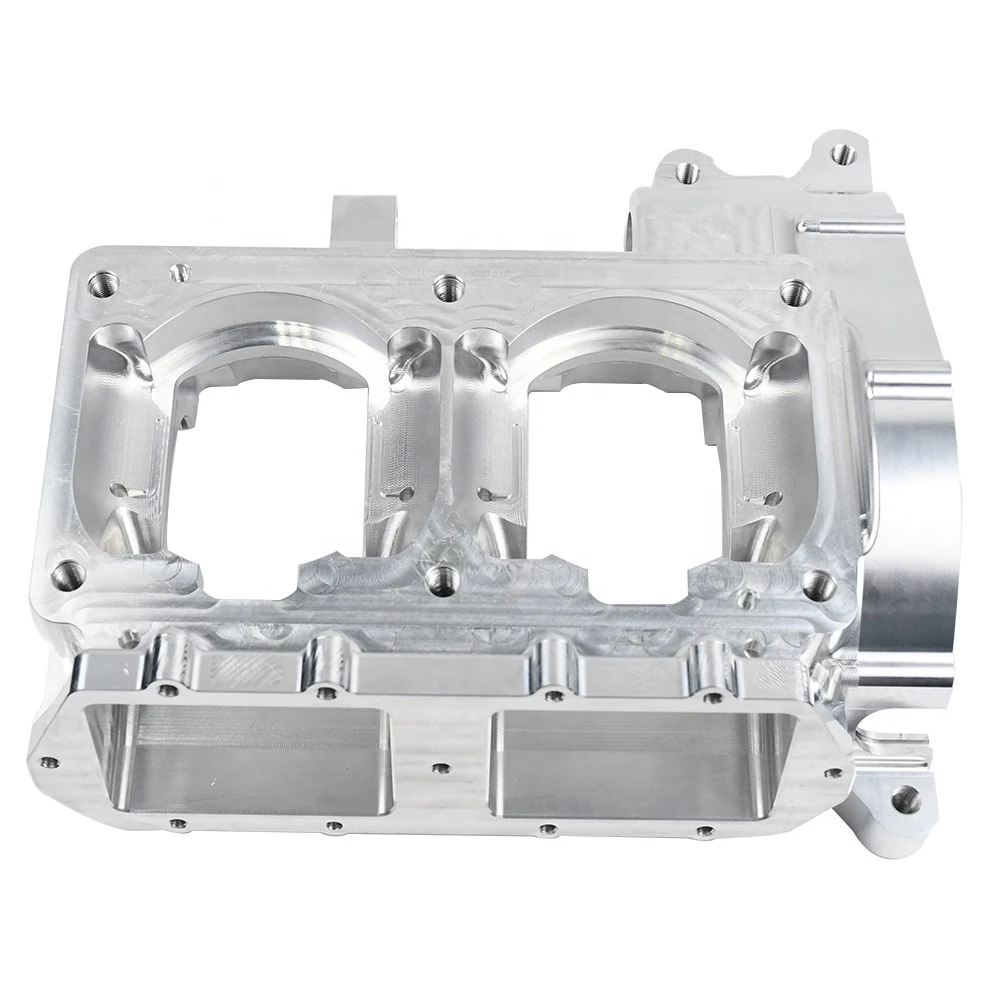
The seat is a machined part, and this is where the tolerance matters. The new position has to hold the mirror face perpendicular to the beam within a few arcminutes, or the beam walks off the nozzle center. We machine these seats to ±0.005 mm on the locating features and check perpendicularity on the CMM before assembly.
A rotary table helps here. With a Ø400 mm rotary table on a 5-axis center, we can cut the eccentric pocket and the locating bore in one setup, so the offset is true to the mount, not just to the drawing.
- 1Offset per step6–8 mm, enough to clear the damaged core without eating the whole annulus.
- 2Usable positionsAbout nine on a 50 mm mirror with a 6 mm dead zone.
- 3Seat tolerance±0.005 mm on locating features; perpendicularity checked on CMM.
- 4Alignment checkBurn a beam card at each position; the spot must stay round and centered.
When Repeated Use of Circular Polarization Reflectors Is the Wrong Call
Reuse is not free. Every step costs you shop time, a beam alignment, and a test cut. On a machine that runs two shifts, a two-hour alignment is real money. If the mirror is already cheap and in stock, replacing it is often faster than re-indexing it.
The method also has a hard limit. Once the clean annulus is narrower than the beam plus the alignment margin, the next step puts the beam edge on damaged coating. At that point you get scatter, heat, and a cut that looks fine on mild steel but fails on stainless.
Substrate condition matters too. If the damage is a pit in the coating only, the copper underneath is fine and reuse works. If the substrate itself is warped or the coating is lifting at the rim, stop. An eccentric seat cannot fix a mirror that has lost flatness across the whole face.
Finally, check the generator. Some 810-style heads have a fixed mirror mount with no room for an eccentric seat. You would have to machine a new mount, and that only makes sense if the mirror is expensive or hard to source.
Setup Steps and the Numbers That Keep It Working
Start with a beam card. Fire a short pulse at low power and look at the burn spot. A round, centered spot means the current position is good. An oval or off-center spot means the mirror has walked and the offset is wrong.
When you step the mirror, move the seat and the mirror together. Do not loosen the mirror in its pocket and rotate it. That changes the polarization axis and you will chase cut quality for a week.
After each step, re-check nozzle centering. The beam should exit the nozzle bore in the middle. A 0.1 mm offset at the nozzle becomes a visible taper on a 6 mm thick plate.
Log each position. Write the step number and date on the seat or in the machine log. Without a log, the next technician cannot tell which sectors are used. We have seen shops lose three good positions because nobody wrote them down.
What the Reuse Actually Saves You
The saving is not the mirror price. It is the downtime you avoid when a mirror fails mid-job and the spare is two weeks out. If you can step to a clean position in 30 minutes and finish the shift, you have won.
It also smooths your spare-parts planning. A shop that indexes nine positions per mirror effectively holds nine mirrors in one. That changes how many spares you need on the shelf.
The cost side is machining. An eccentric seat is a small precision part. On a 5-axis center we can cut it in one setup, and the tolerance is well inside what the optics need. The seat outlives several mirrors.
The break-even is simple: if the seat costs less than two mirrors plus the downtime of one unplanned failure, it pays. Most shops hit that in the first year.
Reuse or Replace: Matching the Call to the Condition
Read the mirror condition first, then pick the row.
| Mirror condition | Reuse? | Best action |
|---|---|---|
| Center pit under 8 mm, rim clean | Yes | Step mirror 6–8 mm, re-align beam |
| Two or three pits in the annulus | Maybe | Index to a clean sector, test cut |
| Coating lifting at the rim | No | Replace reflector, check mount flatness |
| Substrate warped or bowed | No | Replace; eccentric seat will not help |
| Mirror cheap and in stock | No | Replace; alignment time costs more |
| Mirror obsolete or long lead | Yes | Machine eccentric seat, run nine positions |
The Verdict
If the damage is a clean center pit and the mirror is expensive or slow to source, machine an eccentric seat and reuse it up to nine times. If the coating is lifting, the substrate is warped, or the mirror is cheap and on the shelf, replace it and move on.
Questions Engineers Ask About Reflector Reuse
How many times can I reuse a 50 mm circular polarization reflector?
With a 6 mm damaged core and 6–8 mm steps, you get about nine clean positions on a 50 mm face.
That assumes the annulus stays intact. Stop when the clean band is narrower than the beam plus alignment margin.
Does stepping the mirror change the polarization state?
No, as long as you translate the mirror and seat together without rotating the mirror in its pocket.
Rotating the mirror changes the axis and shifts cut quality. Translation only moves the beam spot.
What tolerance does the eccentric seat need?
We hold ±0.005 mm on locating features and check perpendicularity on the CMM.
The mirror face must stay square to the beam within a few arcminutes, or the beam walks off the nozzle center.
Can I reuse a reflector if the coating is lifting at the rim?
No. Rim lift means the coating stack is failing across the face, not just at the center.
An eccentric seat moves the beam but cannot restore a coating that is delaminating.
How do I know the new position is aligned?
Fire a low-power pulse at a beam card and inspect the burn spot.
A round, centered spot is good. An oval or off-center spot means re-align before cutting.
Is reuse worth it if the mirror is cheap?
Usually not. A two-hour alignment costs more than a low-cost mirror.
Reuse pays when the mirror is expensive, obsolete, or has a long lead time.
Need an Eccentric Mirror Seat Machined?
Send us the mirror drawing and mount details. We quote and return a DFM analysis within 12 hours.
12-hour quote±0.005 mm tolerance100% inspection
More From the Shop Floor
We publish setup notes, tooling trials and inspection data from the factory floor.











