
First CNC processing plant: what it actually changes for engineers
A look at what a first CNC processing plant means for part designers and sourcing engineers. We cover the machine mix, the tolerance and finish bands that matter, and the part shapes that fit or do not fit this kind of shop. Read it if you need to judge whether a local CNC plant can hold your drawing.
In this article
- 1
- 2
- 3
- 4
- 5
- 6
What a first CNC processing plant actually has on the floor
A CNC plant is not one machine. It is a group of machine types picked to cover a range of part sizes and shapes. A first CNC processing plant usually starts with 3-axis vertical mills for flat work and pockets, then adds turning centers for round parts. As volume grows, 4-axis and 5-axis centers follow.
The split matters to you as a designer. A 3-axis mill cuts from one direction, so every face needs a new setup. Each setup adds fixture error. A 5-axis center tilts the tool or the table, so it reaches five faces in one setup. On a bracket with holes on three sides, that alone can remove two setups and the stack-up error that comes with them.
Spindle speed and torque decide what the plant can cut, not just how fast. Aluminum runs at high rpm and light load. Titanium and Inconel need low rpm and high torque, plus coolant pressure to clear chips from the cut zone. A shop set up for aluminum will struggle with a Ti-6Al-4V housing unless it has the right spindle and tooling.
Travel limits set the largest part. A compact machine may only reach 500 × 500 × 450 mm. A large gantry-style machine can reach 4,000 mm in one axis. If your part is longer than the travel, the shop either splits it into sections or declines the job. Check travel before you check price.
- 13-axisFlat faces, pockets, one-direction holes. Lowest cost per part.
- 24-axisAdds a rotary table. Good for round parts with cross holes.
- 35-axisTilts tool or table. Complex geometry in one setup.
- 4Mill-turnTurns and mills in one program. Fewer handoffs on shafts.
Tolerance and finish: the bands that decide the process
Tolerance and surface finish are the two numbers that decide whether a part is easy or hard to make. They also decide the price. A shop that holds ±0.005 mm on a 100 mm aluminum plate is doing normal work. The same tolerance across a 1,000 mm steel weldment is a different problem, because heat and vibration grow with part size.
Surface finish works the same way. Ra 0.8–1.6 μm comes off the machine with a good cutter and correct feeds. Ra 0.2–0.8 μm usually needs a finer step-over, a smaller tool, or a secondary polish. Each step adds time. If the drawing calls for Ra 0.4 μm on a deep pocket wall, ask whether a bearing or seal actually touches that surface.
Call out tolerance only where it functions. A mounting face needs a tight flatness spec. A clearance hole for an M6 bolt does not need ±0.01 mm. Over-tolerancing forces the shop to slow the cut, add inspection, and sometimes scrap good parts. That cost comes back to you in the quote, not in the part.
Inspection closes the loop. A plant should check raw material, monitor the cut, and inspect before shipment. Reports on request are normal. If a shop cannot show you a first-article report for a tight-tolerance feature, treat the tolerance as a claim, not a fact.
- 1±0.005 mmTypical tight band on small to medium machined parts.
- 2Ra 1.6–3.2 μmAs-machined finish. Fine for most brackets and covers.
- 3Ra 0.8–1.6 μmGood finish from a sharp cutter and steady feed.
- 4Ra 0.2–0.8 μmNeeds fine step-over or secondary polishing.
Which materials a first CNC processing plant can cut well
Aluminum is the easy case. Grades like 6061, 7075, and 6082 cut fast, hold tolerance, and take anodizing well. A first CNC processing plant can run these all day. If your part is an aluminum housing or a prototype bracket, almost any competent shop can quote it.
Stainless and steel raise the bar. Grade 304 and 316 work-harden if the cutter dwells, so the program has to keep a steady chip load. Grade 17-4PH and 4140 need the right insert grade and coolant. Tool steel and 4340 push spindle torque and tool wear. A shop without rigid machines will burn tools and miss the finish.
Titanium and Inconel sit at the hard end. Ti-6Al-4V conducts heat poorly, so the heat stays in the cut and wears the edge. Inconel is worse. Both need low surface speed, high pressure coolant, and a rigid setup. Many plants quote these and then lose money on them. Ask for a sample cut before you commit a production run.
Plastics behave differently again. POM and PEEK machine cleanly but move with temperature. ABS and PC can melt or chip if the feed is wrong. Carbon fiber eats tool edges and needs dust control. The material list tells you what a shop has actually run, not just what it will quote.
Part shapes that fit a first CNC processing plant, and shapes that do not
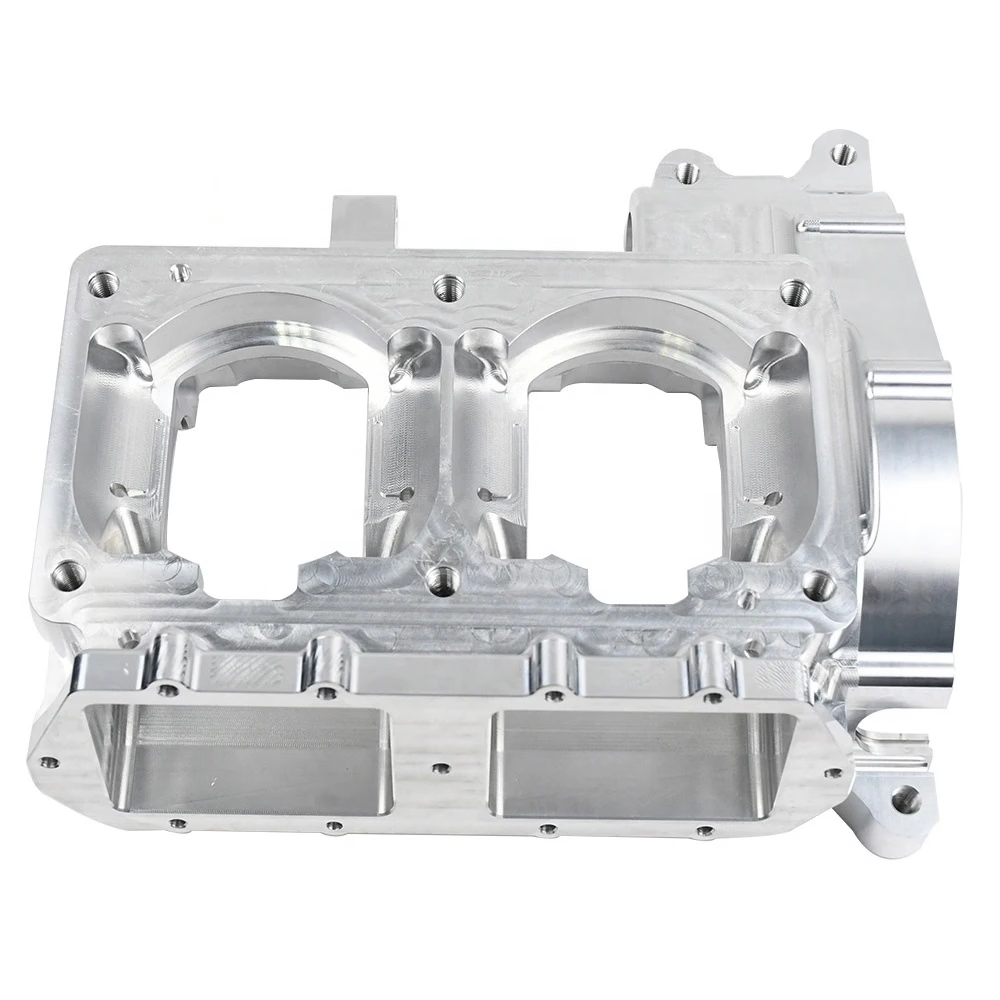
Prismatic parts fit best. Think brackets, plates, housings, manifolds, and covers. These have flat faces, pockets, and holes that a 3-axis or 5-axis mill can reach. They need few setups and standard workholding. A first CNC processing plant can quote these from a 2D drawing plus a 3D model and hit the tolerance.
Round parts fit turning centers. Shafts, bushings, spacers, and fittings are turned between centers or in a chuck. If the part also has cross holes or milled flats, a mill-turn center does both in one setup. That removes the concentricity error you get when a part moves from a lathe to a mill.
Thin walls and deep pockets are the hard cases. A 0.5 mm wall on an aluminum box will deflect under cutting force. Deep pockets need long, thin tools that chatter. Both can be machined, but the shop must slow the cut, use light passes, and sometimes add support. Expect a higher price and a longer lead time.
Some shapes do not belong on a CNC at all. A hollow shell with uniform 2 mm walls and no machined features is often cheaper as a casting or a 3D print. A part with internal channels that no tool can reach is a job for metal 3D printing or vacuum casting. A good shop will tell you this instead of quoting a slow, costly CNC run.
- 1Good fitBrackets, plates, housings, shafts, manifolds.
- 2Hard fitThin walls under 1 mm, deep narrow slots, long flexible parts.
- 3Wrong processHollow shells, internal channels, large thin panels.
How a first CNC processing plant changes cost and lead time
CNC removes the need for a mold. That is the main cost shift. A casting or injection mold can cost thousands and take weeks. A CNC run starts at one part. For prototypes and low-volume builds, CNC is usually the faster path even when the per-part price is higher.
Setup dominates small runs. The first part carries the programming and fixturing cost. Parts 2 through 50 spread that cost. This is why a shop with no minimum order can still be competitive on a single prototype. The price per part falls fast as quantity rises, then flattens once the setup is paid off.
Lead time splits into two phases. Quotation and design-for-manufacturing review come first, often within 12 hours. Production can start within 24 hours once the drawing is locked. Simple parts ship in 3–5 days. Complex 5-axis work with finishing adds time, mostly in inspection and surface treatment.
Late delivery risk is a real metric. A shop that tracks it and keeps it below 2% is managing its schedule, not guessing. Ask how a shop measures on-time delivery. If the answer is vague, the date on your quote is a hope, not a plan.
Which process fits which part
Use this to pick a route before you ask for a quote.
| Part type | Best process | Why | Watch out for |
|---|---|---|---|
| Prototype bracket | 3-axis or 5-axis CNC | No tooling cost, fast setup | Setup cost on one part |
| Round shaft with flats | Mill-turn center | Turning and milling in one setup | Concentricity if split across machines |
| Complex housing | 5-axis CNC | Five faces in one setup | Tool reach in deep pockets |
| Hollow shell, 2 mm wall | Casting or 3D printing | CNC would deflect or waste stock | Post-machining for critical faces |
| Internal channels | Metal 3D printing | No line-of-sight tool path | Surface finish inside channels |
| High-volume simple part | Die casting or injection | Tooling pays back at volume | Upfront mold cost and lead time |
When a local first CNC processing plant is the right call
If you need one to a few hundred complex metal parts fast, and the geometry is prismatic or round, use CNC. If the part is a hollow shell or has internal channels no tool can reach, use casting or 3D printing instead and machine only the critical faces.
Questions engineers ask about a first CNC processing plant
Can a first CNC processing plant hold ±0.005 mm on every part?
No shop holds a tight band on every part size. ±0.005 mm is normal on small and medium machined parts with a rigid setup and a controlled shop temperature. On a 1,000 mm steel part, thermal growth and vibration push the real limit wider.
Ask for the tolerance per feature, not per shop. A mounting face and a clearance hole need different bands. If the drawing only gives one tight tolerance across the whole part, expect a higher price.
What is the largest part a CNC plant can machine?
It depends on machine travel. A compact machine may reach 500 × 500 × 450 mm. A large machine can reach 4,000 mm in one axis. The part must fit the travel with room for the fixture and the tool.
If your part is longer than the travel, the shop can sometimes machine it in sections or use a tombstone setup. That adds cost and a joint. Check travel before you assume a shop can take the job.
How many setups does a 5-axis machine save?
On a bracket with features on four or five sides, a 5-axis center can cut them in one setup. A 3-axis mill would need three or four setups, each with its own fixture error.
Each removed setup cuts both labor and stack-up error. That is the main reason 5-axis work costs more per hour but can cost less per part on complex geometry.
Do I need a mold for a CNC run?
No. CNC cuts from solid stock, so there is no tooling to build. That is why a CNC run can start at one part. A casting or injection mold costs thousands and takes weeks before the first part exists.
For prototypes and low-volume builds, CNC is usually the faster route. Once volume is high and the design is frozen, a mold can pay back and lower the per-part cost.
Which materials are hard for a new CNC plant?
Titanium and nickel alloys like Inconel are the hard cases. They hold heat in the cut, wear tool edges fast, and need low surface speed and high-pressure coolant. A shop set up for aluminum will struggle without the right spindle and tooling.
Stainless grades 304 and 316 also work-harden if the cutter dwells. The program must keep a steady chip load. Ask for a sample cut on these materials before a production run.
How do I judge whether a shop is ready for my part?
Ask three questions. What is your machine travel and spindle torque? Show me a first-article report for a similar tolerance. How do you measure on-time delivery? Clear answers mean the shop tracks its own process, not just its marketing.
Then send a 3D model and a 2D drawing with critical features marked. A shop that returns a design-for-manufacturing note within a day is reading your part, not just pricing it.
Send your drawing and get a real process answer
We review your part, flag the features that will drive cost or risk, and quote within 12 hours. No minimum order, from one prototype to a 10,000-part run.
12-hour quoteFree DFM analysis100% inspectionNDA on request
More machining notes
We publish setup notes, tooling trials and inspection data from the factory floor.











