
Saudi Arabias First CNC Processing Plant Launches
Saudi Arabias first CNC processing plant opened in Jeddah with five-axis equipment and a full finishing line. This page explains what that changes for engineers and buyers: which parts fit local machining, where the process limits sit, and when importing still makes more sense.
In this article
- 1
- 2
- 3
- 4
- 5
- 6
What Saudi Arabias first CNC processing plant actually does
A CNC processing plant turns a CAD model into a metal or plastic part by subtractive cutting. A controller reads G-code, drives a spindle along X, Y and Z, and removes material with end mills, drills, taps and turning tools. The Jeddah plant follows that same model. Nothing about Saudi Arabias first CNC changes the physics of chip removal; what changes is where the chips are made.
The work splits into milling and turning. Milling holds a rotating tool against a moving workpiece for pockets, slots, faces and contours. Turning spins the part instead and cuts with a single-point tool, which suits shafts, bushings and threaded fittings. A plant that only runs one of the two has to send the other half of a job elsewhere.
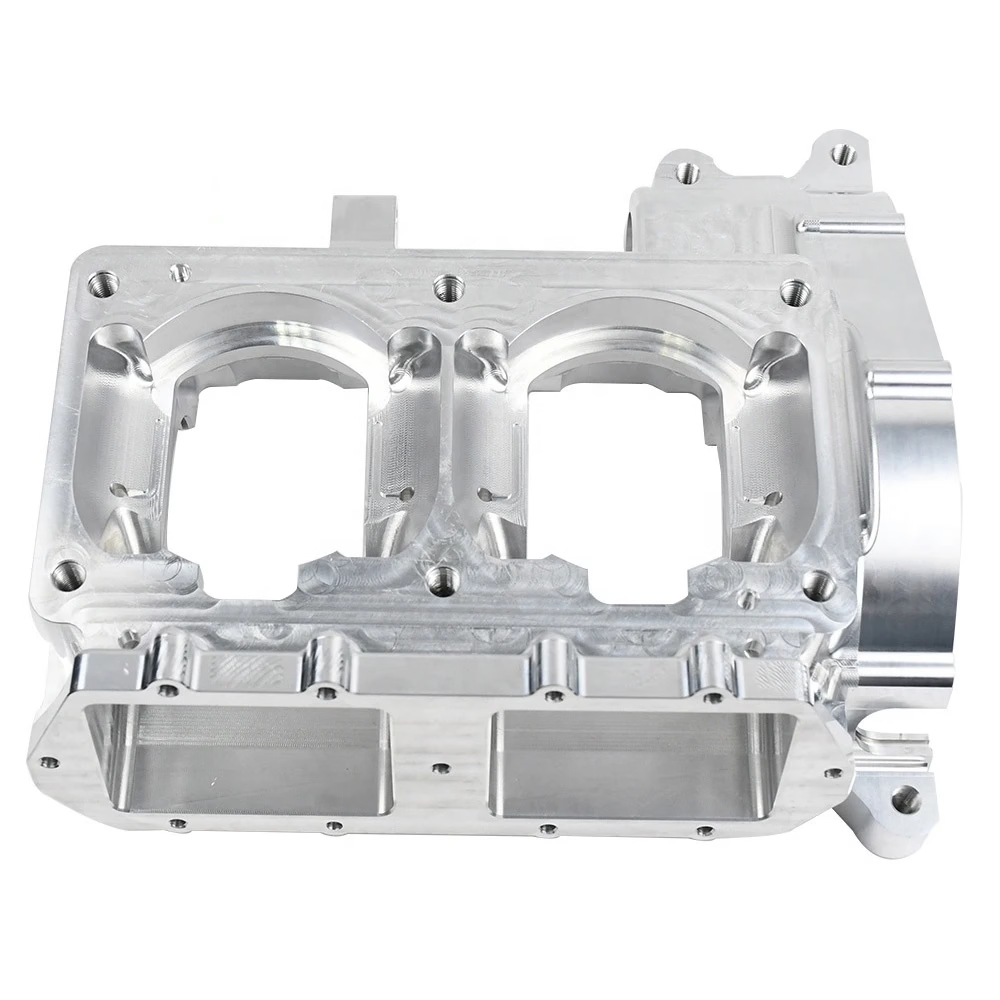
Five-axis machining adds two rotary axes to the three linear ones. The tool can then reach undercuts, angled holes and deep pockets in one setup. Each extra setup on a three-axis machine adds fixture time and stacks positional error. That is the main reason complex parts move to five-axis as soon as volume justifies the hourly rate.
A processing plant is not only spindles. Deburring, surface treatment, grinding and inspection sit on the same floor, so a part does not travel between vendors between operations. That matters more than machine count for parts with tight cosmetic or sealing requirements.
Tolerances, surface finish and where the limits sit
Tolerance is a range, not a single number. A general machining tolerance of ±0.005 mm is achievable on a rigid setup with sharp tooling, but it assumes the feature is reachable and the material is stable. A deep bore 8× its diameter is a different problem from a face milled 2 mm deep, even when both print the same tolerance.
Surface finish follows the same logic. Ra 1.6–3.2 μm is a normal as-machined result. Ra 0.8–1.6 μm usually needs a finishing pass with a smaller stepover. Ra 0.2–0.8 μm generally means grinding, lapping or polishing after machining. Finer finish costs cycle time, so specify it only where a seal, bearing or optical surface needs it.
Thermal behavior is the quiet limit. Aluminium 6061 and 7075 move as the spindle warms the part and the fixture. Long thin parts deflect under clamping pressure. Both effects show up as size drift across a batch, not as a single bad part.
Measurement closes the loop. A ±0.005 mm callout is only meaningful if the shop can measure it. CMM reports, in-process probing and 100% inspection before shipment are what turn a tolerance on a drawing into a tolerance you can rely on.
Materials a new plant can and cannot cut well
Aluminium is the default. 6061-T6 machines fast, holds tolerance and anodizes cleanly, which suits enclosures, brackets and heat sinks. 7075 gives higher strength for aerospace and motorsport parts but is less forgiving of poor toolpaths. 2024 and 5052 cover sheet-heavy work.
Stainless 303 and 304 cover most general parts. 316 and 316L handle marine and medical exposure. 17-4PH (SUS630) adds hardness after heat treatment and is common in valve and pump components. Stainless work-hardens, so light depths of cut and constant feed matter more than spindle speed.
Titanium, Inconel and magnesium sit at the hard end. TC4 (Ti-6Al-4V) and Inconel absorb heat at the cutting edge, so tool life drops and cycle time rises. Magnesium AZ31B and AZ91D cut easily but need chip control because fine magnesium chips are a fire risk. Not every plant stocks these, and a new one may need to qualify them first.
Plastics behave differently from metals. POM and PA machine cleanly, ABS and PC can melt at the tool tip, and PEEK needs sharp tooling and generous coolant. Carbon fibre is abrasive and wears tooling quickly. Ask whether the shop has actually run the material, not whether it is on a list.
Why local machining changes the supply chain
Importing machined parts adds weeks that have nothing to do with cutting. Freight, customs clearance, packing and the risk of damage in transit all sit between the machine and your assembly line. A domestic plant removes most of that. It also shortens the loop when a drawing changes.
Rework is the harder cost to see. If a part arrives out of tolerance, an imported batch may need to go back across a border. A local shop can recut, adjust or replace within days. For low-volume and prototype work, that difference usually outweighs a lower unit price abroad.
Self-sufficiency is the strategic version of the same argument. Parts made inside the country do not depend on shipping schedules or currency swings. The trade-off is depth: a new plant cannot cover every process, every alloy or every size on day one.
So the realistic split is local for standard alloys, moderate sizes and normal tolerances; import for exotic materials, very large parts or processes the local floor has not qualified yet. That split will shift as capacity grows.
Machine envelope: the first thing that rules a part in or out
Before tolerance or finish, a part has to fit. A plant running 500 × 500 × 450 mm travels cannot cut a 1,200 mm housing no matter how simple it is. Envelope is the first filter, and it is a hard one.
Large travels change the setup as well. A machine with 4,000 × 400 × 150 mm of travel cuts long rails, beams and profiles, but only in a narrow height band. Medium travels around 750 × 1,150 × 550 mm suit plates and box parts. Compact machines handle small, high-mix work.
A Ø400 mm rotary table adds a fourth axis and lets a part be cut on several faces without refixturing. That is where position tolerance between faces stops depending on how well a fixture was set.
Check the envelope against the part plus its fixture, not the part alone. Clamps, vises and soft jaws all consume travel, and a part that fits on paper can still be unreachable at the corners.
Local machining vs importing: what to weigh
Use this to decide where a part should be cut.
| Factor | Local plant | Import |
|---|---|---|
| Lead time | Days, plus short rework loop | Weeks including freight and customs |
| Tolerance risk | Fast rework if a batch drifts | Return shipment and re-qualification |
| Material range | Standard alloys first | Broad, including exotics |
| Part size | Fits the machine envelope | Any size, higher freight cost |
| Process depth | Core cutting plus finishing | Specialist processes available |
| Drawing changes | Revise and recut quickly | New batch and new shipment |
| Unit price | Higher on simple parts | Lower at high volume |
| Supply risk | Low, domestic | Exposed to shipping and tariffs |
The verdict
For standard alloys, moderate part sizes and normal tolerances, cut locally and keep the rework loop short. For exotic alloys, oversized parts or processes the local floor has not qualified, import until capacity catches up.
Questions engineers ask next
Does a five-axis machine always beat a three-axis one?
No. Five-axis wins when a part has angled features, undercuts or several faces that would otherwise need separate setups. For flat plates with holes on one face, a three-axis machine cuts faster and cheaper because there is less rotary motion to control.
The rule of thumb: count the setups. If a part needs four or more setups on a three-axis machine, the extra hourly rate for five-axis usually pays back in fixture time and scrap.
How do I know if a tolerance is realistic?
Match the tolerance to the feature. A bore, a face and a slot all behave differently even when the drawing calls the same ±0.005 mm. Deep holes, thin walls and long unsupported sections are the usual trouble spots.
Send the drawing for a DFM review before quoting. A shop that flags an unmeasurable or unstable callout early saves a rejected batch later.
What surface finish should I call out?
Start from function. Sealing faces and bearing seats usually need Ra 0.8–1.6 μm. Cosmetic covers are fine at Ra 1.6–3.2 μm as machined. Sliding or optical surfaces may push to Ra 0.2–0.8 μm, which adds a grinding or polishing step.
Specifying a finer finish than the function needs adds cost without adding value.
Which materials should stay imported for now?
Titanium, Inconel and magnesium are the usual candidates, because they need qualified tooling, chip handling and cutting parameters. The same applies to any alloy the shop has not run before.
Ask for a first-article report on a sample part before committing a production batch to an unproven material and process pair.
How does part size affect the choice?
Size sets the machine, and the machine sets the price. A part inside a compact envelope can run on a small machine with fast moves. A part near the maximum travel needs a large machine, slower positioning and often a custom fixture.
Measure the finished part plus stock and fixture. That total, not the drawing dimensions, decides what can be cut.
What inspection evidence should come with a batch?
Ask for the raw material certificate, in-process checks and a final dimensional report. CMM reports on critical features are standard for tight work.
For regulated industries, the shop should also hold process certifications such as ISO 9001, IATF 16949, ISO 13485 or ISO 27001, depending on the sector. Confirm which ones apply before you send drawings.
Send a drawing, get a manufacturability answer
Upload your CAD files and get a quotation with free DFM analysis within 12 hours, with NDA available on request.
12-hour quote100% inspectionNo minimum order quantity
More from the shop floor
We publish setup notes, tooling trials and inspection data from the factory floor.











