
3D printing materials railway industry: what changed and when to machine instead
Flame-retardant compounds are now sold specifically for rail interiors, so engineers ask a new question: print the bracket or machine it? This page covers the material classes, the FST and mechanical limits behind them, and the cases where CNC still wins.
In this article
- 1
- 2
- 3
- 4
- 5
- 6
- 7
Key takeaways
What rail-grade 3D printing materials railway industry suppliers actually offer
Two families carry most rail interior work today. The first is flame-retardant thermoplastic compound, usually a polycarbonate blend or a PA6-based powder filled with a halogen-free flame retardant. The second is flame-retardant photopolymer for large-format resin printing, which reaches fine detail on covers, bezels and ducting.
The properties that matter are not the headline tensile number. They are limiting oxygen index, smoke density under a controlled burn, and toxicity of the off-gas. A compound can print beautifully and still fail a smoke test at the first bench trial.
Fillers change the print window. Glass-filled and mineral-filled grades raise stiffness and lower warpage, but they also drop flow. Expect 20–40 °C higher nozzle temperature and a slower volumetric rate than the neat resin.
Moisture is the usual culprit behind weak layers. PA-based rail compounds absorb water fast. Dry them per the supplier datasheet before every run, then keep the spool in a dry box during printing.
- 1PC/ABS-FR blendsStiff covers, clips and housings; easy to print, moderate heat resistance.
- 2PA6-FR powdersDucts and brackets; good toughness, needs strict drying.
- 3FR photopolymersFine-feature bezels and grilles; best surface out of the machine.
- 4PEI and PEEK gradesHigh-temperature zones near traction equipment; expensive and slow.
FST and smoke limits you have to design around
Rail interior approval usually runs through a fire, smoke and toxicity test set. The part is burned in a controlled chamber and scored on flame spread, smoke optical density and gas composition. A material datasheet that only lists a UL 94 rating is not enough for a seating or ceiling component.
Geometry changes the result. A thin wall ignites faster than a thick boss, and trapped air in a hollow print feeds the flame. Design solid sections where the burn test will look, and avoid internal voids near exposed surfaces.
Surface finish also matters. A rough, porous print surface has more area to release smoke. Bead blasting after printing lowers surface roughness and gives a cleaner burn profile, and it hides layer lines at the same time.
If a coupon fails, the fix is rarely a new polymer. It is usually wall thickness, void content or a coating. Retest the assembly, not just the resin.
Where print tolerance stops and CNC has to take over
FDM and powder-bed printing hold roughly ±0.3 mm on a well-tuned machine, and worse on tall parts as the build plate cools. That is fine for a duct that clips into place. It is not fine for a bracket that carries a sensor at a fixed air gap.
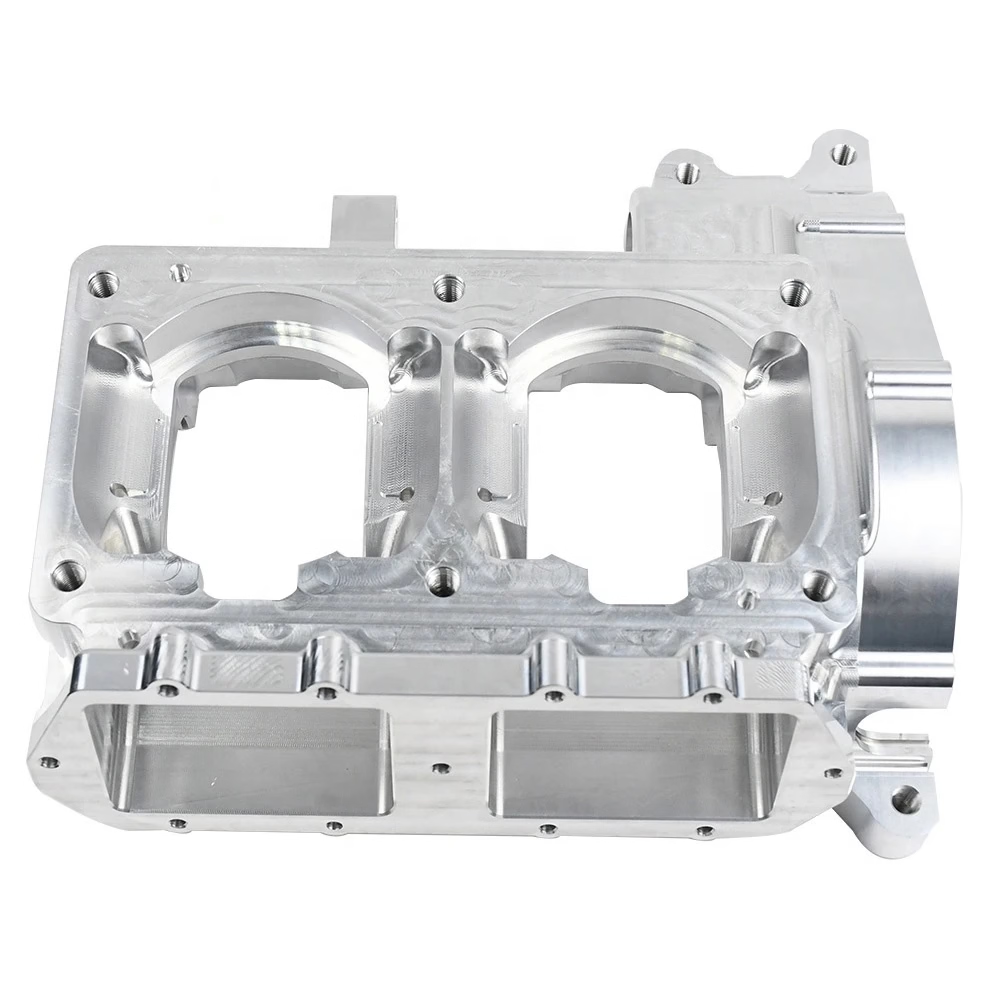
A practical split: print the body, machine the interfaces. Bolt holes, bearing bores, sealing faces and dowel locations get reamed or milled after printing. We hold ±0.005 mm on those features, which is tighter than any polymer print can reach.
Shrinkage is the reason. Every polymer shrinks as it cools, and the amount varies with wall thickness and fill pattern. A print that measures correctly on a thin wall will be undersize on a 10 mm boss.
The hybrid route costs more than a print alone, but less than a steel tool. It is the usual answer for a pilot build of 50 to 500 interior parts that must pass a dimensional check.
Rail parts that should stay CNC machined
Load-bearing and safety-relevant parts belong in metal. A door hanger, a seat frame node or a coupler shim carries repeated dynamic load and needs a fatigue life you can calculate. Printed polymer does not get there.
Metal also wins wherever heat is present. Near traction motors, brake equipment and power electronics, a printed polymer will creep or soften. Aluminium 6061-T6 and 7075 stay stable, and 17-4PH stainless covers the corrosive wash-down areas.
If the part is a one-off fixture or a repair shim, machining is faster than printing and finishing. A 5-axis cut in aluminium takes hours, not days, and no post-cure or coating step is needed.
The decision rule is simple. If the part moves, holds a tolerance under load, or sits above roughly 100 °C, machine it. If it covers, routes or guides, print it.
- 1Seat and door hardwareAluminium 6061-T6 or 7075, anodized.
- 2Brake and traction bracketsSteel 4130 or 4140, black oxide.
- 3Wash-down covers316L stainless, bead blasted.
A hybrid build that passes both fire and dimensional review
The workflow we use on rail interior programs starts with a printed shell. We slice with solid perimeters on the exposed faces so the burn test sees dense material, and keep infill only in hidden ribs.
Printed parts then go to the mill for interface work. Mating faces are skimmed, holes are reamed to size, and any insert pockets are cut to a press fit. A metal threaded insert gives a reusable fastening point that a printed thread cannot match.
Finally, the part is finished. Bead blasting removes layer lines and reduces surface area for smoke release. If the spec calls for it, we mask and coat the show surface, then inspect every unit before it ships.
We run a first-article inspection on the hybrid assembly and keep the report with the lot. If a dimension drifts, you see it on paper before the parts reach the line.
Print or machine: which route fits the part
Use this to pick a process before you draw the part.
| Part type | Best process | Why | Typical tolerance |
|---|---|---|---|
| Interior duct or cover | FDM with FR compound | Large, thin, low load | ±0.3 mm |
| Bezel or grille | FR photopolymer | Fine detail, smooth face | ±0.1 mm |
| Sensor bracket | Print shell, CNC interfaces | Critical hole positions | ±0.005 mm on holes |
| Seat or door hardware | 5-axis aluminium | Dynamic load, fatigue life | ±0.005 mm |
| High-temp zone part | CNC steel or stainless | Creep above 100 °C | ±0.005 mm |
| Pilot run, 50–500 pcs | Hybrid print plus machining | No tooling cost | ±0.005 mm on interfaces |
| Production, 10,000+ pcs | Injection molding or die casting | Unit cost falls with volume | Per mold spec |
The verdict
If the part covers, routes or guides, print it in a flame-retardant rail compound. If it carries load, holds a tight bore or runs hot, machine it in aluminium or stainless. When it does both, print the shell and machine the interfaces.
Common questions on rail additive parts
Can a printed rail part pass an FST test?
Yes, if the compound is formulated for it and the geometry is designed for the burn. Solid perimeters on exposed faces, no internal voids near the surface, and a bead-blasted finish all help.
Always test a coupon in the final thickness and finish. A passing resin can still fail as a thin wall.
How tight can you hold a printed dimension?
Around ±0.3 mm on a stable FDM or powder-bed part, and ±0.1 mm on resin printing for small features. Tall builds drift more as they cool.
For anything tighter, we machine the feature after printing and hold ±0.005 mm.
Do you need tooling for a pilot run?
No. Hybrid printing plus interface machining covers pilot quantities without a mold. That is the usual path between 50 and 500 parts.
Once volume climbs past a few thousand, we review injection molding or die casting for unit cost.
Which metals do you use for rail hardware?
Aluminium 6061-T6, 2024 and 7075 for brackets and housings; 4130 and 4140 steel for loaded fittings; 316L and 17-4PH stainless for wash-down areas.
Finishes include anodizing, black oxide, zinc plating and bead blasting.
How fast can you turn a quote and a first part?
Quotation and DFM analysis come back within 12 hours. Production can start within 24 hours, and parts ship in 3–5 days.
Uploads stay confidential, and we sign an NDA on request.
What file formats and details do you need?
Send STEP or STL plus a drawing with the critical dimensions marked. Note the fire standard, the surface finish and any insert locations.
That lets us split the part into printed and machined features before quoting.
Send the drawing, get a process split back
We review the fire spec, the tolerance callouts and the volume, then tell you which features to print and which to machine.
12-hour quote±0.005 mm on machined interfaces100% inspection
More on rail and additive work
We publish setup notes, tooling trials and inspection data from the factory floor.











