
Savannah CNC Services: 7 Checks Before You Order
This guide is for engineers and buyers sourcing Savannah CNC services for metal and plastic parts. It covers the checks that decide whether a shop can hold your tolerance, meet your schedule, and quote the job in a way you can compare against other suppliers.
Key takeaways
What to compare across Savannah CNC services
Each column is a check you can run before sending an RFQ.
| Check | What good looks like | Warning sign |
|---|---|---|
| Tolerance | Callouts tied to specific features | One blanket ±0.005 mm on every dimension |
| Lead time | Quote in 12 hours, parts in 3–5 days | Vague 'several weeks' answer |
| MOQ | One prototype to 10,000+ parts | High minimum before any work starts |
| Certifications | ISO 9001, IATF 16949, ISO 13485 | Certificate numbers you cannot verify |
| Inspection | 100% inspection before shipment | No reports unless you pay extra |
| Finishing | Anodizing, plating, powder coat in house | Finish sent to an unnamed third party |
Pick the machine before you pick the shop
Most RFQs that come back wrong were sent to the wrong class of machine. A flat bracket with holes on one face is three-axis work. A housing with angled ports, a tapered bore, and features on five sides is not. If the quote does not say which machine will run the part, you cannot tell whether the price reflects the geometry or a guess.
Simultaneous five-axis machining moves the tool along X, Y and Z while the workpiece tilts and rotates on two more axes, usually A and B. That lets the cutter reach the part from nearly any angle in one setup. The gain is not just speed. Every extra setup adds a datum shift, and datum shifts stack up into position errors that no tighter tolerance callout will fix.
Three-axis work still wins on cost when the part is prismatic and the tolerances are open. Shops that push five-axis for a simple plate are selling capacity, not solving your problem. Ask what the part needs, then match it. A useful rule: if the part can be machined from two sides with no compound angles, three-axis with a good fixture is usually the cheaper route.
Size matters too. GreatLight runs 16 simultaneous five-axis centers, 12 four-axis mills, 27 three-axis machines and 16 mill-turn centers. Maximum processing size is 4,000 mm, with travels from 500 × 500 × 450 mm up to 4,000 × 400 × 150 mm and a Ø400 mm rotary table. If your part is outside those envelopes, say so early.
- 1Five-axis fitsCompound angles, deep cavities, five-sided features, tight true-position callouts
- 2Three-axis fitsFlat plates, simple pockets, open tolerances, short runs
- 3Mill-turn fitsShafts and bodies that need turning and milling without a second op
Tolerance, surface finish and material choice
Tolerance is a capability statement, not a wish. A shop that can hold ±0.005 mm on a 50 mm aluminum part may not hold it on a 900 mm steel weldment, because thermal growth and fixture deflection scale with size. When you compare Savannah CNC services, send the drawing and ask which dimensions the shop considers critical. A short written answer tells you more than a certificate PDF.
Surface finish drives cost more than people expect. As-machined aluminum lands around Ra 1.6–3.2 μm. A fine finish of Ra 0.2–0.8 μm needs slower feeds, sharper tools, and often a second operation. If your drawing calls for Ra 0.4 μm across a large face, expect a real price jump and ask whether the finish is functional or cosmetic.
Material availability shapes lead time. Common grades like 6061-T6, 304 stainless, and 1018 steel are usually in stock. Titanium grade 5, Inconel, and beryllium copper often need ordering, which adds days before chips ever fly. Plastics behave differently again: POM and PEEK machine cleanly, while carbon fibre and soft PP need special tools and support.
For medical and automotive work the material spec is not negotiable. GreatLight machines aluminium 6061, 2024, 5052, 6063, 6082, 7075 and ADC12; stainless 303, 304, 316L, 17-4PH and 440C; titanium TA1, TA2 and TC4; plus Inconel and magnesium AZ31B. If a shop cannot name the mill cert for your alloy, keep looking.
- 1State critical dimensionsMark them on the drawing instead of tightening everything
- 2Separate cosmetic from functionalA fine Ra on a hidden face is money burned
- 3Check mill certsEspecially for 17-4PH, TC4 and aerospace alloys
Lead time, MOQ and what a quote should contain
A useful quote has four numbers: setup, cycle time estimate, material cost, and finish cost. If a supplier returns a single lump sum with no breakdown, you cannot tell whether the low price came from a faster cycle or a cheaper, softer alloy. Ask for the breakdown before you compare. It is a fair request and a fast filter.
Lead time claims deserve the same treatment. GreatLight quotes and returns a free DFM analysis within 12 hours, can start production within 24 hours, and ships parts in 3–5 days. Those numbers assume material in stock and a drawing that does not change mid-run. When a part needs a custom fixture or a first-article inspection, add time. A shop that admits this is easier to plan around than one that promises everything.
Minimum order quantity tells you how the shop is set up. No minimum order quantity, from one prototype to runs of 10,000+ parts, means the shop is organized around single-piece setup and quick changeover. That suits prototype and bridge production. If you are placing a 50,000-part order, ask instead about dedicated fixturing and tooling amortization.
Confidentiality belongs in the same conversation. Uploads should be secure and confidential, and an NDA should be available on request, not after three follow-up emails. If your drawings carry export-controlled or proprietary geometry, settle this before sending files.
- 1Ask for the breakdownSetup, material, machining, finish, inspection
- 2Name your deadlineA real date changes the routing, not just the promise
- 3NDA before filesNot after
7 steps to qualify a Savannah CNC supplier
Run these in order. Most bad fits fail at step 2 or step 5.
- 11. Classify the partDecide whether it is three-axis, four-axis, five-axis or mill-turn work. Note the largest envelope dimension and the number of machined faces.
- 22. Send a marked drawingHighlight critical dimensions and the datum scheme. Note any GD&T callouts, thread specs and finish requirements per face.
- 33. Ask for a DFM responseA good shop returns questions within 12 hours: thin walls, tool reach, corner radii, and features that cannot be inspected.
- 44. Compare tolerance offersExpect ±0.005 mm on critical features for small parts, looser on large weldments. Blanket claims are a warning sign.
- 55. Check certifications against your marketISO 9001:2015 for general work, IATF 16949:2016 for automotive, ISO 13485:2016 for medical, ISO 27001:2022 for data handling.
- 66. Confirm inspection scopeAsk for raw material check, in-process monitoring and final inspection. Reports should be available on request, and 100% inspection should happen before shipment.
- 77. Lock the commercial termsAgree MOQ, finish spec, packaging, freight terms and NDA before the purchase order. Then place a small first order to test the process.
Common questions
How tight a tolerance can Savannah CNC services realistically hold?
For small aluminium and stainless parts, ±0.005 mm (±0.0002 in) on critical features is achievable with the right machine and a stable fixture.
The limit moves with part size and material. A 4,000 mm steel part will not hold the same number because thermal growth and cutting forces dominate. Send the drawing and ask which dimensions the shop will control.
What is a normal lead time for a prototype order?
A quote and free DFM analysis can come back within 12 hours, production can start within 24 hours, and parts typically ship in 3–5 days.
Add time for out-of-stock alloys, custom fixtures, or first-article inspection reports. Ask for the assumption list behind any date you are given.
Do I have to order a minimum quantity?
No. GreatLight runs from a single prototype up to 10,000+ part runs, which suits design validation and bridge builds.
For high-volume programs, ask about dedicated fixtures so cycle time and unit cost both come down.
Which certifications should I check for my industry?
ISO 9001:2015 covers general quality systems. IATF 16949:2016 applies to automotive, ISO 13485:2016 to medical devices, and ISO 27001:2022 to information security.
Match the certificate to the market you sell into, and ask for the scope statement, not just the logo.
How should surface finish be specified?
Give an Ra value per face rather than a single note for the whole part. As-machined is Ra 1.6–3.2 μm, a standard fine finish is Ra 0.8–1.6 μm, and Ra 0.2–0.8 μm is a precision finish that costs more.
Say whether the finish is functional, such as a sealing face, or cosmetic. That decides whether bead blasting is enough.
Can the shop handle finishing and assembly too?
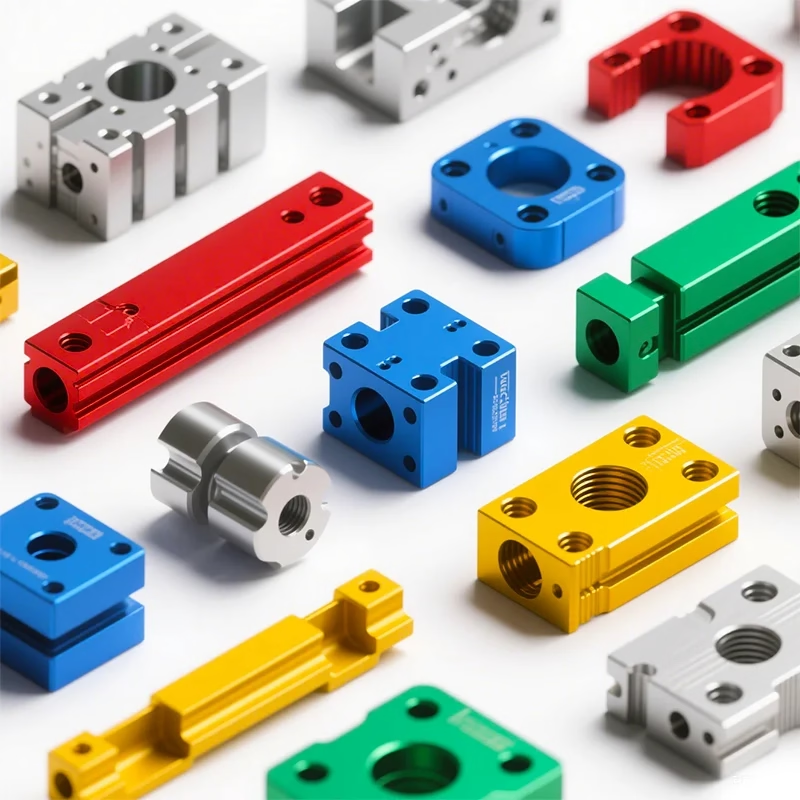
Anodizing, electroless nickel and other plating, powder coating, black oxide, bead blasting, tumbling, brushing, polishing, and laser marking with a minimum character height of 1.5 mm are all available.
Keeping finish in the same supply chain removes one freight leg and one source of damage between operations.
Send the drawing, get a quote in 12 hours
Upload your files and we will return pricing plus a free DFM analysis. No minimum order quantity, NDA available on request, and 100% inspection before shipment.
12-hour quoteNo MOQ100% inspection±0.005 mm
More from GreatLight
We publish setup notes, tooling trials and inspection data from the factory floor.











