
Should I Buy a 2D or 3D CNC Machine?
The label on the machine matters less than the axes, the tool orientation and the CAM strategy behind it. This page explains how 2D, 2.5D and 3D cutting actually differ, which part geometry forces you into a 3D machine, and where a 3-axis plus a fixture still wins. Written for engineers and buyers who have to justify the purchase.
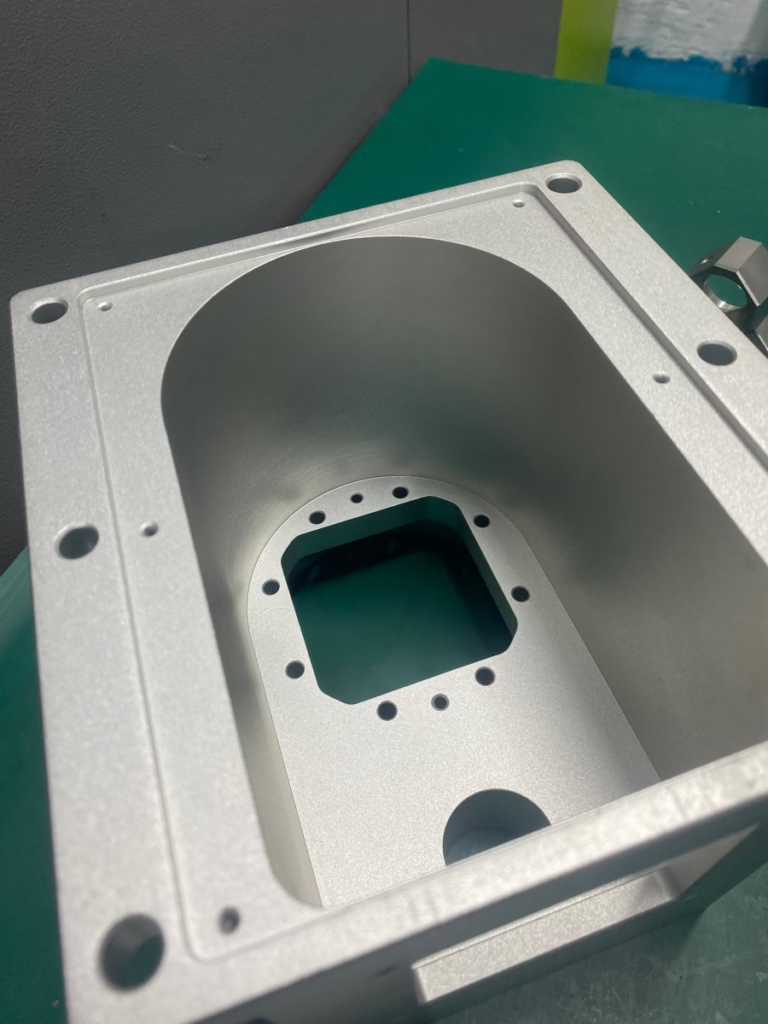
What 2D and 3D Actually Mean on a CNC Machine
A CNC machine does not cut in two or three dimensions. It moves a tool along axes, and each axis adds a direction of travel. A 2-axis lathe moves X and Z. A 3-axis mill moves X, Y and Z. Adding a rotary axis gives the tool or the table a fourth direction, and a fifth axis tilts the tool so it can approach a surface from an angle instead of straight down.
People still say 2D or 3D CNC machine because that is how the part looks on a drawing. A flat bracket with holes is a 2D part. A turbine blade, an impeller or a dental implant is a 3D part. The confusion starts when a flat part needs a 3D machine, or a curved part can be cut on a 3-axis machine with the right fixture.
The practical question is not how many dimensions the part has. It is how many tool orientations the surfaces need. If every surface you must cut faces the spindle, a 3-axis machine can finish the part. If some surfaces turn away from the spindle, you need either a rotary axis or a second setup.
One more term is worth keeping: 2.5D. That is a 3-axis cut where the tool steps down in Z at fixed depths. It produces pockets, slots, counterbores and stepped profiles. Most machined parts in the world are 2.5D, and they run fastest on a 3-axis machine.
Which Part Geometry Forces You Onto a 3D Machine
Start with the surfaces that must be machined after the part is clamped. A face that points along X or Y is easy. A face that points along Z is easy. A face that points at 37° from the spindle has to be reached by tilting the tool or tilting the part, and that is where the axis count climbs.
Compound curvature is the second trigger. A surface curved in two directions at once cannot be cut with a flat or ball end mill in a single pass without leaving scallops, so the CAM system has to step the tool across the surface. This works on a 3-axis machine as long as the surface stays visible from above.
Undercuts and re-entrant features are the third trigger. If the tool has to reach behind a wall, under a flange or into the side of a pocket, a 3-axis machine needs a second or third setup, and each setup adds fixture error. A 4-axis or 5-axis machine reaches the feature by rotating the part or the tool instead of re-clamping it.
Deep cavities with steep walls are the fourth trigger. As the wall angle passes roughly 30° from vertical, a ball end mill on a 3-axis machine can no longer reach the bottom corner without a long, thin tool that deflects. Tilting the tool shortens the effective reach and keeps the cut stable.
Setup Count and Tolerance Stack-Up
Every time a part leaves the table, it gains error. The vise or fixture repeats to perhaps 0.02 mm on a good day, and a soft jaw that was skimmed for one part may not repeat at all for the next. A 2.5D part in one setup holds tight position between features. The same part in three setups holds position only as well as the fixture repeats.
This is why the axis decision is really a setup decision. A 4-axis machine with a rotary table turns a four-sided part into a single setup. A 5-axis machine turns a five-sided part with angled holes into a single setup. You are not buying dimensions. You are buying the ability to keep the part clamped while more of it gets cut.
Position tolerance is where this shows up first. Holes on one face at ±0.05 mm are easy on a 3-axis machine. A hole on one face and a mating bore on the opposite face at ±0.02 mm relative to each other can be painful across two setups, even though each feature alone is simple.
Surface finish follows the same logic. A tool that reaches a surface at an angle leaves a different scallop pattern than one that approaches it straight. On a 5-axis machine the tool can be kept normal to the surface, which spreads the stepover evenly and holds Ra 0.8–1.6 μm with fewer polishing hours.
For parts that stay flat, none of this matters. A 3-axis machine with a good fixture will out-cut a 5-axis machine on a plate every time, because the table never has to index and the tool never has to tilt.
CAM, Tool Access and Programming Load
A 3-axis toolpath is a sequence of passes at fixed Z depths. It is easy to check, easy to post-process and easy to prove out on the machine. A 5-axis toolpath adds two rotary values to every block, and the CAM system has to check the tool holder against the part and the table for every one of them.
That collision check is where the real cost sits. A 3-axis job might need 20 minutes of programming for a simple bracket. A 5-axis job with a deep cavity can need several hours, plus a simulation pass. The machine time saved on the floor is real, but it is paid for partly in the office.
Tool access is the other half. Short tools cut better. A 5-axis machine can tilt a short tool into a deep pocket and keep the flute length engaged, which raises the stable depth of cut and reduces chatter. On a 3-axis machine the same pocket needs a long tool, and long tools ring.
Post-processor quality matters as much as the CAM seat. A poor post on a 5-axis machine produces jerky rotary moves, and the surface shows it. Before buying, ask what post the reseller provides for your control and whether they will tune it against a test part.
For most shops the honest split is this: 3-axis programming for flat and prismatic work, 5-axis programming for curved, angled and undercut work. Mixing the two on one machine is possible, but the operator has to know which strategy is running.
Cost Structure and Where the Money Goes
The purchase price is the smallest part of the decision. A 3-axis vertical mill is a mature product with many builders, so the spread between a basic and a good one is narrow. A 5-axis machine adds rotary drives, a stiffer structure and a control that can keep five axes in sync, and the price reflects all three.
Tooling follows. A 5-axis machine rewards the use of shorter, more rigid tools and often needs more of them, because the CAM system will reach for a smaller cutter to get into a corner. A 3-axis machine running 2.5D work tends to use fewer, larger tools and cheaper inserts.
Fixtures run the other way. A 3-axis shop spends money on vises, soft jaws, angle plates and dedicated fixtures for every extra setup. A 5-axis shop spends less on fixtures because the rotary axes do the positioning, and it can often hold a part in a simple dovetail or a self-centering vise.
Labor is the last line. A 3-axis operator can be trained on the machine in weeks. A 5-axis operator has to read a simulation, understand tool axis control and know when a rotary move is about to crash. Skilled operators cost more and are harder to replace.
The break-even is not a formula. It is a question of how many parts per year need angled or curved features. If that number is small, outsource those parts and keep the 3-axis machines busy on the flat ones.
How to Decide in Five Steps
Work through these before you request a machine quote.
- 1List the machined surfacesMark every surface that must be cut after the final clamp. Note which direction each one faces relative to the spindle.
- 2Count the tool orientationsOne orientation means 3-axis. Two or three means a rotary axis or extra setups. Four or more, spread around the part, means 5-axis.
- 3Check the wall anglesAny wall beyond roughly 30° from vertical, or any undercut, pushes toward a tilting spindle to keep the tool short.
- 4Tally the annual volumeUnder a few hundred angled parts per year, outsourcing usually beats a machine payment. High repeat volume changes the math.
- 5Price the fixtures you avoidAdd up the vises, soft jaws and angle plates the 3-axis route needs. That number often closes part of the price gap.
Machine Choice by Part Feature
Match the feature first, then the machine.
| Part feature | 3-axis (2.5D) | 4-axis | 5-axis |
|---|---|---|---|
| Flat plate, holes on one face | Ideal, one setup | Not needed | Not needed |
| Pockets and steps, all faces up | Ideal, fast cycle | Not needed | Not needed |
| Features on 3 or 4 sides | 2-3 setups, fixture error | Good fit | Also works, higher rate |
| Cylindrical part with cross holes | Difficult to hold | Good fit | Good fit |
| Compound curved surface, visible from above | Ball end mill, scallops | Rarely helps | Better surface, fewer tools |
| Undercut or re-entrant wall | Extra setups | Partial reach | Cleanest solution |
| Impeller, blade, implant | Not practical | Limited | Required |
| Wall angle over 30° from vertical | Long tool, chatter risk | Partial help | Shorter tool, stable cut |
The Short Answer
If your parts are flat or prismatic and every machined face points at the spindle, buy 3-axis and spend the savings on fixtures and tooling. If the part has compound curves, undercuts or features around four or more sides, buy 5-axis, because the extra setups will cost you more in scrap and inspection than the machine costs in payments.
Common Questions
Can a 3-axis machine cut a curved 3D surface?
Yes, as long as the surface faces the spindle. The CAM system steps a ball end mill across the surface in a raster or spiral pattern, and the tool follows the curve in Z.
The limits are reach and finish. Steep walls force a longer tool that deflects, and the scallop height between passes sets how much polishing is needed afterward.
Is a 4-axis machine a cheaper route to 5-axis work?
Sometimes. A 4-axis machine with a rotary table handles cylinders with cross holes and parts with features on three or four sides in one setup.
It cannot tilt the tool, so compound curved surfaces and undercuts still need either a second setup or a 5-axis machine. If your parts are round and drilled, 4-axis is often the right buy.
Does 5-axis always give a better surface finish?
No. It gives you the option to keep the tool normal to the surface, which spreads the stepover and reduces scallops on curved geometry.
On a flat face, a 3-axis machine with a rigid setup will match or beat it, because the tool is already normal to the surface and the machine is stiffer in that direction.
What tolerance can I expect from each machine type?
Axis count does not set the tolerance. Machine geometry, thermal stability and the fixture do. Our shops hold ±0.005 mm (±0.0002 in) on production work across 3-axis, 4-axis and 5-axis machines.
A 5-axis machine earns its price on position tolerance between features, because it cuts them in one setup instead of three.
Should I buy a machine or outsource the 3D parts?
Run the numbers on annual volume and part mix. If angled or curved work is a small share of the year, outsourcing keeps capital free and avoids a skill gap.
If it is most of the year, the machine pays back in setup time and inspection. Many shops start by outsourcing and buy once the volume is predictable.
Do I need a 5-axis machine to machine an impeller?
A closed impeller with twisted blades needs simultaneous 5-axis motion. The tool has to tilt along the blade passage to reach the hub without gouging.
An open impeller or a simple blade profile can sometimes be done on a 4-axis machine with indexed rotary moves. It depends on how much twist and how much overlap the blades have.
Send the Drawing, Get a Process Answer
Upload your CAD file and we will tell you which machine the part should run on, with a DFM note and a quote inside 12 hours. No minimum order quantity, from one prototype to 10,000+ parts.
12-hour quote and DFM±0.005 mm tolerance100% inspection before shipment
More Process Notes
We publish setup notes, tooling trials and inspection data from the factory floor.











