
China Stainless Steel CNC Machining Wholesaler: 5 Checks
Five checks that separate a real factory from a trading desk. Written for engineers and sourcing staff who order 303, 304, 316L, 17-4PH or 440C parts in runs from one piece to 10,000+.
In this article
- 1
- 2
- 3
- 4
- 5
- 6
- 7
- 8
Key takeaways
Sourcing criteria at a glance
Match the column to the part you actually need made.
| Criterion | What good looks like | Red flag |
|---|---|---|
| Stock form | Bar, plate and tube in 303/304/316L on hand | Buyer sources material after order |
| Grade coverage | 303, 304, 316L, 17-4PH, 440C all quoted | Only 304 offered regardless of part |
| Spindle capacity | 16 simultaneous 5-axis centers | One machine runs every job |
| Tolerance | ±0.005 mm held on stainless | Tolerance quoted only for aluminum |
| Finish range | Ra 0.2–0.8 μm when called out | One finish for all features |
| Inspection | 100% before shipment, reports on request | Sample check only |
| MOQ | One prototype to 10,000+ parts | Minimum lot forced on first order |
| Quote detail | Material, finish, inspection, lead time listed | Single number with no breakdown |
Why grade choice decides the whole job
Stainless is not one material. 303 machines freely because of its sulfur content, but that same sulfur limits weldability and corrosion resistance. 304 is the general-purpose grade, and 316L adds molybdenum for chloride exposure. A wholesaler who quotes the same feed and speed for all three is not reading your drawing.
The harder grades change the plan. 17-4PH arrives in condition A and needs a solution treat plus aging to reach its strength, and that heat treat moves dimensions. 440C is a bearing-grade martensitic steel: it cuts well in the annealed state and then distorts during hardening. Both grades need machining stock left on critical faces.
Ask what stock form the quote assumes. Bar stock suits turned parts like shafts and fittings. Plate suits manifolds and housings. If your part starts as a 60 mm bar and the shop plans to cut it from plate, you pay for removed material and lose grain direction.
One more check: does the quote name the grade the way you wrote it? SUS630 and 17-4PH are the same alloy. A supplier who treats them as different items is working from a catalog, not a material certificate.
Cutting behavior and what it does to your features
Stainless work-hardens. A light pass that rubs instead of cutting raises surface hardness and dulls the next insert, so shops that run stainless well keep a minimum chip load and avoid dwelling in the cut. This matters most in deep pockets and thin walls, where the tool has little support.
Thermal growth is the second issue. Stainless conducts heat poorly, so heat stays at the cutting edge. On a 200 mm long bore, the part can grow enough to move a tight tolerance if the shop measures while the part is still warm. Good shops rough, cool, then finish.
Threads and small holes are where grade choice bites hardest. Tapping 316L in a blind hole at M4 or smaller breaks taps when the hole is drilled undersize or the tap runs dry. A supplier who has run these features before will ask about thread depth and coolant access before quoting.
Surface finish interacts with function. A Ra 0.8–1.6 μm finish is normal for sealing faces and sliding bores. Ra 0.2–0.8 μm is reserved for optical and seal-critical surfaces. If a quote applies a fine finish to every face, you are paying for polishing you do not need.
Capacity: what wholesale actually requires
The word wholesaler implies volume. Volume comes from machines that can run in parallel and from a shop that plans tooling around your part rather than around its own convenience. Ask how many spindles can be assigned to your order in a given week.
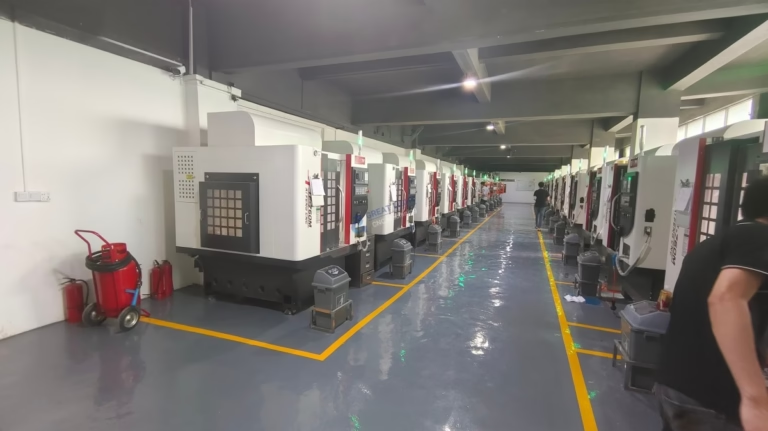
For stainless parts with several faces, a 5-axis center removes the part-handling error that comes from moving between fixtures. A shop with 16 simultaneous 5-axis machining centers can hold position across five faces in one setup. That matters for pump bodies, valve blocks and manifolds.
Size range also matters. A 4,000 mm maximum processing size covers long shafts and structural rails. Medium travels like 750 × 1,150 × 550 mm and 600 × 600 × 600 mm cover most housings. Compact machines handle small fittings where cycle time rules.
Fixture cost is the hidden line item. On a 500-piece run, a soft jaw or dedicated fixture adds cost once and saves it many times. On a 5-piece run, it does not. A shop that tells you which case you are in is doing the analysis for you.
Quality systems and how they apply to stainless
Certificates on a wall mean the system exists. They do not mean your batch was checked. Ask for the inspection plan tied to your part number: which dimensions are measured, with what instrument, and at what frequency. Stainless parts that see pressure or motion need that plan written down.
For medical work, ISO 13485:2016 changes documentation, cleaning and traceability rules. For automotive, IATF 16949:2016 adds process capability and change control. A wholesaler that holds both can serve two very different customer sets without rebuilding its paperwork each time.
Material traceability is the practical test. A melt lot number should follow the stainless from incoming inspection to the shipping carton. Without it, a corrosion failure six months later cannot be traced to a heat of steel.
Inspection coverage should be stated as a percentage, not as a habit. 100% inspection before shipment, with raw material check, in-process monitoring and final inspection, is what a wholesale order needs. Reports should be available on request rather than promised verbally.
Quote terms, MOQ and confidentiality
Read the quote as a document, not a number. It should list material grade and stock form, finish callout per face, tolerance on critical dimensions, inspection method, and lead time. If any of those are missing, you will discover the gap after the parts arrive.
MOQ tells you how the shop schedules. A supplier with no minimum order quantity runs one prototype and a 10,000+ part run on the same floor. That flexibility usually means the shop owns its machines instead of brokering work.
Confidentiality should be available before you send CAD. An NDA on request and secure handling of uploads protect your design. For work under an existing NDA with your own customer, confirm the shop can work under a flow-down.
Lead time deserves a second look. A quotation and free DFM analysis within 12 hours, production starting within 24 hours and parts shipping in 3–5 days describe a shop with open capacity. Ask what happens to that schedule when a large order lands.
How to vet a wholesaler in five steps
Run these in order. Each step filters out a class of supplier.
- 1Send a real drawing with grades namedInclude the stainless grade, stock form, critical tolerances and finish callout. See whether the reply asks questions or just returns a number.
- 2Request the DFM analysisA free DFM within 12 hours shows whether the shop reads features. Look for comments on wall thickness, thread depth and datum choice, not generic notes.
- 3Ask for the inspection planName the dimensions you care about and ask how they are measured. Expect a list of instruments and frequencies, plus a report on request.
- 4Confirm material traceabilityAsk how the melt lot number is recorded and whether it appears on the shipping documents. This is the difference between a batch and a guess.
- 5Run a small order firstOrder one to five parts before committing to volume. Check the finish on a sealing face, the thread fit and the dimensional report against your drawing.
- 6Review the terms before scalingConfirm MOQ, lead time, NDA coverage and what happens on a schedule change. Then place the volume order with the same drawing revision.
Questions buyers ask before ordering
Which stainless grade should I specify for a machined housing?
304 covers most indoor housings and general hardware. Move to 316L when the part sees chlorides, washdown or marine air. Use 303 only when machinability outweighs corrosion resistance, such as bushing-type parts with no welding.
Can a wholesaler hold ±0.005 mm on stainless parts?
Yes, on features that are accessible and stable after thermal cooling. Very thin walls, long unsupported bores and parts that are heat treated after machining are harder. Discuss which dimensions are truly critical before quoting.
What does no minimum order quantity actually mean?
It means the shop will run one prototype and a 10,000+ part run without forcing a minimum lot. Expect the per-piece price to fall as volume rises, because fixture and setup cost is spread across more parts.
How do I check that the material is really 316L?
Ask for the mill certificate and the melt lot number on the shipping paperwork. A shop that records traceability from incoming inspection to the carton can produce both without a special request.
Do I need an NDA before sending CAD files?
Send an NDA first if the design is yours or your customer's. A supplier that offers an NDA on request and treats uploads as confidential is set up for this. Flow-down terms from your own customer should be agreed in writing.
What finish should I call out on a stainless sealing face?
Ra 0.8–1.6 μm suits most sealing and sliding faces. Reserve Ra 0.2–0.8 μm for optical surfaces and seal-critical grooves. As-machined Ra 1.6–3.2 μm is fine for non-contact faces and saves cost.
Send your stainless drawing and get a quote
Quotation and free DFM analysis within 12 hours. Production can start within 24 hours, and parts ship in 3–5 days.
12-hour quote100% inspectionNDA on request
More from the shop floor
We publish setup notes, tooling trials and inspection data from the factory floor.











