
The Difference Between the CNC Cut and the Traditional Cut
A practical comparison of the CNC cut and the traditional cut for engineers and buyers. We cover how each method holds tolerance, what setup really costs, where each one fails, and how to pick for a given part.
In this article
- 1
- 2
- 3
- 4
- 5
- 6
- 7
- 8
The CNC Cut and the Traditional Cut Compared
Values are typical shop-floor ranges, not guarantees for every geometry.
| Point | CNC cut | Traditional cut |
|---|---|---|
| Tolerance held | ±0.005 mm on a controlled process | 0.5–2 mm by hand, varies by operator |
| Setup time | Program, fixture and first article | Mark, clamp and cut, ready in minutes |
| Per-part cost at 100 pcs | Falls sharply once programmed | Stays flat, mostly labor |
| Edge quality | Ra 0.8–1.6 μm off the tool | File and deburr work needed |
| Repeatability | Same result on part 1 and part 5,000 | Drifts with fatigue and tool wear |
| Material waste | Nest to 70–90% yield on sheet | Kerf and rework lose more |
| Best fit | Repeated parts, tight features | One-offs, field repair, odd shapes |
What Each Method Actually Does to Metal
A traditional cut removes material with a tool guided by a person. A hacksaw, a band saw with a hand feed, a shear, a chisel, an abrasive disc. The operator reads a scribed line, watches the kerf, and adjusts pressure by feel. Nothing is wrong with that. It is how most of the built world was made before 1970.
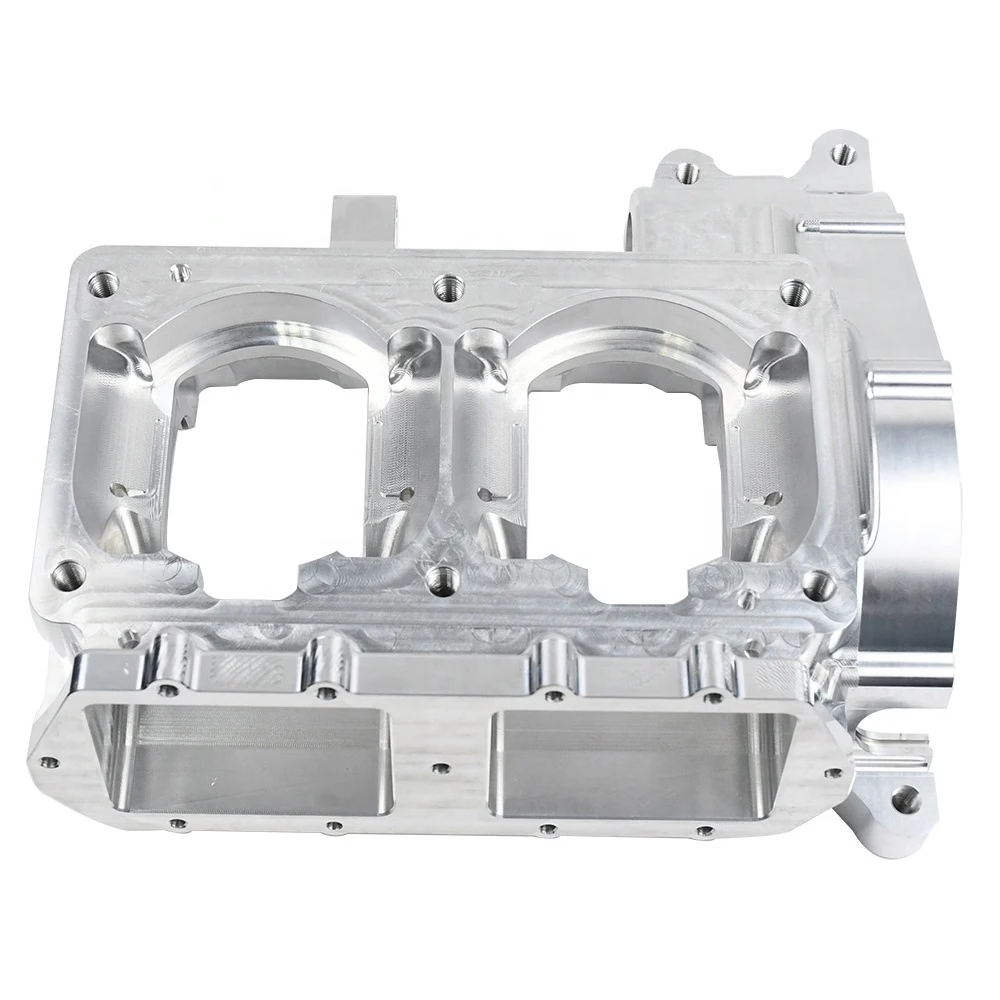
The CNC cut replaces the hand with a program. Coordinates from a CAD model drive the axis motors, and the tool follows the same path every cycle. On our 5-axis centers the tool can tilt, so undercuts and compound angles come off in one setup instead of three.
The physical difference is not the cutter. A band saw blade and a CNC band saw blade look alike. The difference sits in who decides where the tool goes next, and how precisely that decision repeats.
That single change drives almost everything else on this page: tolerance, cost curve, scrap rate, and how much of the quality depends on the operator that day.
- 1Manual pathPosition set by eye and feel, corrected mid-cut.
- 2Programmed pathPosition set by coordinates, corrected in the file.
- 3Same tool, different controlBlade or cutter type is often identical.
Tolerance and Fit: Where the Gap Shows Up
Hand cutting holds roughly 0.5–2 mm on a straight cut, and the spread depends on operator skill, blade condition and how tired the shift is. A good fitter with a sharp blade can hit 0.5 mm on a short cut. Over a 1,000 mm length, thermal drift and blade wander push that outward.
A controlled CNC process holds ±0.005 mm on critical features. That number only applies where the fixture is rigid, the tool is fresh, and the feature is reachable by the machine. A deep pocket in a thin wall will not hold it.
The practical question is not which number is smaller. It is whether your assembly needs it. A weld prep or a bracket clearance slot does not care about 0.05 mm. A bearing bore, a dowel hole or a mating flange does.
When a drawing carries a tight fit, that fit has to be machined, not cut to a line. Anything else puts the tolerance in the hands of whoever is holding the tool.
- 1Loose fitsHand cutting is fine for clearance and weld prep.
- 2Pilot holes and boresCNC, then ream or bore in the same setup.
- 3Long partsTolerance drifts with length on manual work.
Cost Curve: Why the Numbers Flip at Volume
Manual cutting has almost no setup cost. You pick up the tool and start. That is why it wins on a single bracket, a repair plate, or a one-off fixture in the maintenance shop.
CNC has front-end work: CAD clean-up, CAM programming, fixture design, a first article. On a simple 2D profile that is a short job. On a 5-axis contour with a dozen features it is not. You pay for it once.
After that, the marginal cost per part drops fast. Cutting the second part costs the cycle time plus material. Cutting the hundredth costs the same. Manual work does not behave that way — the hundredth cut costs the same as the first, because the labor is the same.
So the crossover sits wherever the saved setup stops mattering. For simple profiles it is often a handful of parts. For complex geometry with several setups, it can be 20 to 50 parts before CNC pulls ahead on total spend.
- 1One part, one cutManual is hard to beat on total cost.
- 2Ten identical partsProgramming usually pays back here.
- 3Complex geometryCrossover moves later, 20–50 parts.
Edge Quality, Burrs and Rework
A hand-cut edge carries saw marks, a burr on the exit side, and a slight taper through the thickness. In structural work nobody cares. In a visible enclosure or a sliding fit, somebody has to file it, which is labor you did not quote.
A CNC cut leaves a controlled edge. On aluminum we typically see Ra 0.8–1.6 μm off the tool, or Ra 0.2–0.8 μm after a finishing pass. Burrs are smaller and predictable, so deburring becomes a short, repeatable step instead of a judgment call.
Rework is the hidden line item. Manual cutting generates scrap when a line is misread, and it generates rework when an edge needs correction. Both consume the same skilled hour.
If the part is cosmetic, or if it slides against another part, budget for edge finishing either way. CNC just makes that budget smaller and steadier.
- 1Structural edgesSaw finish is acceptable.
- 2Visible or slidingPlan for deburr and finish.
- 3Tight burr limitsCNC plus a defined deburr step.
Repeatability, Records and Audits
Run 5,000 parts manually and the first and last will differ. Not because anyone got worse, but because blade wear, fixture slip and fatigue all accumulate. You can inspect your way around it, at a cost.
A CNC program produces the same path every cycle until a tool wears out, and tool wear is measurable. Change the insert on a schedule and the spread stays inside the tolerance band. On our runs we hold a 99.99% qualification rate with 100% inspection before shipment.
Records matter in regulated work. Aerospace, medical and automotive programs want to see the inspection report, the material cert and the revision of the program that made the part. A hand-cut part has a signature and a date. That is a thinner paper trail.
If your customer or your quality system asks for traceability, the method choice is partly made for you.
- 1Prototype or jigManual record is often enough.
- 2Regulated productionProgram revision plus inspection data.
- 3Tool wearScheduled changes keep spread tight.
Materials and Geometry: When Hand Cutting Still Wins
CNC is not always the answer. Thick plate in a awkward position, a pipe already welded into a frame, a field repair on a machine that cannot be moved, a one-off art piece with an organic curve — these are manual jobs, and forcing them onto a machine wastes money.
There is also a size ceiling. Our largest travel is 4,000 × 400 × 150 mm, and the 5-axis centers cover 750 × 1,150 × 550 mm. Beyond the envelope, the part has to be split, repositioned, or cut another way.
Material matters too. Aluminum 6061, 7075 and 6082 cut clean. Stainless 304 and 316 work-harden, so a hand saw that dwells will glaze the surface and make the next pass harder. Titanium and Inconel punish light feeds.
Pick the method after you look at the part, not before.
- 1In-place repairHand tools reach where a machine cannot.
- 2Over 4,000 mmSplit the part or change process.
- 3Work-hardening alloysSteady CNC feed beats hand dwell.
How to Choose: 5 Steps
Run these in order; most parts settle at step 3.
- 11. Read the tightest toleranceIf it is looser than ±0.2 mm and non-critical, manual cutting is on the table.
- 22. Count the partsOne to five simple parts favors manual. Ten or more favors CNC once programmed.
- 33. Check the geometryCompound angles, undercuts or 3D contours point to 5-axis CNC in one setup.
- 44. Check the envelopeConfirm the part fits 4,000 × 400 × 150 mm or 750 × 1,150 × 550 mm before quoting CNC.
- 55. Check the paperworkIf a cert, inspection report or program revision is required, plan for CNC.
The Verdict
For one-off parts, field repairs or anything where the fit is loose, the traditional cut is cheaper and faster. For repeated parts, tight bores, compound angles or anything that needs an inspection record, use the CNC cut. If you are between the two, send the drawing and we will tell you which side it lands on.
Frequently Asked Questions
Can a hand-cut part ever hold ±0.05 mm?
Not reliably, and not across a batch. A skilled operator can sometimes hit it on one short cut with a fresh blade and a good guide. The next part will not match.
If the drawing calls for ±0.05 mm, plan a machining operation after cutting. Cut oversize by 0.5–1 mm and machine to the line.
Does the CNC cut always cost more than the traditional cut?
On a single part, usually yes, because you pay for programming and fixturing once.
From roughly ten identical parts upward the picture flips for simple profiles. For complex geometry the crossover often lands between 20 and 50 parts. Send the quantity with the drawing and we quote both sides.
What file do you need to program a CNC cut?
A STEP or IGES 3D model is ideal. A 2D DXF works for flat profiles and sheet parts. PDF drawings help us read tolerances, datums and finish callouts.
We run a free DFM analysis within 12 hours of receiving the files, and flag any feature that cannot be cut as drawn.
Which materials are hard to cut by hand?
Stainless 304, 316 and 17-4PH work-harden. A hand blade that rubs instead of cutting glazes the surface and makes the next pass harder.
Titanium and Inconel behave the same way and also wear blades fast. On those alloys a steady CNC feed with controlled chip load is easier to keep consistent.
How fast can CNC parts ship after the cut is programmed?
Quotation and free DFM analysis come back within 12 hours. Production can start within 24 hours of approval, and parts typically ship in 3–5 days.
There is no minimum order quantity, so a single prototype runs on the same process as a 10,000-part batch.
Do you keep my drawings confidential?
Yes. Uploads are secure and confidential. We can sign an NDA before you send files, and we do not share customer geometry or part numbers.
If your program requires a documented flow-down, ask for it at quote stage and we will set it up.
Send the Drawing, Get a Straight Answer
Tell us the quantity, the tightest tolerance and the material. We will tell you which cut fits and quote it within 12 hours.
12-hour quote100% inspectionNo minimum order
More From the Shop Floor
We publish setup notes, tooling trials and inspection data from the factory floor.











