
The domestic CNC center explained
What a local CNC machine shop actually is, where its limits sit, and how to read a supplier's machine list before you send a drawing. Written for design and sourcing engineers who compare a domestic shop against an overseas one.
In this article
- 1
- 2
- 3
- 4
- 5
- 6
What a domestic CNC center actually is
A CNC center is a machine tool that reads a program and moves its own axes. The operator loads stock, sets the zero, and changes tools; the controller handles the geometry. "Domestic" adds one more variable: the machine sits in the same country or customs region as your engineering team. That single fact changes shipping, inspection and how fast a problem gets fixed.
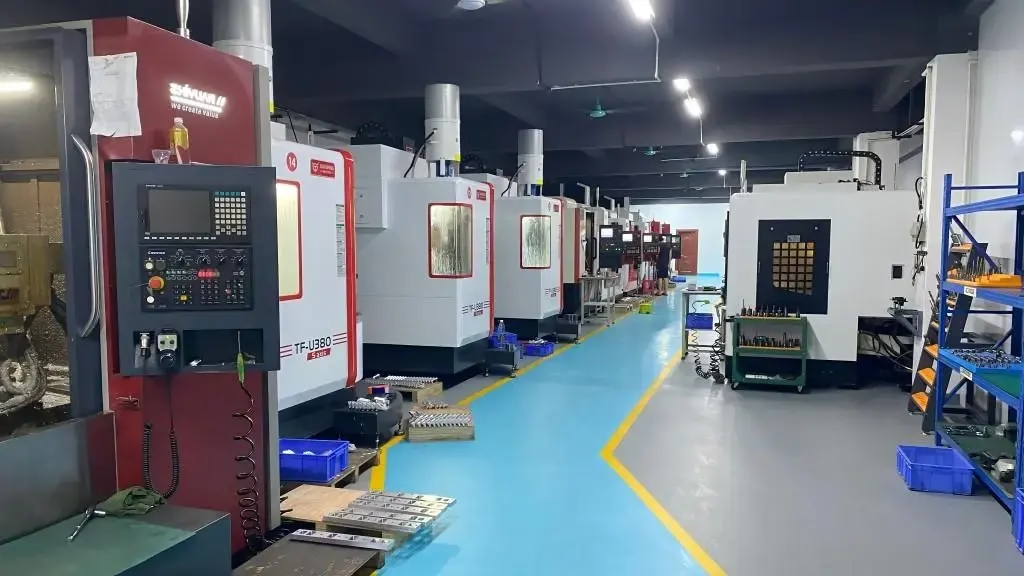
Most people picture one machine. In practice a domestic CNC center is a floor of them, plus the equipment around it. A typical shop runs 3-axis mills for flat work, 4-axis machines for parts that need index positions, mill-turn centers for round parts with milled features, and 5-axis centers for contoured surfaces. GreatLight operates 127 high-precision CNC machines across 3 wholly-owned plants covering 7,600 m².
The definition matters because it sets expectations. A domestic center is not a different machining process. It is the same spindle, the same carbide, the same CAM toolpath. What differs is the logistics loop around the cut: who signs the inspection report, who pays the freight, who answers the phone at 4 pm when a bore comes out 0.01 mm undersize.
So when someone asks for a domestic CNC center explained in one line, this is it: identical machining physics, shorter supply chain. Everything else in this article follows from that split.
- 1Same process, shorter loopMachining physics does not change with geography.
- 2Equipment mix decides fitAxis count and travels, not the country, determine what a shop can cut.
- 3Inspection ownershipA local shop can hand you the report and the part together.
How the machine turns a drawing into a part
Every CNC center runs the same four-stage loop. First, CAM software converts your model into toolpaths and posts them into G-code. Second, the operator proves the setup: vise or fixture, datum edges, tool length offsets, work coordinate zero. Third, the machine cuts, and the controller interpolates the programmed path through closed-loop feedback on each axis. Fourth, the part goes to inspection, and the measured values either close the loop or send it back.
The precision ceiling comes from that loop, not from the brand on the panel. Thermal growth, tool deflection, fixture rigidity and spindle runout all add error. A shop holding ±0.005 mm does it with temperature-stable rooms, sharp tooling and short stick-out, and by measuring rather than assuming. The same machine in a drafty bay with dull cutters will drift to ±0.05 mm.
Axis count changes the setup count, and setup count is where most error enters. A part with features on five faces needs four or five setups on a 3-axis machine. Each re-clamp stacks a new datum error. A simultaneous 5-axis center reaches those faces in one setup, so the tolerance chain stays short. That is the real reason to pay for 5-axis.
Material behavior sets the cutting window. Aluminum 6061 and 7075 run fast with high rake angles and generous coolant. Stainless 316 and 17-4PH work-harden, so the tool must keep moving and never rub. Titanium TC4 (Ti-6Al-4V) burns cutters at the wrong surface speed. Inconel punishes both the tool and the schedule. A domestic shop that cuts these weekly has the speeds and feeds already dialed in.
- 1Setup count drives errorEach re-clamp adds a datum shift to the stack.
- 2Measure, do not assumeIn-process checks catch drift before the run finishes.
- 3Material sets the windowAluminum, stainless and titanium need different parameters.
Where a domestic CNC center fits and where it does not
A domestic CNC center fits parts that carry real geometry: housings, brackets, manifolds, impellers, bone plates, robot end-effectors, EV busbar components, heat-sink plates. If the part has tight bores, true-position callouts, or a surface finish spec like Ra 0.8–1.6 μm, a machined route is usually the shortest path to a conforming part.
It also fits low and mid volume. Setup cost is fixed, so the per-part price falls as quantity rises, but a shop with no minimum order quantity will run one prototype and a 10,000-part batch on the same floor. That matters when a design is still moving and you need ten parts this week, not a tooling commitment.
It fits badly when the geometry is thin-wall sheet at high volume. Stamped or die-cast parts beat machining once annual volume crosses roughly 10,000 pieces and the wall is uniform. It also fits badly when the part is a simple prismatic block with loose tolerance and the only real requirement is the lowest unit price. In that case the machining route is correct but the domestic premium buys you nothing.
The honest boundary is this: choose a domestic CNC center when the part is hard, the tolerance is tight, the volume is low to mid, or the schedule is compressed. Choose offshore when the part is easy, the volume is high, and you can absorb a long freight and inspection cycle.
- 1Good fitComplex geometry, tight tolerance, low to mid volume.
- 2Poor fitThin-wall sheet or simple blocks at very high volume.
- 3Tie-breakerIf a revision is likely, proximity usually wins.
What to verify before you place the order
Ask for the machine list, not a brochure. You want axis count, travels and spindle speed per machine. A shop with 16 simultaneous 5-axis centers, 12 four-axis mills and 27 three-axis machines can route work sensibly. A shop with one 5-axis machine and a long queue will route your job onto a 3-axis machine and add setups you did not budget for.
Check the largest envelope against your part. GreatLight runs a 4,000 mm maximum processing size and a large travel of 4,000 × 400 × 150 mm, plus medium travels of 750 × 1,150 × 550 mm and 600 × 600 × 600 mm. If your part is 900 mm long, a shop capped at 600 mm will either split the part or decline it. Ask early.
Ask how inspection is done. 100% inspection before shipment, with raw material check, in-process monitoring and a final report, is the baseline for a real domestic CNC center. Reports on request is fine; reports never offered is a warning.
Check the quality system against your industry. ISO 9001:2015 covers general manufacturing. IATF 16949:2016 matters for automotive and EV. ISO 13485:2016 matters for medical devices. ISO 27001:2022 covers information security, which is what protects your drawings. If your part is regulated, an uncertified shop adds audit work to your plate.
- 1Machine list, not brochureAxis count and travels decide whether your part fits.
- 2Envelope checkCompare your longest dimension against the stated travel.
- 3Certification matchRegulated parts need the matching standard.
Local versus offshore: the real trade-off
Offshore machining wins on unit price for simple, high-volume parts. The gap is real and it comes from labor rates and scale. What you pay for instead is time: weeks of ocean freight, a customs window, and an inspection that happens after the parts have already crossed an ocean. If a dimension is wrong, you find out late and the rework round trip is long.
A domestic CNC center trades some of that unit-price advantage for a short loop. Quotation and free DFM analysis come back within 12 hours. Production can start within 24 hours. Parts ship in 3–5 days. If a drawing has an undercut tool problem, an engineer flags it before the spindle turns, and you fix the model instead of scrapping the run.
The break-even depends on part complexity more than on quantity. For a simple bracket at 50,000 pieces per year, offshore tooling and freight usually pay off. For a 5-axis impeller at 200 pieces per year with a ±0.005 mm bore, the local option is cheaper once you count scrap, air freight and engineering time.
One more factor: confidentiality. Uploads are secure and confidential, and an NDA is available on request. For defense-adjacent, medical or unreleased consumer hardware, a domestic shop under NDA is easier to defend in an internal review than an overseas broker with no paper trail.
- 1Offshore wins onSimple geometry, very high volume, price-first sourcing.
- 2Domestic wins onComplex geometry, tight tolerance, short schedule.
- 3Count the hidden costScrap, air freight and engineering hours are real money.
Domestic CNC center explained against offshore machining
Match the part profile to the sourcing route.
| Part profile | Domestic CNC center | Offshore machining |
|---|---|---|
| Simple prismatic part, 50,000 pcs/yr | Correct process, premium buys little | Usually lower unit price |
| 5-axis contoured part, 200 pcs/yr | One setup, short tolerance chain | Multiple setups, more datum error |
| Tolerance at ±0.005 mm | Achievable with in-process checks | Achievable, harder to verify remotely |
| Revision likely within 2 weeks | Model fixed before the run | Change order after freight |
| Medical or regulated part | ISO 13485:2016 available | Audit burden stays with you |
| Schedule under 2 weeks | Parts ship in 3–5 days | Freight and customs dominate |
| No MOQ, one prototype | Runs from 1 piece | Tooling or setup minimums common |
Which route to pick
If the part is complex, tight-tolerance or on a short clock, send it to a domestic CNC center and pay for the short loop. If the part is simple, the volume is high and price is the only lever, go offshore and budget the freight and inspection time.
Domestic CNC center questions engineers ask
Does a domestic CNC center cost more per part than an overseas shop?
For simple parts at high volume, yes. Labor rates and scale favor offshore production, and the gap can be significant.
For complex parts at low to mid volume, the gap narrows or reverses. Fewer setups, less scrap, cheaper freight and shorter engineering loops often outweigh the unit-price difference.
How tight a tolerance can a domestic shop actually hold?
GreatLight holds ±0.005 mm (±0.0002 in) on qualifying features, with surface finish from Ra 0.2–0.8 μm on fine work up to Ra 1.6–3.2 μm as-machined.
The number is only meaningful with the inspection method attached. Ask which features are measured, on what equipment, and whether the report ships with the parts.
What is the largest part a domestic CNC center can machine?
It depends on the machine envelope. GreatLight runs a 4,000 mm maximum processing size, with a large travel of 4,000 × 400 × 150 mm.
Medium travels cover 750 × 1,150 × 550 mm and 600 × 600 × 600 mm, and compact machines cover 500 × 500 × 450 mm and 500 × 310 × 200 mm. Send the bounding box with your RFQ.
Do I need an NDA before sending CAD files?
If the design is unreleased or regulated, yes. Uploads are secure and confidential, and an NDA is available on request.
For most commercial parts an NDA is optional, but it costs little and removes an internal approval blocker later.
Can a domestic CNC center run one prototype and then scale up?
Yes, when there is no minimum order quantity. GreatLight runs from one prototype to 10,000+ part runs on the same floor.
The advantage is that the prototype process, fixture and inspection plan carry into production instead of being rebuilt by a second supplier.
How fast can parts ship?
Quotation and free DFM analysis come back within 12 hours, production can start within 24 hours, and parts ship in 3–5 days.
Historical late-delivery probability is below 2%. Those numbers assume a released drawing and available material, so confirm stock on exotic grades early.
Send a drawing and get a DFM review
Upload your CAD file and we return a quotation with free DFM analysis within 12 hours, then run the parts on the machine that fits the geometry.
12-hour quote100% inspectionNo MOQNDA on request
More machining notes
We publish setup notes, tooling trials and inspection data from the factory floor.











