
Understand 5-axis CNC machining
This page explains how the two rotary axes move, what that changes about tool access and setup count, and where the process stops being worth the hourly rate. Written for design and manufacturing engineers who have to choose a process, not read a brochure.
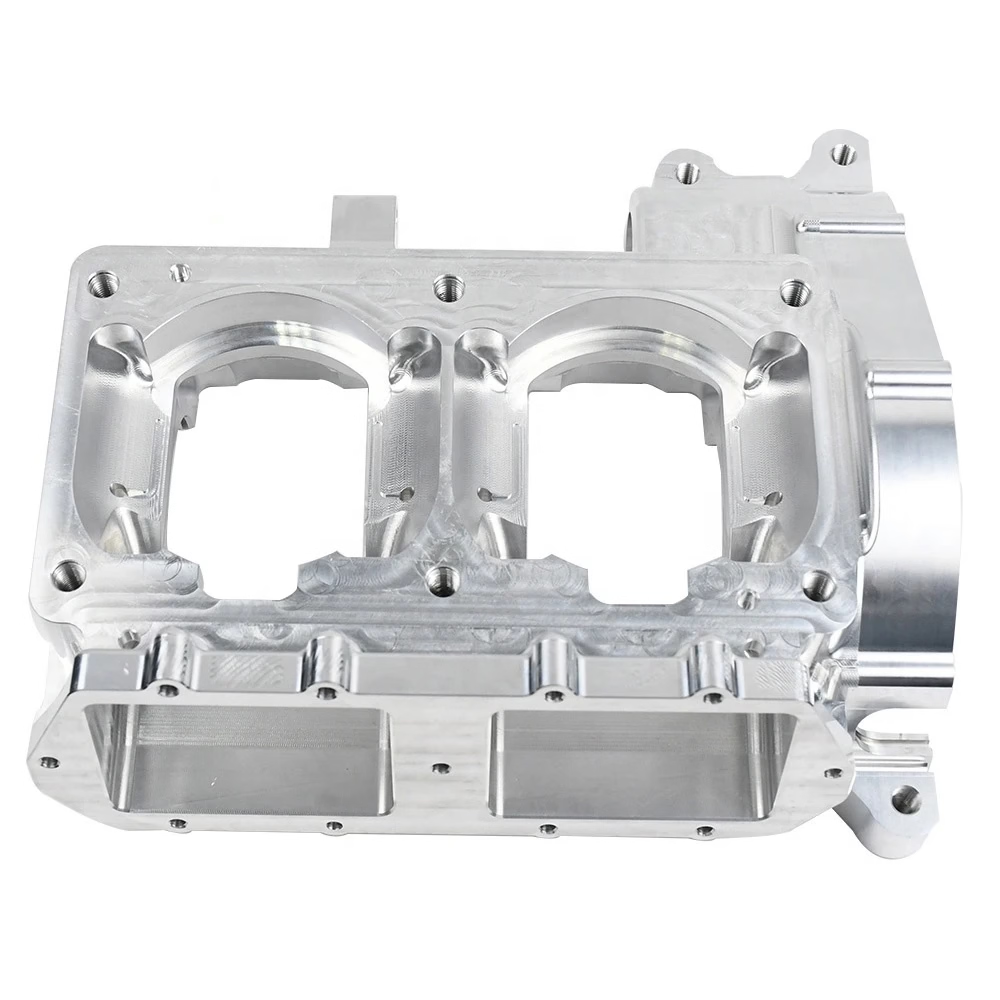
Understand 5-axis CNC machining: what the two extra axes do
A 3-axis mill moves the tool along X, Y and Z while the part sits still. Tool access comes from one direction, so every feature has to face the spindle or be reached by a long, thin tool. A 5-axis machine adds two rotary axes, and those two rotations are what change the process.
Most machines in our shop are trunnion style: the table tilts around A and rotates around C. The tool stays vertical while the part tilts and spins underneath it. Other builders swing the spindle head instead, which suits large single fixtures. Both approaches put the cutting tool at an angle to the surface, and that angle is the whole point.
True simultaneous motion means all five axes interpolate at once, so the tool tip follows a path through space while the part turns under it. That is different from 3+2, often called positional 5-axis, where the table indexes to a new angle and then locks before cutting begins. 3+2 is easier to program and stiffer. Simultaneous motion is slower to prove out but handles contoured surfaces in one pass.
The practical result is shorter tools. A tool that reaches a deep pocket wall at 30° of tilt can be three times the diameter of the same tool held vertically. Short tools deflect less, chatter less and hold size longer. On a part with a 60 mm deep cavity, that single change often decides whether the feature can be cut at all.
Why one setup changes the tolerance stack
Every time a part is unclamped and turned, the new datum carries the error of the first setup plus the error of the fixture. Datum shift of 0.02 mm is normal on a well-built vise, and it stacks with each re-fixture. A part with four faces machined on a 3-axis machine may see four separate datum shifts before it is done.
On a 5-axis machine, the same part often comes off in one or two setups. Features on five faces are cut from the same zero point, so the positional relationship between them is held by the machine, not by the operator. That is where the bore-to-bore and face-to-bore relationships hold to ±0.005 mm in our shop.
This is the part of the process that is hardest to see on a quote. A 5-axis hour costs more than a 3-axis hour, but if it removes three setups, three fixture builds and a rework loop, the total job can still land lower. Runs of 20 to 200 parts usually show this most clearly.
There is a limit. When a part has one critical face and everything else is loose, 3-axis with a simple fixture is cheaper and just as accurate. Buying rotary motion for a part that does not need it is the most common mistake we see in incoming RFQs.
Which geometries actually need five axes
Impellers, turbine blades, medical bone plates, mold cores with drafted walls and engine ports with curved centerlines are the classic cases. What they share is a surface that curves in two directions at once, or a feature whose axis does not line up with any face of the blank. If the tool cannot reach the surface square, you either tilt the part or accept a worse cut.
A second group is parts with many faces and tight relationships between them. A manifold with ports on four sides and a flatness callout across all of them is easier to hold in one rotary setup than in four. The geometry is not exotic. The fixturing is what makes it a 5-axis job.
A third group is simply too large or too heavy to move. On our 4,000 mm machines, a long weldment or extrusion can be indexed under the spindle instead of re-rigged on a crane. Setup time drops, and so does the risk of dropping the part.
What does not need five axes: flat plates, square brackets, parts with all features on one side, and anything with a tolerance looser than ±0.05 mm on secondary faces. Those jobs run faster on a 3-axis mill, and the money is better spent on material or finishing.
Where the process gets hard
Rigidity falls as the part moves away from the rotary center. A trunnion table swinging a 200 kg block out to 45° puts a bending moment on the tilt axis that does not exist at zero. We keep heavy parts close to center and reduce depth of cut rather than push the machine.
Tool reach is the second limit. A ball nose tool cutting a contoured wall at an angle leaves a scallop pattern that depends on stepover, tool radius and tilt. Stepover of 0.2 mm with a Ø6 mm tool at Ra 0.8–1.6 μm is a workable starting point in aluminium. Tighten the finish and cycle time climbs fast.
Programming and simulation are real costs, not overhead. Five-axis toolpaths need full machine simulation, stock models and collision checking before the first cut. On a one-off prototype, that programming can exceed the cutting time. It pays back on the second and third part.
Thermal drift matters on long cycles. A 6-hour cut on a titanium housing will move the machine unless the shop manages warm-up and in-process probing. We probe critical bores between operations rather than trusting the setup from hour one.
3-axis, 3+2 and simultaneous 5-axis side by side
Use this to pick a process before you ask for a quote.
| Factor | 3-axis | 3+2 positional | Simultaneous 5-axis |
|---|---|---|---|
| Typical setup count | 2–4 per part | 1–2 per part | 1 per part |
| Tool length needed | Long, 4× diameter or more | Medium, 3× diameter | Short, 2× diameter |
| Surface finish on curves | Faceted, needs hand work | Good on flat faces | Ra 0.8–1.6 μm as cut |
| Programming effort | Low | Medium | High, needs simulation |
| Undercuts and deep pockets | Often not reachable | Reachable at set angles | Reachable in one pass |
| Hourly rate | Lowest | Middle | Highest |
| Best batch size | 1–10,000+ | 10–500 | 5–500 |
| Weak point | Datum stack-up | Idle time at each index | Collision risk, prove-out time |
The trade-off in one line
If your part has curved surfaces, undercuts or features on four or more faces, choose simultaneous 5-axis and pay for one setup. If it is a flat plate or a simple bracket with loose secondary tolerances, stay on 3-axis and spend the difference on material and finishing.
Common questions about 5-axis work
Does 5-axis machining always give a better surface finish?
Not by itself. Finish comes from tool radius, stepover, feed per tooth and spindle speed. What five axes add is the ability to keep the tool at a consistent angle to a curved surface, which removes the faceting you get when a ball nose tool changes contact angle across a sweep.
On flat faces, a 3-axis cut with a face mill will beat a tilted ball nose pass every time. Use the rotary axes where the surface curves, not everywhere.
How much does a 5-axis setup add to the price of a part?
The machine hour is higher than a 3-axis hour, and programming plus simulation adds front-loaded time. On a single prototype, that can dominate the quote.
On runs from 20 to 200 parts, the removed setups and fixtures usually offset it. Ask for both process routes quoted so you can compare total cost, not hourly rate.
Can every material be cut on a 5-axis machine?
We run aluminium 6061, 7075 and 2024, stainless 303, 304, 316L and 17-4PH, steels including 4140 and 4340, titanium Ti-6Al-4V, Inconel, copper alloys and engineering plastics such as POM and PEEK.
The limit is not the axis count, it is the cutting parameters. Titanium and Inconel need lower surface speed, more coolant and lighter radial engagement, which stretches cycle time.
What tolerance can I expect on a curved surface?
On a rigid setup with in-process probing, we hold ±0.005 mm on critical bores and faces. Contoured surfaces are usually specified with a profile tolerance and a surface finish rather than a single size callout.
Give the drawing with the datum scheme you intend. A 5-axis process can only hold relationships between features it cuts in the same setup.
Do I need to model the part differently for 5-axis?
No, but a clean solid with sharp edges and a stated datum helps. Send STEP or IGES plus a PDF drawing with GD&T.
We return a free DFM analysis within 12 hours, flagging features that will be slow, unreachable or better moved to another process.
Send the part and we will tell you which process fits
Upload your model and drawing. You get a quotation and a free DFM analysis within 12 hours, with a note on whether the job should run on 3-axis, 3+2 or simultaneous 5-axis.
12-hour quote100% inspectionNo minimum order quantity
More machining notes
We publish setup notes, tooling trials and inspection data from the factory floor.











