
What Are the Common Types of CNC Machines?
Six machine families do most of the work in a contract shop, and each one removes metal in a different way. Here is how to tell them apart by part geometry, tolerance and volume, so you can pick the right process before a quote is issued.
In this article
- 1
- 2
- 3
- 4
- 5
- 6
- 7
How a CNC machine family is defined
Every CNC machine follows the same control loop: a CAM program outputs coordinates, the controller drives servo motors, and a cutting tool removes material along the path. What changes between machine families is how many axes move at once, whether the tool or the workpiece rotates, and how the part is held. Those three variables decide which geometries are practical and which are not.
The common types of CNC machines fall into subtractive families: milling, turning, mill-turn, multi-axis machining centers, EDM and routers. Each family removes material with a different tool-workpiece relationship, and that relationship sets the tolerance floor, the achievable surface finish and the cost per part.
A mill spins a tool against a stationary workpiece. A lathe spins the workpiece against a stationary tool. That single difference explains why round parts are turned and prismatic parts are milled. Once you know the family, you know which features are easy, which are slow, and which require a second setup or a different machine entirely.
Axis count matters more than machine size for most jobs. Three axes cut prismatic faces, pockets and holes from one direction. Adding a fourth axis rotates the part about one linear axis. Five simultaneous axes keep the tool normal to a curved surface as it moves, which removes the need for multiple fixtures on contoured parts.
CNC milling machines and machining centers
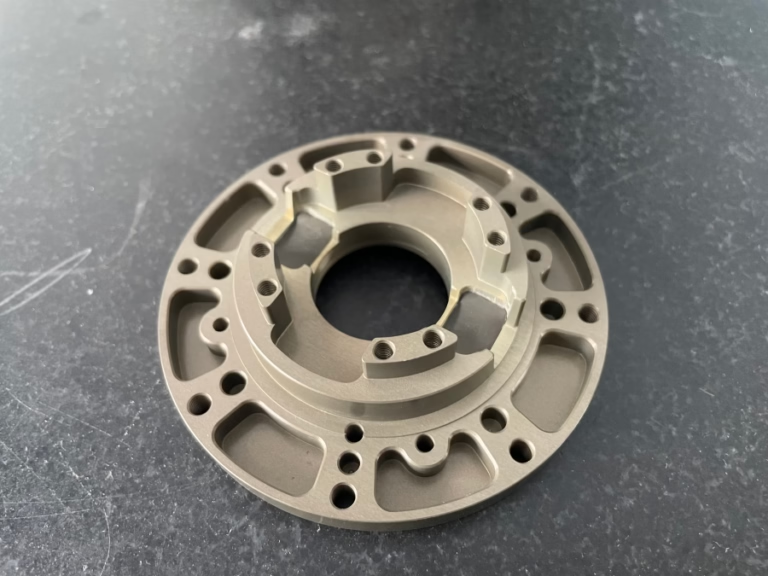
CNC mills are the most common type in any job shop. The spindle holds a rotating end mill, drill or face mill, and the table moves the workpiece underneath it. A 3-axis mill handles brackets, plates, housings and manifolds where all machined faces can be reached from the top, plus one or two side setups.
A vertical machining center with travels around 750 × 1,150 × 550 mm covers most enclosure-sized parts. Compact machines at 500 × 500 × 450 mm suit small, high-mix work where fast changeover matters more than envelope size. Both hold ±0.005 mm on well-fixtured features in aluminium and stainless.
When a part has features on five or six faces, a 4-axis mill with a rotary table cuts several sides in one setup. That reduces fixture error and re-clamping. For parts with compound angles, deep 3D contours or thin walls, a 5-axis center tilts the tool and reaches the feature without repositioning the part.
Milling is a poor fit for long, slender turned features and for hardened material above roughly 45 HRC. Those go to a lathe or to EDM. Deep pockets with a small tool also cost time, because the tool must be short and stiff enough to avoid chatter, which limits depth-to-diameter ratios.
- 1Best forPrismatic parts, pockets, slots, bores, flatness-critical faces
- 2Watch forDeep cavities, thin floors, and features needing a long reach
- 3Typical tolerance±0.005 mm on fixtured features, Ra 0.8–1.6 μm as machined
CNC lathes, turning centers and mill-turn machines
A CNC lathe rotates the workpiece while a stationary tool feeds along the axis. This makes it the natural choice for shafts, bushings, pins, fittings, valve bodies and any part dominated by a cylindrical surface. Diameters and lengths are controlled by the same program, so roundness and concentricity come from the spindle, not from the operator.
Live tooling turns a lathe into a turning center that can mill flats, drill cross holes and cut keyways without a second machine. A mill-turn center goes further and completes both turning and milling operations in one setup, which matters when concentricity between a bore and an outer diameter must hold tight.
Parts with a length-to-diameter ratio above roughly 4:1 usually need a tailstock or steady rest to control deflection. Thin-walled tubes and rings are harder to turn than they look: chuck pressure deforms the part, so light passes and soft jaws are often required.
Turning is the wrong process for a plate with pockets on two faces, or for a part whose critical features are all flat and orthogonal. Those belong on a mill. If the part is mostly round but has a few milled flats, mill-turn usually beats two separate setups.
- 1Best forShafts, bushings, fittings, connectors, cylindrical housings
- 2Setup ruleL/D over 4:1 needs tailstock or steady rest support
- 3Combined optionMill-turn holds concentricity between bore and OD
Three, four and five-axis machining compared
Axis count is the clearest dividing line between the common types of CNC machines. A 3-axis mill moves X, Y and Z. A 4-axis machine adds rotation about one linear axis, usually A, so the part can be indexed to a new face. A 5-axis machine adds a second rotary axis, letting the tool approach the part from nearly any direction.
The difference is not just reach. On a 5-axis center the tool stays normal to the surface, so a ball nose cutter can sweep a curved surface with consistent stepover. That produces uniform surface finish on aerospace skins, turbine blades, impellers and mold cores. It also lets a short, stiff tool reach features that would need a long, vibrating tool on a 3-axis machine.
Five-axis machining is not always the cheaper route. Programming takes longer, simulation is mandatory, and the machine hourly rate is higher. For a simple bracket with holes on three faces, a 3-axis mill plus a fixture is faster and cheaper. The rule we apply: if the part has more than two compound-angle features, contoured 3D surfaces, or a tolerance stack that depends on setup count, 5-axis pays for itself.
Deep cavities with a small tool and hardened tool steel above 45 HRC are better routed to EDM. No amount of axis count fixes a tool that cannot reach or a material that will not cut cleanly.
- 13-axisPrismatic parts, one or two setups, lowest hourly rate
- 24-axisMultiple faces, drilled and milled features around a part
- 35-axisContoured surfaces, compound angles, single-setup accuracy
EDM, routers and when each one fits
Electrical discharge machining removes material with sparks instead of a cutting tool. Wire EDM cuts through hardened steel with a thin wire and holds tight edges on punches, dies and fine slots. Sinker EDM burns a shaped electrode into a cavity, which suits sharp internal corners that no end mill can produce. Neither process cares much about material hardness.
CNC routers cut softer material: wood, plastic, foam, composites and thin aluminium sheet. They use a gantry frame and a high-speed spindle, so they cover large flat panels but hold looser tolerance than a metal-cutting machining center. A router is a sensible choice for a signage panel and a poor one for a bearing housing.
Grinding is the last common family worth naming. It removes very small amounts of material with an abrasive wheel to reach fine finish and tight size on hardened parts. It is usually a finishing operation after turning or milling, not a primary shaping process.
Pick the process by feature, not by habit. Sharp internal corners, hardened material and burr-free edges point to EDM. Large flat panels in soft material point to a router. Precision metal features with defined tolerances point to a machining center.
How part geometry, volume and material narrow the choice
Start with the geometry. If the part is mostly round, a lathe or mill-turn center is the default. If it is mostly flat and boxy, a 3-axis or 4-axis mill handles it. If it has freeform surfaces, sharp internal corners in hard material, or features on many faces, the choice moves to 5-axis or EDM.
Then look at volume. One prototype and a 10,000-part run rarely use the same process. Prototypes favor 3-axis milling or turning because setup is fast and no tooling is needed. Higher volumes often move to die casting or vacuum casting, with CNC finishing on critical features. A shop that runs all of these can shift a part between processes without redesigning it.
Material closes the loop. Aluminium 6061, 7075 and 6082 cut fast and hold tight tolerance. Stainless 304 and 17-4PH work-harden, so feeds and speeds must stay aggressive enough to cut below the hardened layer. Titanium Ti-6Al-4V and Inconel generate heat at the cutting edge and wear tools quickly, which raises cost per part. Hardened tool steel above 45 HRC usually goes to EDM.
Fixturing is the hidden variable. A part that looks simple on a drawing can need three custom fixtures because of thin walls or awkward datums. Reviewing the model before machining, and adjusting the design where possible, removes cost before the first chip is cut.
- 1Geometry firstRound, prismatic or contoured decides the machine family
- 2Volume secondPrototype routes differ from 10,000-part runs
- 3Material thirdWork-hardening alloys and hardened steel change the process
- 4Fixturing fourthFewer setups usually means tighter tolerance stack
Common types of CNC machines at a glance
Use this table to shortlist a process before requesting a quote.
| Machine type | Best part geometry | Typical tolerance | Main limitation |
|---|---|---|---|
| 3-axis mill | Prismatic plates, pockets, holes | ±0.005 mm | One approach direction per setup |
| 4-axis mill | Multi-face parts, rotary features | ±0.005 mm | Indexed, not continuous motion |
| 5-axis center | Contoured surfaces, compound angles | ±0.005 mm | Higher hourly rate, longer programming |
| CNC lathe | Shafts, bushings, cylindrical parts | ±0.005 mm | Poor fit for flat prismatic work |
| Mill-turn center | Round parts with milled flats | ±0.005 mm | Complex setup planning |
| Wire EDM | Hardened punches, dies, fine slots | ±0.005 mm | Through-cuts only, slow on thick stock |
| CNC router | Large soft panels, composites | Looser than metal mills | Low stiffness on metal parts |
Which machine type should you pick?
Choose a 3-axis mill or a lathe for simple geometry, budget and speed. Choose a 5-axis center or mill-turn when setup count drives your tolerance stack, and choose EDM when the material is hardened or the corner must be sharp.
Common questions about CNC machine types
What is the most common type of CNC machine?
The 3-axis vertical machining center is the most common in contract manufacturing. It covers flat and boxy parts with holes, pockets and slots, and it has the lowest hourly rate of the metal-cutting options.
Lathes are equally common in shops that serve automotive and hydraulic customers, because so many parts are cylindrical.
Do I need 5-axis machining for my part?
Only if the part has contoured 3D surfaces, compound angles, or a tolerance stack that depends on reducing setups. Five-axis work carries a higher hourly rate and longer programming time.
For a bracket with holes on three faces, a 4-axis mill with a rotary table is usually cheaper and just as accurate.
When is EDM better than milling?
EDM wins when the material is hardened above roughly 45 HRC, when an internal corner must be sharp, or when a slot is too fine for an end mill. Wire EDM cuts through hardened steel with minimal edge burr.
Milling remains faster for softer material and for three-dimensional cavities with generous corner radii.
What tolerance can these machines hold?
On well-fixtured features in aluminium and stainless, the machine families above hold ±0.005 mm. Surface finish ranges from Ra 0.2–0.8 μm on fine-finished surfaces to Ra 1.6–3.2 μm as machined.
Achievable tolerance depends on part stiffness, fixture rigidity and feature depth, not only on the machine.
Can one shop run all of these processes?
Yes. A shop with milling, turning, mill-turn, multi-axis and EDM capacity can move a part between processes without sending it out, which keeps the tolerance stack under one roof.
That matters most when a prototype later becomes a production run and the process has to change.
How do I choose between a router and a machining center?
A router suits large flat panels in wood, plastic, foam, composites and thin aluminium. It covers a big table at lower cost.
A machining center is stiffer and holds metal tolerance, so any metal part with a defined tolerance belongs on a mill, not a router.
Send your drawing and we will match the process
Upload a 3D model or 2D drawing and our engineers will confirm the machine type, tolerance and finish, with a quotation and DFM analysis in 12 hours.
12-hour quote±0.005 mm tolerance100% inspection before shipmentNo minimum order quantity
More machining guides and shop updates
We publish setup notes, tooling trials and inspection data from the factory floor.











