
What Are the Main Categories of Industrial Control Machines?
A control machine is any box that reads sensors, decides something, and drives actuators. Most plants run on five families of them. This page explains how each one works, where it fits, and when it is the wrong pick. Written for engineers and buyers who need to specify hardware, not read a sales sheet.
In this article
- 1
- 2
- 3
- 4
- 5
- 6
- 7
What the main categories of industrial control machines share
Every industrial controller runs the same loop. Input cards sample sensors. A processor scans the logic. Output cards switch contactors, valves or drives. The differences between the main categories of industrial control machines sit in scan time, I/O count, physical hardening and how the units talk to each other.
A PLC scans in 1–20 ms and holds a few hundred I/O points. A DCS scans in 100–500 ms but carries tens of thousands of points across redundant networks. An RTU may scan in under 10 ms yet run on 12 VDC and a radio link. Same loop, different constraints.
Pick by the loop you must close, not by the label on the cabinet. If a valve must react inside 50 ms, the network and the processor both have to support that. If a tank level only needs updating every second, a slower and cheaper platform is fine.
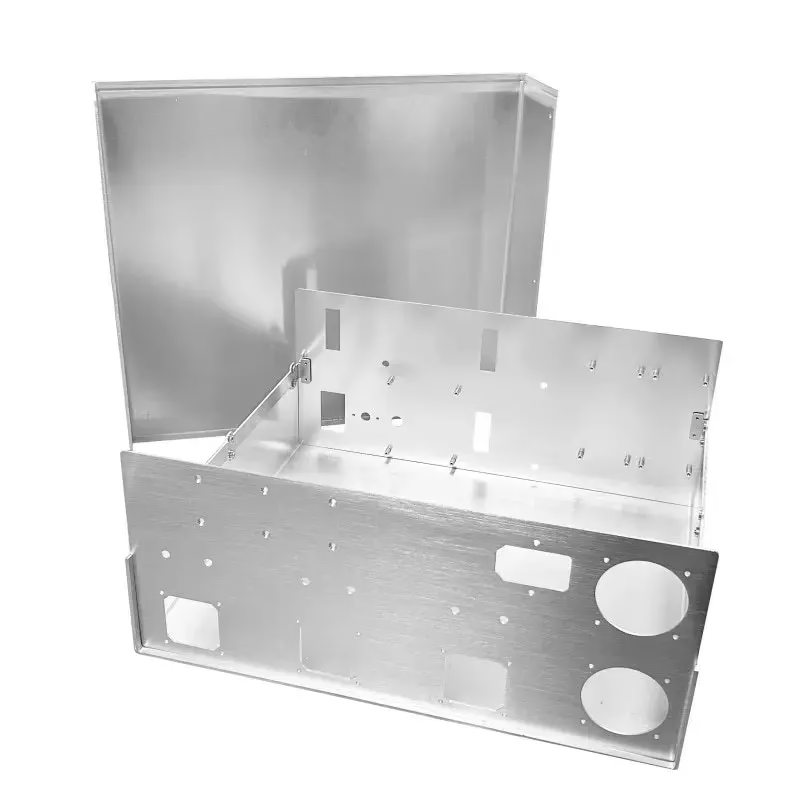
The control hardware itself is a machined or sheet metal assembly. Enclosure flatness, DIN rail spacing and connector cutouts decide whether the electronics survive vibration and heat. Those tolerances come from the fabrication shop, not the automation vendor.
PLC: the workhorse of discrete control
A programmable logic controller is a hardened computer with a fixed scan cycle. It reads digital and analog inputs, executes ladder or structured text, then writes outputs. Typical units handle 16 to 2,048 I/O points and scan in 1–20 ms.
PLCs win in discrete manufacturing: conveyors, pick-and-place, packaging, machine tools. They tolerate 0–60 °C cabinets, 24 VDC I/O and electrical noise. A micro PLC can run a single test bench; a rack-based unit can run a whole line.
The limits show up in three places. First, large analog loops with heavy PID math push scan time up. Second, cross-plant coordination needs extra networking. Third, a single PLC is a single point of failure unless you add redundancy, which many compact models do not offer.
For a 300-point cell with 20 axes, a PLC plus remote I/O is usually cheaper and faster to commission than a DCS. For 5,000 points across three buildings, the wiring and engineering effort starts to favor a distributed system.
RTU: control where the network is thin
A remote terminal unit is built for sites without reliable power or data. It runs on 12–24 VDC, often from a battery or solar panel, and reports over radio, cellular or satellite links. Scan times stay short because the RTU must catch fast events such as a breaker trip.
RTUs buffer data locally. When the link drops, they store events with timestamps and forward them later. That store-and-forward behavior is the main difference from a PLC, which normally assumes a live network.
Typical deployments are pump stations, pipelines, substations and water towers. One RTU may carry 8–256 points. Enclosures are rated for outdoor use, and operating range often spans –40 to +70 °C.
Do not use an RTU as a plant controller. Its strength is a few hundred points across a wide area. Its weakness is heavy sequential logic and high-speed motion. When a site needs both, engineers pair an RTU for telemetry with a PLC for local machine control.
SCADA: the layer above the controllers
SCADA is not a single box. It is a software and communications layer that gathers data from PLCs, RTUs and meters, then presents it to operators. Servers, historians and HMIs sit at the top; field devices sit at the bottom.
The scan rate of SCADA is seconds, not milliseconds. A screen refresh every 1–2 s is normal. That is fast enough for supervisory decisions and far too slow for closing a motion loop. Control stays in the field device.
Protocols matter here. Modbus TCP, DNP3, IEC 60870-5-104 and OPC UA are common. Mixing vendors is normal, and a gateway often translates between them.
SCADA projects fail more often from network design than from software. Redundant paths, segmented VLANs and a clear tag naming convention prevent most of the pain. Plan those before buying licenses.
DCS: continuous process at scale
A distributed control system spreads control across many processors linked by a redundant network. Each node owns a section of the plant. If one node fails, the rest keep running. That architecture suits chemical, refining, power and pharmaceutical plants.
DCS platforms carry 10,000 to 100,000 I/O points. Analog loops and PID control are first-class citizens, with faceplate graphics and alarm management built in. Scan times of 100–500 ms are normal and acceptable for slow thermal or flow processes.
The cost is high and so is the engineering effort. A DCS rollout takes months, not weeks. Vendors supply the whole stack: controllers, network, workstations, engineering tools. That integration is the selling point and the lock-in.
Choose a DCS when loop count is large, uptime matters more than price, and the process changes slowly. Choose something else when the line changes every quarter or the budget is tight.
Cell controllers and PC-based automation
The fifth group covers industrial PCs, edge controllers and cell controllers. These run a real operating system, speak to vision systems and robots, and often hold a database or an MES connection. Scan times range from 0.5 ms to 10 ms depending on the runtime.
They fit cells that mix motion, vision and data. A robot cell that logs every cycle to a server is a natural fit. So is a test bench that runs 200 measurement channels and writes a report per unit.
The trade-off is fragility. A PC needs cooling, a clean power supply and a UPS. It boots slower than a PLC and can be disrupted by an OS update. Harden it or keep it out of the safety path.
Many modern lines blend categories. A PLC handles interlocks and safety. An IPC handles vision and data. SCADA watches both. That mix is normal and often the cheapest correct answer.
Compare the main categories of industrial control machines
Typical figures, not vendor limits. Confirm against the specific model.
| Category | Typical I/O | Scan time | Best fit |
|---|---|---|---|
| PLC | 16–2,048 points | 1–20 ms | Discrete machines, conveyors, packaging |
| RTU | 8–256 points | Under 10 ms | Remote sites, pipelines, substations |
| SCADA | Software layer | 1–2 s refresh | Supervisory view across many controllers |
| DCS | 10,000–100,000 points | 100–500 ms | Continuous process, high uptime |
| Cell controller / IPC | 50–500 channels | 0.5–10 ms | Vision, robot cells, test benches |
Which category to pick
Fast discrete logic on one machine: use a PLC. Remote site on a thin network: use an RTU. Large slow process with high uptime: use a DCS. Mixed cell with vision and data logging: use an IPC plus a PLC for interlocks. SCADA is the viewing layer, never the loop.
Questions engineers ask about control hardware
Can a PLC replace a DCS?
Sometimes. A redundant PLC pair with distributed I/O can cover 5,000–10,000 points and run a continuous process. The gap is engineering tooling: DCS platforms ship with loop tuning, alarm management and faceplate libraries already built.
Below roughly 5,000 points, a PLC system usually costs less and commissions faster. Above that, the DCS engineering environment starts to pay for itself.
How do you size an enclosure for a control machine?
Start with the heat load. Sum the watts of every device inside, then pick a surface area that keeps the internal air below the rated ambient of the weakest component. Add 20 percent headroom for future cards.
Leave at least 50 mm around vents and 100 mm above the DIN rail for cable bend radius. Cutouts for connectors need ±0.2 mm or better so gaskets seal properly.
What tolerance matters on a control chassis?
Panel flatness and hole position drive assembly fit. A warped panel stresses the PCB and can crack solder joints over time. Machined enclosures hold ±0.005 mm on hole position and stay flat after anodizing.
Sheet metal versions typically hold ±0.1 mm, which is fine for DIN rail mounting but not for precision connector alignment.
When is an RTU better than a PLC with a cellular modem?
When the site is remote, power is limited, and the link drops often. An RTU is built around low power draw and store-and-forward telemetry, so it survives outages without losing events.
If the site has stable power and a reliable wired network, a PLC with a modem does the same job for less money.
Do SCADA systems control anything directly?
No. SCADA reads and displays. The actual control loop closes inside the PLC, RTU or DCS node. Putting a control decision in the SCADA layer adds network latency and a single point of failure.
Keep interlocks and safety logic in the field controller. Use SCADA for operator decisions, trends and alarms.
What changes when a control cabinet is used outdoors?
Ingress protection, temperature range and corrosion resistance all change. An outdoor cabinet needs at least IP54, heaters or fans for –40 to +70 °C swings, and a coating that resists UV and salt spray.
Powder coating over a phosphate layer handles most industrial outdoor sites. For coastal areas, add a thicker film and stainless hardware.
Need control enclosures or chassis parts machined?
Send your drawings and we will return a quotation with free DFM analysis within 12 hours. No minimum order quantity, from one prototype to 10,000+ part runs.
12-hour quote100% inspection±0.005 mmNDA on request
More from GreatLight
We publish setup notes, tooling trials and inspection data from the factory floor.











