
What Are the Parts of CNC Machine? A Complete Guide
A CNC machine is a stack of systems, and each one adds error to the finished part. This guide covers the main parts of CNC machine design, what each part does, and the tolerances it can realistically hold. Written for engineers and buyers who need to judge a supplier's capability, not just read a spec sheet.
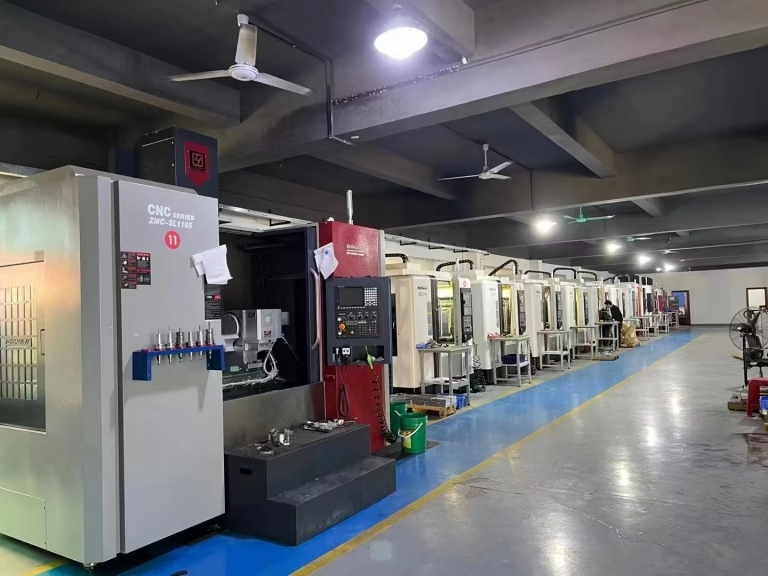
Structural Parts: The Rigid Frame
Every cut starts with the frame. The bed, column, gantry, and spindle housing form a closed loop of cast iron or welded steel that absorbs cutting force and vibration before they reach the tool tip. A frame that is 20 percent lighter will deflect more under the same load, and that deflection shows up directly in the part. On a 300 mm aluminum bracket, 0.02 mm of frame flex is enough to blow a ±0.05 mm callout.
Cast iron is the default for smaller machines because it damps vibration well. Welded steel frames are common on gantries and large travel machines, where a single casting would be impractical. The trade-off: welded frames need stress relief before finish machining, or they move over the first year of use.
Thermal behavior matters as much as stiffness. A spindle running at 12,000 rpm for two hours will grow a few tenths in Z. Machines that hold ±0.005 mm over a full shift usually have temperature sensors on the frame and a warm-up routine in the control. Skipping warm-up is one of the most common causes of first-part scrap.
What to ask a supplier: frame material, stress-relief process, and whether the machine is leveled and re-checked on a schedule. Those three answers tell you more than a brochure photo of the machine.
Spindle and Tooling: Where the Cut Happens
The spindle is the part that turns cutting force into material removal. Its key numbers are maximum speed, power at the tool, taper type, and runout. Runout at the tool tip is what matters: a spindle with 2 µm runout at the taper can still cut a ragged hole if the holder adds another 5 µm.
Taper choice follows the job. BT30 and HSK-E40 suit small, fast work in aluminum. BT40 and HSK-A63 cover most general milling. Bigger tapers like BT50 or HSK-A100 appear on heavy cuts in steel, where stiffness matters more than speed. Using a small taper for a heavy cut is a common mistake; it shows up as chatter and short tool life.
Tool holders and collets are part of the cutting system. A worn collet adds runout that no controller can correct. For finishing passes that need Ra 0.8–1.6 μm, we check holder condition and balance grade before the job, not after the first bad part.
Coolant delivery sits inside this system too. Through-spindle coolant clears chips in deep holes; flood coolant handles most face and pocket work. On titanium and Inconel, high-pressure coolant is often the difference between a tool lasting 20 minutes and 90 minutes.
Control System: The Machine's Brain
The control reads G-code and turns it into motion commands. Modern controls run look-ahead over hundreds of blocks, which lets them slow down before a corner instead of overshooting it. That is why two machines with identical mechanics can hold different tolerances on the same part.
Feedback comes from encoders. Semi-closed systems read the motor, so they cannot see backlash or thermal growth in the screw. Full-closed systems read a scale on the axis itself, which is how machines hold ±0.005 mm over long travel. For parts longer than 1,000 mm, closed-loop feedback is usually the deciding factor.
The control also holds the offsets, tool table, and probing cycles. Probe routines set work origin and check stock before the first cut. Skipping them saves two minutes and risks a scrapped casting worth far more.
Control choice is often brand-locked to the machine builder, so buyers rarely pick it directly. What you can check is whether the supplier uses probing, thermal compensation, and tool-break detection. Those features are what keep tolerance stable across a production run.
Drive System: Motors, Screws and Ways
The drive system converts control signals into motion. Servo motors, ball screws, and linear guides make up most of it. The numbers that matter are screw pitch, guide preload, and whether the axis uses a rotary table or a trunnion.
Ball screws trade speed against stiffness. A fine-pitch screw gives more force and finer resolution but limits rapid speed. On a 4,000 mm travel machine, rapid speed matters for cycle time, so builders balance pitch against the load the axis must move.
Linear guides come in roller and ball types. Roller guides carry heavier loads and resist tipping better, which helps on gantry machines. Ball guides run smoother at high speed. Both need lubrication on a schedule; dry guides show up as chatter marks first, then as position error.
For 5-axis work, the rotary table adds its own error stack. A Ø400 mm rotary table with 5 arc-second accuracy is typical for our 5-axis centers. Angular error of 5 arc-seconds is about 0.024 mm at a 1,000 mm radius, so long parts on a rotary table need the error budget checked, not assumed.
Workholding and Auxiliary Systems
Workholding decides how much of the machine's accuracy you actually get. A vise bolted to a T-slot table can hold a part rigidly, but the part may spring when the jaws release. Thin walls and long cantilevers move the most. Soft jaws machined in place, or a fixture with support under the cut, often fixes a tolerance problem that the machine itself never had.
For 5-axis work, workholding has to clear the tool from five directions. Zero-point clamping systems let a part move between operations without losing position. That matters for parts that need milling on one face and turning on another, since re-chucking is a common source of runout.
Auxiliary systems keep the machine stable: coolant, chip conveyors, way lubrication, and air supply. Chip evacuation is underrated. A pocket full of chips recuts material and drives up tool wear, and it can push a finishing pass out of tolerance on deep cavities.
Vacuum tables suit thin plate and composite panels. Magnetic chucks suit ferrous parts where you need full face access. Both have limits: vacuum loses grip on small parts, and magnetic chucks do nothing for aluminum. Matching the workholding to the part, not to habit, is where a lot of precision is won or lost.
Machine Part vs. What It Controls
Each row maps a machine part to the tolerance or process it governs.
| Machine part | Main job | What it limits |
|---|---|---|
| Frame and bed | Absorb cutting force | Deflection and chatter |
| Spindle and taper | Hold and turn the tool | Speed, runout, surface finish |
| Control and encoders | Command and correct motion | Accuracy over long travel |
| Ball screws and guides | Move each axis | Repeatability, rapid speed |
| Rotary table | Rotate the part | Angular error on 5-axis work |
| Workholding | Hold the part rigidly | Distortion after release |
| Coolant and chips | Clear heat and chips | Tool life, deep-cavity finish |
Which Part Matters Most?
If your part is small and simple, workholding decides the result. If it is long, the control and feedback system decides it. If it is 5-axis, the rotary table joins the error stack. Buy the machine spec that matches your part, not the biggest number on the brochure.
Common Questions
Which part of a CNC machine has the biggest effect on tolerance?
On short parts, workholding and spindle runout usually dominate. On parts longer than 1,000 mm, the feedback system and ball screw accuracy matter more, because thermal growth and lead error accumulate over travel.
The practical answer is to look at the whole error stack. A machine rated at ±0.005 mm will not hit that number if the fixture lets the part move.
Does a 5-axis machine need different parts than a 3-axis machine?
The frame, spindle, and control are similar. The difference is the rotary table or trunnion, which adds two axes of motion and their own error. Workholding also changes, because the tool must reach the part from five directions.
For parts with undercuts or angled holes, the 5-axis setup often removes a second operation, which is where the real gain sits.
How often do machine parts need calibration or replacement?
Ball screws, guides, and spindles wear with use, not with the calendar. A machine running heavy steel cuts will need attention sooner than one running aluminum. Geometry checks and backlash measurement are the usual early indicators.
We keep maintenance records per machine and check geometry on a schedule. Reports are available on request.
Can you machine parts that need custom workholding?
Yes. Soft jaws, dedicated fixtures, and zero-point plates are all in scope. For thin-wall or odd-shaped parts, we design the fixture together with the machining plan so the part does not spring when it is released.
Share the drawing and the critical dimensions, and we will flag any feature that needs a fixture before quoting.
What size parts can your machines handle?
Our largest travel is 4,000 × 400 × 150 mm. Medium machines cover 750 × 1,150 × 550 mm and 600 × 600 × 600 mm. Compact machines handle 500 × 500 × 450 mm and 500 × 310 × 200 mm.
We run 127 high-precision CNC machines, including 16 simultaneous 5-axis centers, 12 four-axis mills, 27 three-axis machines, and 16 mill-turn centers.
How do you inspect parts after machining?
We inspect 100 percent of parts before shipment. That includes raw material check, in-process monitoring, and final inspection. Inspection reports are available on request.
For tight features, we use the same datum scheme as the customer's drawing, so the numbers match what their incoming inspection will see.
Send Your Drawing, Get a Quote in 12 Hours
Tell us the material, tolerance, and quantity. We will review the parts of CNC machine work your job needs and reply with a quote and free DFM analysis within 12 hours.
12-hour quote100% inspectionNo minimum order quantityNDA on request
More from GreatLight
We publish setup notes, tooling trials and inspection data from the factory floor.











