
What Does CNC Machine Stand For?
The letters stand for Computer Numerical Control: a computer reads a part program, converts it into axis commands, and a machine tool cuts metal to those commands. This page breaks the three words apart for engineers and buyers who need to judge whether a part belongs on a CNC machine.
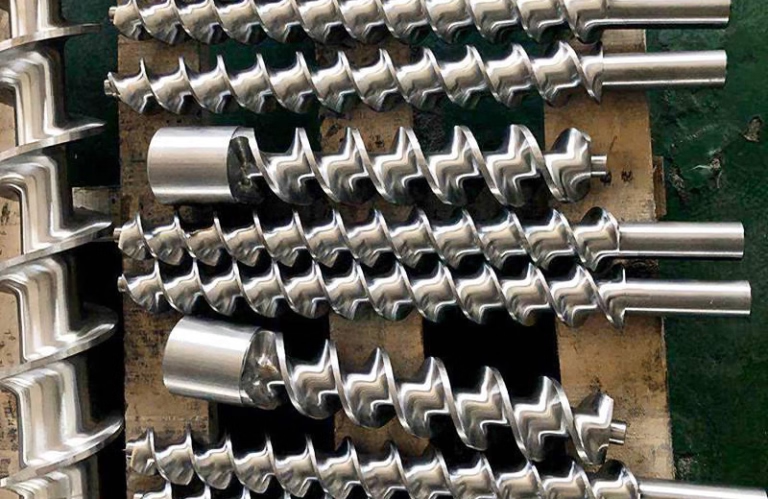
What does CNC machine stand for, word by word
CNC is short for Computer Numerical Control. The three words describe a chain, not a single device. A computer holds the part program. Numerical control is the method of driving machine motion with coded numbers instead of handwheels. The machine is the cutting hardware that moves on those numbers.
The phrase entered the shop floor in the 1950s, when punched tape replaced a skilled operator turning dials by feel. Tape is gone. The logic is not. Every modern control still reads a line of coordinates, decides which axis moves first, and sends a pulse train to a servo motor.
That is why the acronym matters to a buyer. When someone asks what does CNC machine stand for, they are really asking how a drawing becomes a metal part with repeatable dimensions. The answer sits in three layers: program, control, and machine.
It is not a single brand or a single process. A CNC lathe, a CNC mill, a CNC router and a CNC grinder all share the same three-layer structure. The cutting method changes. The way the motion is commanded does not.
Computer: where the part program is born
A machined part starts as a 3D CAD model. That model carries the geometry but not the strategy. CAM software turns it into tool paths: which cutter, what depth of cut, how fast to feed, where to enter and exit the material.
The CAM programmer picks cutting parameters from the material and the feature. Aluminum 6061 might run at 3,000–8,000 rpm with a 0.5–2 mm radial depth of cut on a 10 mm end mill. A 17-4PH stainless feature runs far slower, often 300–800 rpm, because the same chipload would burn the edge.
Simulation runs before the program is released. The software checks for tool holder collisions, uncut stock, and rapid moves that would bury the cutter. A missed collision on a 5-axis cycle can scrap a part worth several hundred dollars in a few seconds.
This layer is also where tolerances are allocated. A ±0.005 mm bore and a ±0.1 mm clearance hole should not get the same cutter or the same number of passes. The computer decides that, and the operator inherits the decision.
- 1CADDefines nominal geometry and any GD&T callouts.
- 2CAMChooses tools, stepdown, feed and speed.
- 3SimulationCatches collisions and gouges before metal is cut.
Numerical Control: the coded language of motion
Numerical control means the machine obeys numbers rather than a human hand on a crank. The numbers arrive as G-code and M-code. G-code commands axis position and feed. M-code switches auxiliary functions such as spindle on, coolant on, or tool change.
A single line can carry a lot of intent. G01 X15.0 Y8.0 Z-3.0 F120 tells the control to move in a straight line to that coordinate at 120 mm/min. The control then interpolates the path, blending the three axes so the cutter follows a straight line in space.
The control also handles the physics the programmer cannot see. Servo feedback compares commanded position to actual position thousands of times per second. If the axis lags, the control adds current. If the tool load spikes, feed override or adaptive control can slow the cut before the cutter breaks.
This is the layer that separates CNC from manual machining. A manual operator can hit a dimension once. A control can hit it on part 1 and part 4,000, provided the tool, the fixture and the thermal state stay stable.
- 1G-codeMotion, feed rate, coordinate systems, cutter compensation.
- 2M-codeSpindle, coolant, tool change and program stop.
- 3Servo loopCloses the gap between commanded and actual position.
Machine: the physical side of the acronym
The machine turns code into chips. Its value is stiffness, not software. A cast iron or polymer concrete base absorbs vibration. Linear guides or box ways resist deflection. The spindle delivers torque at the rpm the cutter needs.
Axis count changes what the machine can reach. A 3-axis mill moves X, Y and Z. A 4-axis machine adds rotation, usually around X or Y. A 5-axis machine adds a second rotary axis, so the tool can approach a face from almost any direction in one setup.
That matters for parts with compound angles, deep pockets on multiple faces, or undercut features. On a 3-axis machine, those features need extra fixtures and extra setups. Each setup adds a datum shift and a chance to lose 0.02 mm.
Machine size sets the upper bound too. At GreatLight, the largest travel is 4,000 × 400 × 150 mm, and the compact class covers 500 × 500 × 450 mm. A part outside the envelope is not a programming problem. It is a different machine or a different process.
- 1StructureMass and damping decide surface finish at high feed.
- 2SpindleTorque curve must match the cutter and material.
- 3AxesMore axes mean fewer setups and tighter true position.
When CNC fits a part, and when it does not
Use this as a first screen before requesting a quote.
| Part situation | CNC fit | Why |
|---|---|---|
| Tight tolerance, ±0.005 mm | Strong | Closed-loop control holds size across the run. |
| One prototype, no MOQ | Strong | Program once, cut one; no tooling cost. |
| Complex 3D contour | Strong | 5-axis reaches the face without extra fixtures. |
| Thin wall under 0.5 mm | Careful | Chatter and deflection need light passes. |
| 50,000 identical simple brackets | Weak | Die casting or stamping wins on unit cost. |
| Soft elastomer gasket | Weak | Cutting rubber tears; molding is cleaner. |
| Hardened tool steel, HRC 55+ | Careful | Needs carbide or grinding after heat treat. |
The short answer
If the part needs tight tolerance, complex geometry or a small batch, CNC is the right call. If it is a simple shape in the tens of thousands, pick casting or stamping and keep CNC for the prototype.
Common questions
Is CNC the same as a machining center?
No. CNC describes the control method. A machining center is one type of CNC machine, usually a mill with a tool changer.
A CNC lathe, a CNC grinder and a CNC router are also CNC machines, but they remove material in different ways.
What does the N and the C actually control?
The control manages axis position, spindle speed, feed rate and auxiliary functions such as coolant and tool change.
It compares commanded position to feedback from the servo motor and corrects the error in real time.
Do I need 5-axis for a part with one angled hole?
Usually not. A single angled hole can be cut on a 3-axis machine with an angled fixture or a chamfer tool.
5-axis pays off when several faces carry features and datum shift between setups would break the tolerance.
How tight can a CNC machine hold on a production run?
At GreatLight, the working tolerance is ±0.005 mm on qualifying features, with surface finish from Ra 0.2–0.8 μm when the drawing calls for it.
Holding that over thousands of parts depends on tool wear control, fixturing and thermal stability, not on the control alone.
What materials can a CNC machine cut?
Aluminum 6061 and 7075, stainless 303, 304, 316L and 17-4PH, alloy steels, titanium TC4, brass, copper and engineering plastics such as POM, PEEK and PC.
Hardened steel above HRC 45 is usually roughed before heat treat and finished by grinding.
Does the acronym cover the finishing steps too?
No. Anodizing, plating, powder coating and laser marking are separate operations that follow machining.
They still matter to the drawing, because a hardcoat anodize can add 0.02–0.05 mm per surface.
Send the drawing, get a process answer
We review geometry, tolerance and material, then return a quotation with free DFM analysis within 12 hours.
12-hour quote100% inspectionNDA on request
More from the shop floor
We publish setup notes, tooling trials and inspection data from the factory floor.











