
What Is an AC Servo System on a CNC Machine?
The servo system on a CNC machine is the closed-loop chain that moves every axis and holds the commanded position. This page covers the parts, the feedback loop, and when a servo axis is the right choice over a stepper. Written for engineers who need to judge machine capability before releasing a part.
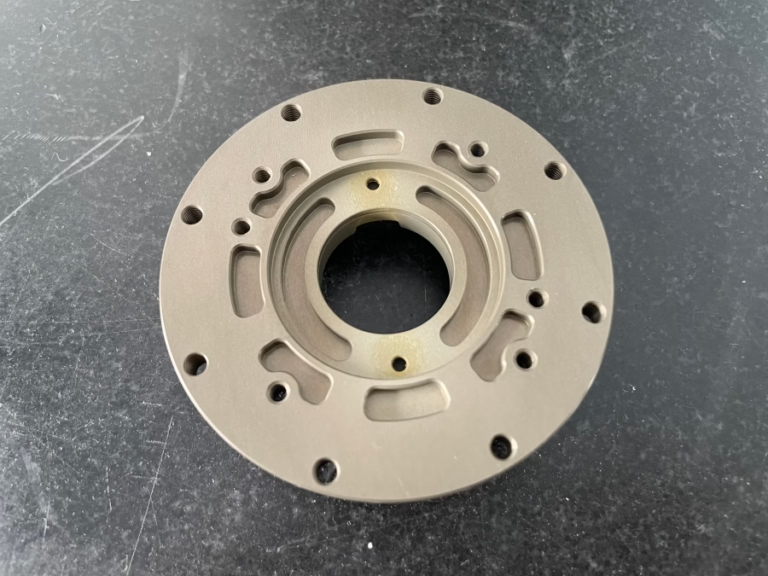
What the servo system on a CNC machine actually does
A servo system on a CNC machine is a closed-loop electromechanical chain that moves one axis to a commanded position, speed, or torque. It has three parts: a synchronous AC servo motor, a drive that supplies three-phase power, and a feedback device on the motor shaft or the screw end.
The controller sends a command. The drive compares it with the signal coming back from the encoder, then adjusts voltage and frequency to the motor. If the axis lags, the drive pushes more current. If it overshoots, current drops. This correction happens thousands of times per second.
That constant comparison is what separates a servo axis from a stepper. A stepper receives pulses and hopes the rotor keeps up. It has no way to know whether the table actually arrived. A servo axis measures the result and corrects it, which is why it holds ±0.005 mm on a well-tuned machine.
The practical effect shows up in the cut. Thermal growth in a ball screw, chip load changes, and tool wear all push an axis off target. A servo axis pulls it back before the next tooth engages.
Motor, encoder and drive: the three links in the chain
The motor is a permanent-magnet synchronous machine. It runs on three-phase AC from the drive, not on line power. Rotor position is known at all times because the drive has to commutate the phases in the right order. Rare-earth magnets give high torque in a small frame, so a 400 W motor can drive a light axis without gearing.
The encoder is the measuring device. Optical or magnetic, it reports angular position to 17–23 bits on modern units. Some machines mount it on the motor shaft, others on the screw end. Screw-end mounting catches pitch error and thermal growth in the screw itself. Shaft mounting is cheaper but blind to the mechanics.
The drive is the power stage and the calculator. It takes a low-power command from the CNC, runs a position loop, a velocity loop, and a current loop, and outputs controlled three-phase power. Loop gains are tuned at commissioning. Poor tuning shows up as chatter, following error, or a high-pitched whine at standstill.
Cables matter more than people expect. Encoder lines run next to motor power lines, so shielding and separate routing prevent feedback noise. A noisy encoder signal looks like a mechanical fault and sends maintenance down the wrong path.
Following error, gain and what good tuning looks like
Following error is the gap between commanded position and actual position during motion. Every axis has some. The question is how much, and whether it stays consistent. A ball screw axis at 10 m/min may show 5–20 μm of following error with proper tuning. If it grows over a shift, something is warming up or wearing.
Gain sets how hard the drive pushes to close that gap. Too low and the axis trails behind, leaving rounded corners and undersized features. Too high and the axis overshoots, rings, or buzzes. The sweet spot is the highest gain that stays quiet through the full speed range and the full table load.
Feed-forward helps. It predicts the required torque from the commanded profile and applies it before error builds. With feed-forward active, following error at constant feed drops close to zero, and the axis only lags during acceleration. This matters on contouring work where two axes must stay synchronized.
Tuning drifts. Belts stretch, couplings loosen, and grease thickens in cold shops. A machine that held ±0.005 mm in summer may not in winter. Re-checking backlash and following error after a season change is normal maintenance, not a sign of a bad machine.
How the servo system on a CNC machine shows up in the part
On a 5-axis job, the rotary and tilt axes are servo driven too. Their error adds to the linear axes. A small tilt error at the tool tip becomes a large position error on a long tool, so rotary axes on our Ø400 mm tables are tuned with the same care as the linear ones.
Surface finish carries the signature of the motion system. A well-tuned axis at Ra 0.8–1.6 μm leaves even tool marks. A mistuned axis leaves a repeating pattern that matches the screw pitch or the encoder period. If the pattern repeats every 10 mm, look at the screw. If it repeats every motor revolution, look at the coupling or the encoder.
Warm-up matters on long parts. A 4,000 mm travel machine grows as the screws heat. Running a warm-up cycle before the first cut, and keeping the shop at a steady temperature, holds the tolerance across the whole bed. We check the first part, not just the last one.
The payoff is repeatability. When the same program runs on the same machine a month later and lands within a few microns, that is the servo loop doing its job quietly in the background.
Servo versus stepper: when each one fits
Match the drive type to the part, not to the price list.
| Factor | AC servo axis | Stepper axis |
|---|---|---|
| Position feedback | Continuous, closed loop | None, open loop |
| Typical holding accuracy | ±0.005 mm on a tuned machine | Depends on load and speed |
| Torque at high speed | Flat to rated speed | Falls off quickly |
| Behavior when overloaded | Faults and reports the error | Skips steps silently |
| Best for | Contouring, tight tolerance, 5-axis | Light drilling, engraving, hobby work |
| Cost and setup | Higher, needs tuning | Lower, plug and run |
The short version
If the part needs contouring, tight tolerance, or 5-axis motion, use a servo axis and budget for tuning. If it is light drilling or engraving on a loose tolerance, a stepper is cheaper and adequate. Do not put a tight-tolerance part on a machine that cannot measure where it is.
Common questions
Does a servo system guarantee tight tolerance?
No. The servo loop holds the axis where it is told to go. Tolerance also depends on the screw, the spindle, the fixture, and thermal stability.
A good servo system removes one source of error. It does not remove the others.
Why does my machine hum or buzz at standstill?
Usually the velocity loop gain is too high, or there is mechanical backlash the drive is chasing. Back off the gain slightly and check the coupling.
If the noise follows the spindle, it may be a grounding or shielding problem on the encoder cable.
How often should servo axes be retuned?
After any mechanical repair, after a crash, and whenever following error drifts beyond its normal band. Seasonal temperature swings are a common trigger.
Routine backlash checks catch most problems before they reach the part.
Can a servo axis run without an encoder?
Not as a servo. Without feedback the drive cannot commutate correctly or verify position. That is a stepper or an open-loop vector drive, a different animal.
Some systems use a resolver instead of an encoder, but the principle is the same: measure, compare, correct.
What encoder resolution do I need for ±0.005 mm?
Resolution is only part of it. A 23-bit encoder on a 10 mm pitch screw gives sub-micron counting, but screw error and thermal growth can be larger than the count.
Look at the whole error budget, not just the encoder spec.
Does the servo system affect surface finish?
Yes. Gain, feed-forward, and mechanical stiffness all leave marks. Repeating patterns that match the screw pitch or motor revolution point to the motion system.
Even tool marks usually mean the loop is doing its job.
Send us the part that needs tight motion control
Upload your drawing and we will review the tolerance, the geometry, and the machine that fits it. Quotation and DFM feedback within 12 hours.
12-hour quote100% inspectionNo minimum order quantityNDA on request
More from the shop floor
We publish setup notes, tooling trials and inspection data from the factory floor.











