
What Is a CNC Machine Control?
Knowing what is a cnc machine control matters because it is the unit that turns a G-code file into motor commands and reads feedback thousands of times per second. This page is for design engineers and buyers who need to know where that unit sets the real limit on tolerance and finish, and when the machine is not the bottleneck at all.
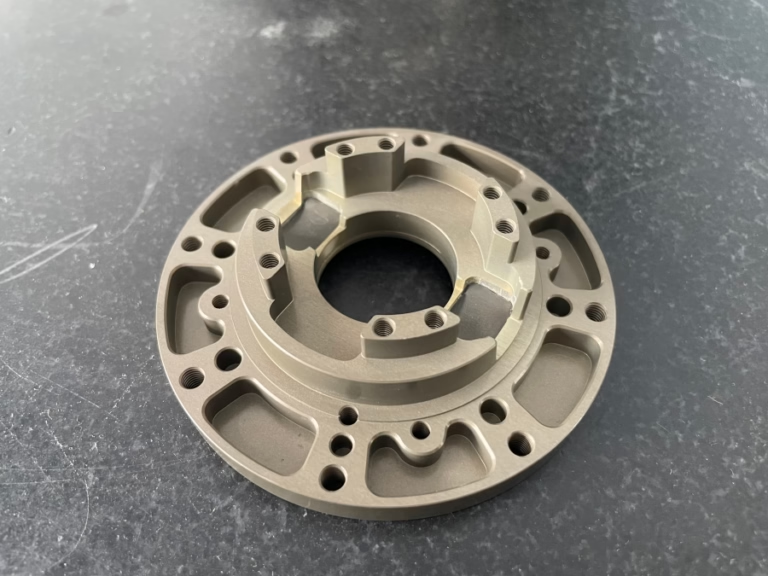
What is a cnc machine control and what it actually does
At its simplest, what is a cnc machine control comes down to one box: a hardened industrial computer bolted to the machine frame. It reads the part program, works out where each axis should be at the next clock tick, and sends that demand to the drives. Then it reads the encoders and corrects. That loop runs thousands of times per second and never stops while the spindle turns.
The program it reads is G-code, plus machine-specific M-codes for coolant, tool change and spindle. The control does not machine anything itself. It is a translator and a referee. It converts a path written in coordinates into a stream of position, velocity and torque commands the servos can follow.
Three layers sit inside the cabinet. The numerical control kernel handles interpolation and look-ahead. The motion control card closes the position loop. The PLC handles the non-motion logic: door interlocks, chip conveyor, pallet change, spindle orientation. A fault in any layer stops the cycle.
For a buyer, the practical point is this. The control unit's update rate, its encoder resolution and its look-ahead depth set a ceiling on what the machine can hold. A tight tolerance callout on a print is a request. The control decides whether that request is physically reachable at the feed rate you asked for.
The five core parts inside the cabinet
The CPU board runs the NC kernel: block reading, interpolation, tool radius and length compensation, and look-ahead. Look-ahead matters more than raw clock speed. A control that reads 200 blocks ahead can slow into a corner before it arrives, which keeps the tool on the arc instead of overshooting it.
The motion control card is a separate processor, often a DSP or FPGA. It takes the interpolated path and runs closed-loop control on each axis. It compares commanded position against encoder feedback and adjusts current to the motor. This is the part that decides how faithfully the machine follows the path.
Servo drives and motors are the muscle. A drive takes a low-power command signal and delivers the current the motor needs. Modern drives also hold their own current and velocity loops, so the motion card only has to manage position. That division keeps the fast loops fast.
Feedback devices tell the control where the axis really is. A rotary encoder on the motor shaft is the common choice. A linear scale mounted on the slide is better because it measures the table, not the screw, so it catches thermal growth and backlash that the motor encoder cannot see.
The PLC and I/O racks handle everything that is not axis motion. Tool changers, coolant valves, safety interlocks, spindle orientation for tool change, and probe inputs all route through here. On a mill-turn or a 5-axis center, the PLC logic is often the difference between a smooth cycle and a crash.
Open loop, closed loop, and what each holds
An open-loop control sends pulses and assumes the motor moved. Stepper-based routers and light-duty machines work this way. It is cheap and simple, but nothing verifies the position. If the tool hits a hard spot and the motor stalls, the control keeps counting and the rest of the part is scrap.
A semi-closed loop reads an encoder on the motor shaft. This catches most lost motion and is the baseline for production CNC. It cannot see screw wear, thermal expansion of the ballscrew, or table lift under load, because those happen between the motor and the part.
A full closed loop reads a linear scale on the slide. The control now measures the part's actual position. This is how a machine holds ±0.005 mm and repeats it over a long run as the screws warm up. It costs more and needs a cleaner environment, but for tight work there is no substitute.
The engineering consequence: if a print calls for ±0.005 mm, the machine must have a full closed loop, a temperature-stable shop, and a control with enough look-ahead to keep feed rates constant through corners. A semi-closed machine can hit that number on a good day. It cannot hold it across a 10,000-part run.
Where the control stops being the limit
It is easy to blame the control for a bad part. Often the control is fine and something else is moving. Tool deflection, fixture rigidity, material stress and thermal growth all push the part off nominal before the control ever gets a chance to correct.
Take a thin-wall aluminum housing. The control can hold position to ±0.005 mm, but a 3 mm wall will spring away from the cutter under cutting force and spring back after. No update rate fixes that. The fix is a lighter finishing pass, a support fixture, or a different tool path strategy.
Thermal growth is the other common culprit. A 4,000 mm steel part can move more than 0.1 mm from a 5 °C shop temperature swing. A full closed loop with a linear scale will follow that growth and cut to the scale, which may not be what the print wants. Sometimes the right answer is a temperature-controlled room, not a better control.
So the honest rule: the control sets the floor on what is possible, and the rest of the process sets the ceiling. When a part misses tolerance, check the tool, the fixture and the material before you blame the box in the cabinet.
What this means when you send us a drawing
When a print lands on our desk, the first question is not which machine. It is which control and loop type the feature needs. A ±0.005 mm bore on a 50 mm part goes on a full closed-loop mill. A ±0.05 mm bracket can run on a semi-closed machine and ship faster.
We run 127 high-precision CNC machines across three plants, including 16 simultaneous 5-axis centers and 16 mill-turn centers. The 5-axis work relies on rotary table compensation and look-ahead to hold contour tolerance on curved surfaces. That is control work as much as it is cutting work.
If a feature cannot be held on the machine you assumed, we say so in the DFM report and suggest a change. Sometimes that means a looser tolerance that does not affect function. Sometimes it means a different setup. Either way you get the answer before the chips fly, not after.
Quotation and free DFM analysis come back within 12 hours. Production can start within 24 hours, and parts ship in 3–5 days. No minimum order quantity, from one prototype to 10,000+ part runs.
Which control setup fits which job
Match the loop type and control class to the tolerance and volume you actually need.
| Job type | Loop type | Typical hold | Watch out for |
|---|---|---|---|
| Prototype, loose tolerance | Open loop | ±0.05 mm | Stall loss, no feedback |
| General production parts | Semi-closed | ±0.01 mm | Screw wear, thermal drift |
| Tight-tolerance production | Full closed loop | ±0.005 mm | Scale contamination, cost |
| 5-axis contoured surfaces | Full closed loop | ±0.005 mm | Look-ahead depth, RTCP setup |
| Long runs, warm shop | Full closed loop | ±0.005 mm | Coolant temp, scale cleaning |
| Large parts, 4,000 mm | Semi-closed or full | ±0.01 mm | Screw growth over length |
The short version
If your feature needs ±0.005 mm over a long run, specify a full closed-loop machine with a linear scale and a temperature-stable shop. If the tolerance is ±0.05 mm or looser, a semi-closed machine will get you the same part faster and cheaper. Buy the control you need, not the one with the longest spec sheet.
Common questions
Is the control unit the same as the CNC controller?
People use the terms loosely. The control unit is the whole cabinet: NC kernel, motion card, drives, PLC and I/O. The controller often means just the NC kernel and its user interface.
When a machinist says the controller, they usually mean the screen and pendant they type at. When an engineer says the control unit, they mean everything that closes the loop.
Can a control unit be upgraded on an old machine?
Yes, and it is common. A retrofit replaces the NC kernel and drives while keeping the iron, the ballscrews and the spindle. The result can hold tighter tolerance than the original build.
The catch is mechanical condition. A worn ballscrew or a tired spindle will not improve just because the control is new. Retrofit makes sense when the mechanics are still within spec.
Does more look-ahead always mean a better part?
No. Look-ahead lets the control plan deceleration into corners, which helps on contoured surfaces. On simple 2.5D pockets with straight walls, deep look-ahead buys little.
What matters is whether the control can keep feed rate constant through the geometry you have. On a 5-axis impeller, that is everything. On a flat plate with drilled holes, it is not.
Why does the same program run differently on two machines?
Because the control, the drives and the mechanics are not identical. Different look-ahead settings, different servo tuning and different screw condition all change how the tool follows the path.
This is why a proven program should be re-tuned when it moves to a new machine. The G-code is portable. The dynamic behavior is not.
What tolerance can GreatLight hold?
We hold ±0.005 mm (±0.0002 in) on tight-tolerance work, with surface finish from Ra 0.2–0.8 μm on fine finishes. Every part is inspected before shipment, and reports are available on request.
We are certified to ISO 9001:2015, IATF 16949:2016, ISO 13485:2016 and ISO 27001:2022. Uploads are secure and confidential, and an NDA is available on request.
Send a drawing, get a real answer on tolerance
We review your print against the machine and control that can actually hold the callout, and we tell you before cutting starts. Quote and free DFM analysis within 12 hours.
12-hour quote100% inspectionNo minimum order quantity
More from the shop floor
We publish setup notes, tooling trials and inspection data from the factory floor.











