
What Is a CNC Nesting Machine?
A CNC nesting machine cuts many flat parts from one sheet instead of one part from one blank. The layout comes from software, the cutting comes from a router, laser, plasma, or waterjet head. This page explains the mechanism, the numbers behind material yield, and the point where nesting stops paying off.
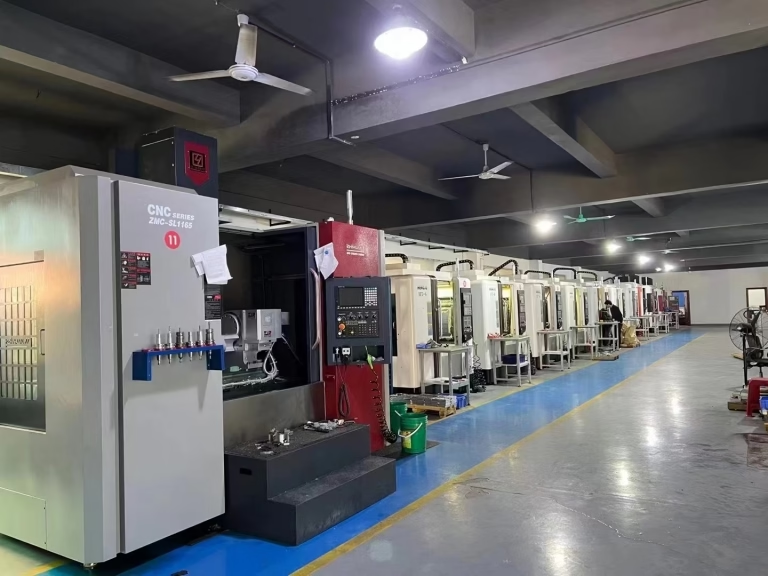
How a CNC nesting machine packs a sheet
A CNC nesting machine is a flat-bed cutting machine driven by a nesting program. You import the 2D outlines of every part in the job, tell the software the sheet size and grain direction, and it searches for an arrangement that wastes as little material as possible. The result is one toolpath file that cuts the whole sheet in a single setup.
Nesting is a packing problem, not a machining strategy. The solver rotates parts, mixes them, and places small parts inside the openings left by large ones. Most CAM packages try several thousand candidate layouts before they settle on one. The one they pick is usually not the mathematically best layout, only a good one found inside a time limit.
The machine itself is ordinary. What makes it a nesting machine is the software decision that parts share one sheet rather than each getting its own blank. A router table with a vacuum bed, a fiber laser, a plasma table and an abrasive waterjet can all run nested programs. The cutting head changes the edge quality and the kerf width. It does not change the packing logic.
Nesting only works on parts that can be described as a flat outline plus a thickness. Brackets, covers, gaskets, panels, chassis plates and shims fit. A part with undercuts, deep pockets on both faces or internal channels cannot be nested in the full sense. It can still be cut from a sheet, but the second operation is milling, not nesting.
What decides material yield on a nested sheet
Yield is the share of sheet area that ends up as finished parts. A well-tuned job on simple rectangular parts reaches 75 to 85 percent. Jobs with long curved outlines, large holes or awkward aspect ratios often land near 60 percent. The gap between those two numbers is usually worth more than any hourly rate difference between two shops.
Three things move yield. Part mix matters most: mixing large and small parts lets the solver fill holes that a single-part job leaves empty. Kerf width sets the floor, because every cut destroys material. A 0.2 mm laser kerf removes far less than a 1.5 mm plasma kerf, and that gap multiplies along every meter of cut path.
Sheet margin and part spacing set the rest. Shops that keep a 10 mm skeleton between parts protect against sheet distortion but throw away area. Dropping to 3 mm on a stable material recovers material, provided the vacuum bed still holds the parts down. On thin sheet, going below 3 mm risks parts shifting mid-cut.
Nesting pays off hardest on expensive stock. On 6061 aluminium or 304 stainless, a 15 percent yield gain on a 2,440 × 1,220 mm sheet is real money. On mild steel plate bought by weight, the same gain matters less than cut speed. That is why the decision to nest is often a material-cost decision, not a machine decision.
Which cutting process runs the nested program
The nesting file is process-neutral. The same layout can go to a router, laser, plasma or waterjet head, and the choice sets edge quality, heat input and achievable tolerance. A CNC router cutting aluminium leaves a machined edge at Ra 1.6–3.2 μm and holds ±0.1 mm on a good vacuum bed. A fiber laser cuts faster and thinner but leaves a heat-affected zone.
Plasma is the cheapest option for mild steel above 6 mm, and the roughest. Expect a bevel of a few degrees and a dross line on the underside. Waterjet cuts any material up to thick plate with no heat input, and it is the slowest per meter. Pick it when the material cannot take heat, such as certain titanium grades or pre-hardened tool steel.
Thickness drives the decision more than material. Below 3 mm, laser or waterjet wins on edge quality. Between 3 and 12 mm in aluminium, a router with a 6 mm cutter gives the cleanest edge and can also add countersinks in the same setup. Above 20 mm in steel, plasma or waterjet takes over.
One practical limit: nested parts are 2.5D. You get the outline, plus holes and pockets reachable from one side. If the drawing needs a step on the back face, that becomes a second operation on a separate machine. Budget for it before you quote the job as a single nested run.
Tolerances, nesting and the limits of flat cutting
Nested cutting is a profiling process, so the tolerance chain is short. Positioning accuracy of the machine, kerf compensation and sheet flatness are the main contributors. On a router with a vacuum bed, ±0.1 mm is routine on aluminium up to 6 mm. On a laser, ±0.05 mm is achievable on thin sheet when the sheet is flat and the lens is clean.
Those numbers are looser than what a milling center holds. GreatLight machines parts to ±0.005 mm (±0.0002 in) on its 5-axis and 3-axis centers, and that level of fit does not come from a nesting table. If a bore needs to accept a bearing, or two holes need to align across a joint, nest the blank and then mill the critical features.
Hole quality is the usual complaint. A laser or plasma cut hole has a taper or a recast layer, and its diameter drifts with thickness. For a clearance hole that is fine. For a press-fit or a threaded hole, drill and tap after nesting. The same applies to countersinks and counterbores, which need a Z-axis move that a 2D profile cannot make.
Sheet flatness matters more than most people expect. A bowed sheet changes the standoff between torch and metal, and the cut quality drifts across the sheet. For thin material, ask for the sheet to be stress-relieved or flatten the stock before cutting. Otherwise the first parts cut well and the last parts do not.
When nesting is the wrong answer
Nesting is the wrong answer for low part counts of complex geometry. If a job is three brackets with pockets on both faces, the setup time for nesting plus a second milling operation exceeds the material you save. Cut them from bar stock on a 3-axis mill and be done. Nesting wins on quantity, on flat geometry, or on expensive sheet.
It is also wrong when the part needs a tight tolerance on the outline. A nested profile is only as good as the machine that cut it. Where the drawing calls for ±0.02 mm on an outside profile, that is a milling job. Nesting can still produce the blank, but the finishing pass moves to a machining center.
Thick plate changes the economics again. Above roughly 25 mm in steel, plasma cut quality drops and waterjet time climbs. At some point the plate is cheaper to bandsaw into blanks and mill. Run the numbers per job rather than per shop policy.
The honest summary: nesting is a material-optimization tool that happens to cut metal. Judge it on yield and on how many parts the job needs, not on how modern the machine looks. A 60 percent yield job on a fast machine is still a 60 percent yield job.
Nested cutting process compared
Typical values for sheet up to 6 mm unless noted
| Process | Edge quality | Tolerance | Best material fit |
|---|---|---|---|
| CNC router | Ra 1.6–3.2 μm | ±0.1 mm | Aluminium, plastics, composites |
| Fiber laser | Ra 0.8–1.6 μm | ±0.05 mm | Thin steel, stainless, aluminium |
| Plasma | Rough, dross line | ±0.5 mm | Mild steel 6–25 mm |
| Waterjet | Ra 1.6–3.2 μm | ±0.13 mm | Thick plate, heat-sensitive alloys |
Nest flat, then machine the critical features
Nest the outline when a job has many flat parts and expensive sheet; move any bore, thread or back-face feature to a milling center. Choose nesting for yield, not for tolerance.
Nesting questions engineers ask
Can a nested part hold a tight bore tolerance?
Not from the nesting operation alone. A laser or plasma cut hole drifts in diameter with thickness and carries a recast or dross layer.
Nest the blank, then drill, ream or bore the hole on a milling center. That combination gives you the yield of nesting and the fit of machining.
Does nesting work on parts with bends?
Yes, if you nest the flat pattern rather than the finished part. The solver works from the developed outline, and the bend allowances live in the flat pattern you export.
Keep bend lines clear of part edges and add relief cuts where two bends meet. Otherwise the press brake tears the corner.
How much material does nesting actually save?
On simple rectangular parts, 75 to 85 percent yield is realistic on a well-tuned job. Parts with long curves or large openings often sit near 60 percent.
The saving versus cutting one part per blank is usually 20 to 40 percent of sheet area, before you count scrap handling.
What gap should I leave between nested parts?
On stable sheet with a vacuum bed, 3 mm spacing holds parts in place. On thin or warped sheet, go to 6–10 mm.
The trade is simple: a wider skeleton protects the cut, a tighter one recovers area. Start at 5 mm on a new material and adjust from the first sheet.
Is nesting only for sheet metal?
No. The same layout logic runs on plywood, MDF, acrylic, PMMA, POM, carbon fiber sheet and composite panels.
The cutting head changes, not the packing. A router handles most non-metals; laser suits acrylic and thin wood where a clean edge matters.
Can you nest parts and then finish them?
Yes. GreatLight runs nested blanks plus anodizing, bead blasting, powder coating, black oxide and laser marking.
Laser marking holds a minimum character height of 1.5 mm, so keep part numbers above that size in the drawing.
Send a flat pattern, get a nesting and machining quote
Upload your DXF or STEP file and we return a quotation with free DFM analysis within 12 hours. Prototypes and 10,000+ part runs both run through the same inspection process.
12-hour quote100% inspectionNo minimum order quantity
More CNC process notes
We publish setup notes, tooling trials and inspection data from the factory floor.











