
What Is a Portal CNC Gantry Machining Center?
A portal gantry machine carries the spindle on a bridge that spans the work table, so the load path stays closed and the part does not have to move. This page explains the axis layout, what the frame does for accuracy, and the part sizes and shapes where a gantry earns its floor space. It is written for engineers and buyers comparing machine types for large parts.
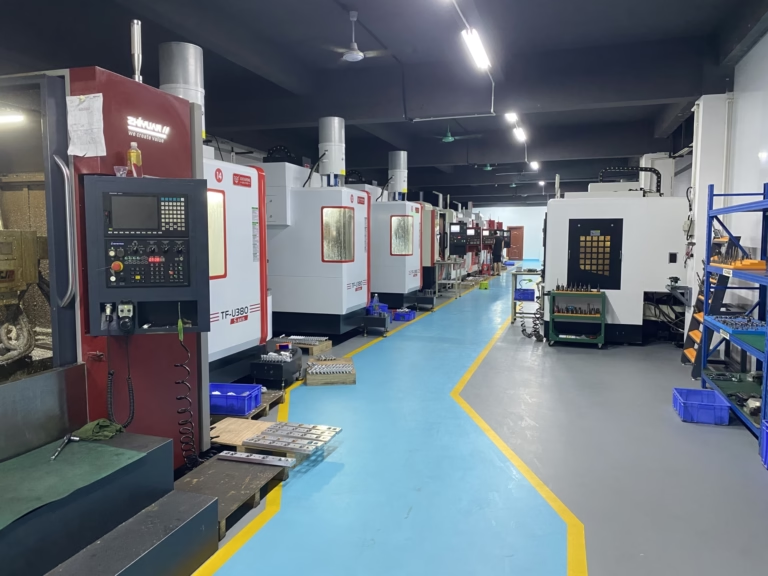
How a portal CNC gantry machining center is built
Picture two upright columns standing on a common bed, joined at the top by a cross-rail. That assembly is the portal, or gantry. The spindle rides on the cross-rail and travels along the rail, while the whole bridge travels along the bed. The work table stays where it is. Nothing under the part moves in X or Y.
That single decision changes everything downstream. On a C-frame vertical machining center the table carries the part back and forth under a fixed column, so the machine has to accelerate the part mass every time X changes direction. On a portal CNC gantry machining center the part is clamped once and stays put. The moving mass is the bridge, the ram, and the spindle head, and the machine builder can size the drives around that known load.
A second consequence is symmetry. The two columns sit on either side of the work zone, so cutting force from the spindle is taken up on both sides of the bridge instead of being fed into one column and one base corner. Symmetric structure also means the two sides expand and contract together as the spindle and drive motors warm up, which keeps the spindle centerline closer to the part centerline over a long cut.
Most machines in this class carry a ram or a spindle carrier that moves vertically on the cross-rail. The rail itself may be fixed or may slide in Y. A fixed cross-rail with a moving ram is the common layout for heavy cutting, because the rail is a stiff beam that never leaves its supports. A sliding rail costs some stiffness but adds Y travel without making the columns taller.
What the axis layout means for cutting
In the usual gantry layout the bridge moves in X along the bed, the spindle carrier moves in Y across the rail, and the ram moves in Z. On a five-axis version, two rotary axes are added, either as a swiveling spindle head or as a trunnion table. The distinction matters for part handling. A head-head machine rotates the tool; a table-table machine rotates the part and adds its mass to the rotary axes.
Because the table is static, you can load a heavy weldment or a cast housing once and leave it. Thermal drift in the part is reduced as well. A part that sits still is not being flexed and released under its own weight each cycle, so a long boring operation stays more consistent from the first pass to the last.
The trade-off is that a gantry needs floor area. The columns, the bed, and the rail guards take up room in a way a compact C-frame machine does not. Long X travel also puts the bridge far from the drives at the extremes of travel, so builders add preload, dual pinions, or linear scales to keep the two sides of the bridge square to each other.
For the programmer, the practical difference shows up in fixturing. On a gantry you can often clamp a part from the top and reach most faces in one setup, because the spindle can travel the full length of the part. Fewer setups means fewer datum shifts, and each shift is a place where tolerance stacks up. That is where the accuracy gain of a gantry usually comes from, not from the frame alone.
Frame stiffness, thermal growth, and accuracy
Stiffness is the headline property. A closed bridge frame resists bending and torsion better than an open C-frame of the same weight, so the machine can take deeper cuts in steel and cast iron without chatter. That translates to heavier radial and axial depth of cut, longer tool life, and fewer light finishing passes to clean up a rough surface left by a flexing machine.
Thermal behavior gets less attention than stiffness but decides accuracy over a long shift. Ball screws, spindle bearings, and drive motors all put heat into the structure. On a symmetric gantry the two columns grow at nearly the same rate, so the bridge stays level. Builders add cooling through the ball screws, temperature sensors on the frame, and compensation tables in the control to correct the small residual change.
Geometric accuracy depends on how the machine was aligned, not just on how it was designed. Squareness between X and Y, straightness of the rail over its full length, and parallelism of the two guideways are set at assembly and checked with a laser interferometer. A machine with 4,000 mm of X travel can lose squareness at the far end if the two sides of the bed are not aligned to each other.
For the buyer, the useful question is not the machine class but the tolerance the shop can hold on the actual part. A gantry machine with linear scales on X, Y, and Z, plus a controlled-temperature shop, can hold tight tolerances on large parts. Without those, the same frame will hold looser tolerances, and no amount of frame stiffness fixes that.
Where gantry machines are used, and where they are not
Typical work includes large mold bases, die plates, machine frames, aerospace structural parts, automotive body and chassis tooling, ship and offshore fittings, and energy components such as wind turbine housings. The common thread is a part that is too large or too heavy for a standard vertical machining center, or a part whose faces are hard to reach in a single setup.
In aerospace, gantry machines cut long stringers, wing ribs, and fixture plates in aluminum, titanium, and Inconel. In automotive tooling, they mill die plates and mold inserts in 4140 and P20. In industrial machinery, they handle weldments and castings in steel and cast iron. The parts are rarely small and rarely light, and the machine is chosen because the part can be loaded once.
A gantry is the wrong choice in several common cases. Small parts with tight tolerances and high volume belong on a compact vertical machining center or a lathe, where cycle time and tool change time matter more than work envelope. Parts with very tight tolerances in every direction on a small footprint, such as medical instruments, are usually cheaper to run on a smaller machine with a faster spindle.
There is also a practical limit on part geometry. A deep pocket in the middle of a large plate can be reached by a gantry, but a tall part that needs access from many sides may need a right-angle head or a five-axis arrangement. And if the part can be split into smaller pieces and bolted together, that is often cheaper than cutting the whole thing on a gantry.
Gantry, C-frame, and five-axis compared
Use this table to pick the machine class for a part, not to rank the classes.
| Machine type | Best for | Weak point | Typical part |
|---|---|---|---|
| Portal gantry | Large, heavy parts in one setup | Floor space and setup time | Mold base, die plate |
| C-frame vertical | Small to medium parts, high volume | Work envelope and part weight | Bracket, housing, cover |
| Five-axis trunnion | Complex angles, contoured surfaces | Part weight on the table | Impeller, medical implant |
| Gantry with five-axis head | Large parts with angled features | Cost and programming time | Aerospace structural part |
Which one fits your part
If the part is larger than about 1,000 mm, heavy, and needs several faces in one setup, choose a portal CNC gantry machining center. If the part is small, high volume, or needs many angled features on a compact footprint, choose a C-frame or a five-axis trunnion machine instead. Let the part size and setup count decide, not the machine class.
Common questions
What is the difference between a gantry and a bridge mill?
The terms are used loosely. In most shops, a gantry machine has two columns that stand on the bed and a bridge that moves over the part. A bridge mill often means the bridge is fixed and the table moves underneath. The moving-bridge layout keeps the part still, which is better for heavy parts.
Ask the builder which element travels in X. That single answer tells you whether the part weight is a problem or not.
How large a part can a portal gantry machine cut?
The limit is set by the machine, not the class. At GreatLight the largest travel is 4,000 × 400 × 150 mm, and other machines cover 750 × 1,150 × 550 mm and 600 × 600 × 600 mm. Parts beyond the largest travel are usually split or machined on a floor-type boring mill.
Check the travel on all three axes, plus the distance from the spindle nose to the table, before you commit a part to a machine.
Does a gantry machine hold tighter tolerances than a C-frame?
Not automatically. On a part that fits both machines, the C-frame can hold the same tolerance or better, because it has less structure to keep aligned. The gantry wins when the part is large enough that setup count and part mass drive the error, not the frame.
Tolerance comes from the machine alignment, the control, the scales, and the shop temperature. Frame type only sets the ceiling.
Why do gantry machines use linear scales?
A long ball screw grows with temperature and can lose accuracy over a full shift. A linear scale reads the actual position of the axis, so the control corrects for screw growth and for backlash. On X travel of several meters, that correction is often worth more than any change to the frame.
Scales also help keep the two sides of the bridge synchronized on a dual-drive machine.
Can a gantry machine cut hardened steel and titanium?
Yes, with the right spindle torque and tooling. The stiff frame is an advantage in 4140, 4340, and tool steel, and in titanium such as TC4 (Ti-6Al-4V) where chatter is the main limit on depth of cut. Inconel and other nickel alloys cut well on a rigid gantry with low surface speed and high-pressure coolant.
The tool and the process matter as much as the machine. A rigid frame with the wrong cutter still produces a poor surface.
What should I check before quoting a large part?
Send the 3D model, the material, the tolerances, and the faces you need machined. The shop can then check travel, workholding, and reach before quoting. A DFM review at that stage often finds a cheaper way to split the part or change a corner radius.
At GreatLight we return a quotation and a free DFM analysis within 12 hours, and production can start within 24 hours of a confirmed order.
Send us your large part
Upload a 3D model and a drawing. We will tell you whether a gantry is the right machine for it, and quote the job.
12-hour quoteNo minimum order quantity100% inspection
More from GreatLight
We publish setup notes, tooling trials and inspection data from the factory floor.











