
What Is a CNC Machine Center?
A CNC machine center is a computer-controlled machining tool that performs milling, drilling, boring and tapping on the same workpiece in one setup. This page explains how it works, what it can and cannot hold, and how to decide whether your part belongs on one. Written for design engineers and buyers who need a straight answer, not a brochure.
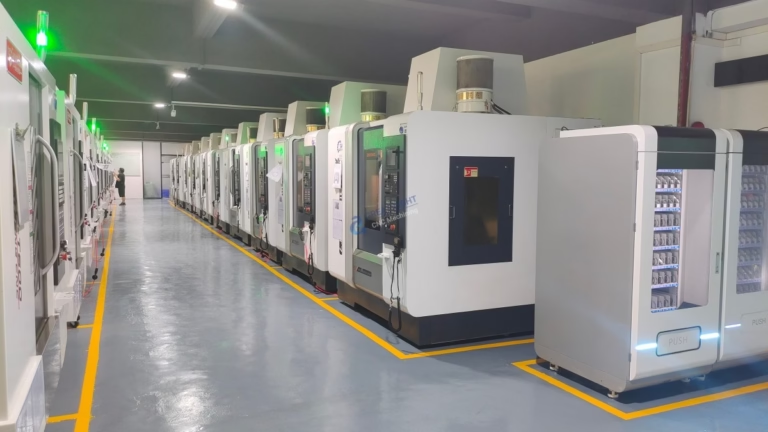
What a CNC machine center actually is
A CNC machine center is a machine tool with a spindle that moves under numerical control, plus an automatic tool changer that swaps cutters without an operator touching the machine. The name distinguishes it from a manual mill or a single-purpose drill press. The word center comes from the ability to bring several operations to one workpiece instead of moving the part across several machines.
The controller reads G-code, a list of coordinates, feed rates, spindle speeds and tool numbers. Each block of code moves an axis to a position. A typical vertical machine center has three linear axes: X, Y and Z. Add a rotary table and you get a fourth axis. Tilt the spindle or the table as well, and you have five axes that can reach a face in a single pass.
That matters because every re-fixture adds error. Clamp a part, cut one face, unclamp, rotate, reclamp, and the second face drifts from the first. On a machine center, one setup can hold the part while the tool works several sides. Fewer setups usually means tighter true position between features and less scrap on complex parts.
The trade-off is cost per hour. A machine center with a 40-taper spindle and a 24-station tool changer costs more to run than a manual mill. It pays back on parts with several features, tight tolerances, or repeat orders. For a single flat bracket with two holes, a drill press and a file may be the cheaper route.
- 1Axes3 linear axes standard; 4th and 5th add reach and reduce setups
- 2Tool changerSwaps 10 to 40+ tools automatically, so one program runs many operations
- 3ControllerExecutes G-code generated from a CAM model of the part
How the cut is made: spindle, feed and rigidity
Cutting happens when a rotating tool is pushed into the material. The spindle provides rotation, the axes provide feed, and the machine structure resists the resulting force. If the structure flexes, the cutter chatters and the surface turns rough. That is why a heavy cast iron base and a box-way or linear-guide system matter more than a long spec sheet of feed rates.
Surface finish and tolerance depend on a balance of speed, feed and depth of cut. Aluminum 6061 machines at 3,000-10,000 rpm with a two- or three-flute carbide cutter, cutting dry or with a light mist. Stainless 304 work-hardens, so the cutter must keep biting: a light chip load on a dull tool will harden the surface and ruin the next pass. Tool steel and Inconel need lower surface speed and rigid setup.
Heat is the quiet enemy. A part that measures 50.000 mm warm can shrink below tolerance once it cools. For tight work, we rough the part, let it stabilize, then finish. A ±0.005 mm callout on a 300 mm aluminum plate is achievable on a rigid machine center. The same callout on a thin 1 mm wall is not, because the wall deflects under the cutter.
- 1Rigid setupShort tool overhang, solid vise, minimal unsupported stock
- 2Right speedsAluminum runs fast and dry; stainless and titanium run slower with coolant
- 3Thermal controlRough, cool, then finish when the part holds a stable size
3-axis, 4-axis and 5-axis: what each one buys you
A 3-axis machine moves the cutter in X, Y and Z. It handles plates, pockets, faces, slots and most prismatic parts. If every feature is reachable from the top or from a small number of sides you can re-fixture, 3-axis is the cheap and fast answer. GreatLight runs 27 three-axis machines for exactly that kind of work.
A 4-axis machine adds rotation around one axis, usually the X or a rotary table. Think of a shaft with flats, a cam, or a part with holes spaced around a cylinder. The part turns while the tool stays put, so the angular spacing comes from the controller, not from a hand-set fixture. This removes a whole class of index errors.
A 5-axis machine adds a second rotary axis. The tool can now approach the part from an angle, so undercuts, deep pockets and blended surfaces can be cut without re-fixturing. It also lets a short, stiff cutter reach deep features by tilting the part toward it. That is the practical benefit: not just complex geometry, but less chatter and fewer tools.
Five axes is not free. Programming takes longer, the machine costs more per hour, and the setup demands a skilled operator. If your part is a flat plate with holes, 5-axis adds cost and no value. If it is an impeller, a medical housing with angled ports, or a single-piece bracket that would need six setups on a 3-axis, it usually wins.
- 13-axisPlates, pockets, prismatic parts; lowest cost per part
- 24-axisShafts, cams, radial hole patterns; one rotation, fewer setups
- 35-axisUndercuts, blended surfaces, deep pockets; shortest cutter reach
Work envelope, tooling and what fits on the table
Every machine center has a work envelope: the volume the spindle can reach. GreatLight's largest travel is 4,000 × 400 × 150 mm for long parts such as rails and extrusion profiles. Medium machines cover 750 × 1,150 × 550 mm and 600 × 600 × 600 mm for general housings and fixtures. Compact cells at 500 × 500 × 450 mm and 500 × 310 × 200 mm handle small, high-mix parts. A Ø400 mm rotary table adds 4-axis capacity on selected machines.
Part size is only half the question. Tool access matters too. A 200 mm deep pocket in a 300 mm block may fit the envelope but not the cutter, because a long tool bends. Sometimes the answer is a smaller cutter with a longer flute and many light passes, which costs time. Rotary tables and angle heads can open up features that a straight Z-axis cannot reach.
Materials shape tool choice. Aluminum 6061, 7075 and ADC12 cut freely with uncoated or ZrN-coated carbide. Stainless 316L and 17-4PH need sharper edges and coolant. Titanium Ti-6Al-4V and Inconel demand low surface speed and generous coolant flow to keep heat out of the edge. Plastics such as POM and PEEK need sharp, polished flutes and high spindle speed to avoid melting.
Before quoting, we look at three things: the smallest internal radius, the deepest pocket, and the tightest tolerance. Those three numbers decide the machine, the tooling and the number of setups. When a drawing shows a sharp internal corner, we call it out in the DFM review rather than quietly adding a corner-break charge.
- 1Max travel4,000 × 400 × 150 mm on the largest machine
- 2Rotary workØ400 mm table for 4-axis parts
- 3DFM checkSmallest radius, deepest pocket, tightest tolerance
Which machine center for which part
Use the feature set and tolerance to pick the axis count before you pick a supplier.
| Part feature | Best machine | Typical tolerance | Watch out for |
|---|---|---|---|
| Flat plate, pockets, through holes | 3-axis vertical | ±0.01 mm | Re-fixturing for side holes |
| Shaft with flats or cross holes | 4-axis with rotary table | ±0.01 mm | Index error if hand-set |
| Radial hole pattern on a cylinder | 4-axis | ±0.005 mm | Angular spacing must come from CAM |
| Impeller, blade, blended surface | 5-axis simultaneous | ±0.005 mm | Programming time and cost |
| Deep pocket with undercut | 5-axis | ±0.005 mm | Cutter reach and chatter |
| Thin wall under 1 mm | 3-axis, light passes | ±0.02 mm | Deflection, not machine error |
| Long rail or extrusion | 3-axis, 4,000 mm travel | ±0.02 mm | Sag over long unsupported spans |
| One-off prototype, 2 holes | 3-axis or drill press | ±0.05 mm | Machine center may be overkill |
The takeaway
Choose a 3-axis machine center for plates and prismatic parts where cost and speed matter. Step up to 4-axis for radial features, and to 5-axis only when the geometry or the tolerance demands it. If your part fits in a small envelope, has few features and loose tolerance, a machine center may not be the right tool at all.
Common questions about CNC machine centers
What is the difference between a CNC machine center and a CNC mill?
A CNC mill usually refers to a machine with a manually changed tool or a small automatic changer, often 3 axes. A machine center adds a larger tool magazine, an enclosed work area, coolant through the spindle on some models, and often a pallet changer. The practical difference is unattended run time and the number of operations per setup.
How tight a tolerance can a CNC machine center hold?
On a rigid machine with a stable setup, ±0.005 mm is achievable on features that are not thin or flexible. The limit is usually the part, not the machine. A 1 mm wall or a long slender tool will deflect well before the machine runs out of resolution. We quote the tolerance the setup can actually hold, not the number on the spec sheet.
When should I not use a 5-axis machine center?
If every feature is reachable from the top, or from a handful of sides you can re-fixture, 3-axis is faster and cheaper. Five axes adds programming time and a higher hourly rate. It earns its cost on undercuts, blended surfaces, deep pockets that need a short cutter, and parts that would otherwise need many setups.
What materials can be machined on a machine center?
Aluminum 6061, 7075 and ADC12 are the most common. Stainless 303, 304, 316L and 17-4PH, steels such as 1045 and 4140, brass C36000, titanium Ti-6Al-4V and Inconel are all machined here. Plastics like POM, PEEK and ABS also run on the same machines with different tooling and speeds.
How do you handle a part that does not fit the work envelope?
We look at whether the part can be split into sub-assemblies, or whether a feature can be reached with an angle head or a rotary table. Sometimes the answer is a different process, such as sheet metal fabrication for a large enclosure. We tell you at the DFM stage, before a quote goes out.
Do you inspect parts before they ship?
Yes. Every order gets a raw material check, in-process monitoring and a final inspection before shipment. Reports are available on request. We hold ISO 9001:2015, IATF 16949:2016, ISO 13485:2016 and ISO 27001:2022 certifications.
Send us your drawing
Upload a STEP file and get a quotation plus a free DFM analysis within 12 hours. No minimum order quantity, from one prototype to a 10,000-part run.
12-hour quote100% inspectionNDA on request1 pc to 10,000+
More from GreatLight
We publish setup notes, tooling trials and inspection data from the factory floor.











