
What Is Ball Screw in CNC Machine?
A ball screw in CNC machine axes is a rolling contact drive that turns the servo motor's rotation into linear motion with very low friction. This article explains the recirculating mechanism, the numbers that matter to an engineer, and when a ball screw is the wrong choice.
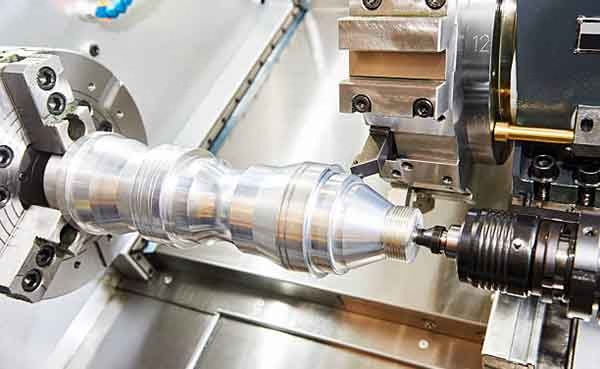
How a ball screw in CNC machine axes converts rotation
A ball screw is a screw shaft with a helical groove ground or rolled into it, a matching nut with the same groove, and a train of hardened steel balls running between the two. The balls roll along the groove, so the nut travels along the shaft on rolling contact instead of sliding contact.
When the servo motor turns the shaft, the balls circulate through a return path inside the nut and re-enter the groove at the other end. One full turn of a 10 mm lead screw moves the nut 10 mm. There is almost no stick-slip at low speed, which is why a ball screw holds a consistent finish on light finishing passes.
The preload matters as much as the screw itself. A preloaded double nut removes axial play so the axis can reverse direction without a dead band. On a machine cutting to ±0.005 mm, backlash of 0.02 mm would show up as a step on every direction change.
Friction coefficient is roughly 0.003 to 0.005 for a ball screw against 0.1 to 0.3 for a sliding lead screw. That difference is what lets a smaller servo motor drive a heavier table at the same acceleration.
- 1Rolling, not slidingBalls carry the load, so wear is spread over many contact points.
- 2Low backlashPreload takes up axial play for accurate reversal.
- 3High efficiencyAround 90% of input torque becomes linear thrust.
Lead, preload, and accuracy class in a CNC machine
Lead is the distance the nut travels in one shaft revolution. A 5 mm lead gives finer resolution but slower rapid moves. A 20 mm lead moves fast but needs more motor torque to hold the same cutting force. Most 3-axis mills sit between 5 mm and 10 mm.
Accuracy classes run from rolled screws for general positioning to ground screws for tight work. A ground C3 screw may hold 0.008 mm per 300 mm of travel; a rolled screw of the same diameter may drift 0.05 mm over the same length. The class, not the brand, sets the floor on what your machine can hold.
Preload is usually 2% to 8% of the dynamic load rating. Too little and the axis rattles on reversal. Too much and friction climbs, the screw runs hot, and service life drops. On a 4,000 mm travel axis, thermal growth along the shaft can reach 0.02 mm if the screw is not cooled or compensated.
Ball diameter and circuit count also set stiffness. More circuits share the load and raise rigidity, but they add drag torque. A screw sized for a 500 × 500 × 450 mm machine does not need the same circuit count as one driving a 4,000 × 400 × 150 mm gantry.
Where a ball screw in CNC machine work pays off
Any axis that reverses direction under load benefits. That covers X, Y, and Z on a mill, the Z axis on a router, and the linear axes on a laser or plasma table. The tighter the tolerance, the more the ball screw earns its cost.
It also suits high duty cycles. A machine running three shifts will wear a sliding screw fast; the rolling contact in a ball screw spreads that wear and keeps accuracy longer between adjustments.
Parts that need mirror finishes gain too. Because there is no stick-slip, the tool does not chatter when the axis creeps at 10 mm/min. That is the difference between Ra 0.2–0.8 μm and a surface that needs hand polishing.
Medical and aerospace work often calls for it. A fixture that holds a bone plate or a bracket must repeat to ±0.005 mm across thousands of cycles, and a preloaded ball screw is the usual way to get there.
- 1Positioning axesX, Y, Z on mills and routers.
- 2High duty cyclesThree-shift production cells.
- 3Fine finishesCreep feed passes without chatter.
- 4Tight repeatabilityFixtures and gauges that cycle daily.
When a ball screw in CNC machine is the wrong choice
A ball screw does not self-lock. On a vertical axis, gravity will pull the slide down when the motor is off, so you need a brake or a counterbalance. A lead screw with a steep enough lead will hold itself, which is why cheap drill presses still use one.
Contamination is the other limit. Chips and fine dust destroy the raceway. A screw without wipers or a bellows will lose preload in months. In a graphite or carbon-fiber shop, this matters more than the accuracy class you paid for.
Very long travel is a problem too. Past about 4,000 mm, shaft sag and whip force you to lower the critical speed. A rack and pinion or linear motor often wins on gantries that long.
Cost is the last filter. If the axis only needs 0.1 mm, a belt or a rolled lead screw will do the job for less. Specifying a ground ball screw there just adds money without adding capability.
Ball screw vs lead screw in a CNC machine
Same diameter, same travel, different result.
| Property | Ball screw | Lead screw |
|---|---|---|
| Friction | 0.003–0.005 | 0.1–0.3 |
| Efficiency | About 90% | About 30–50% |
| Backlash | Low with preload | Higher, wears in |
| Reversal accuracy | µm level | Tens of µm |
| Speed limit | High, 1 m/s plus | Low to medium |
| Load holding | Needs brake | Self-locking on steep lead |
| Cost | Higher | Lower |
| Best for | Positioning axes | Manual or slow feed |
The verdict on ball screw in CNC machine design
If the axis must reverse under load and hold µm-level position, choose a preloaded ground ball screw. If it only needs to move slowly, hold its own weight, or travel past 4,000 mm, choose a lead screw, brake motor, or rack and pinion instead.
Ball screw in CNC machine questions
Does a ball screw need lubrication?
Yes. Grease or oil forms a film that keeps the balls from metal-to-metal contact. Without it, friction and wear rise fast.
Most machine builders specify a lithium-based grease for the nut and a light oil for the shaft. Re-lube intervals depend on duty cycle; a three-shift cell may need it monthly.
How much backlash is acceptable?
For work held to ±0.005 mm, keep backlash under 0.005 mm. Above that, the cutter will leave a step on every reversal.
Preload the nut to remove axial play, then re-check after the first 100 hours of running. Break-in often loosens the fit slightly.
Can a ball screw be repaired?
Usually the nut is replaced, not repaired. If the raceway is pitted, the balls and nut are scrapped together.
A lightly worn screw can sometimes be re-balled with oversize balls, but accuracy class will not return to original. For critical axes, plan on replacement.
Why does my axis drift when the motor is off?
A ball screw has low friction and no self-locking. On a vertical axis, gravity wins as soon as the servo releases.
Fit a brake on the motor or a counterbalance cylinder. Do not rely on the screw to hold the load.
What causes a ball screw to make noise?
A whining or knocking sound usually means the preload has changed, the screw is misaligned, or the return tube is damaged.
Check mounting parallelism first. Then check lubrication. If the noise stays, pull the nut and inspect the balls for flat spots.
Need parts machined to ±0.005 mm?
Send your drawings and we will return a quote plus a free DFM review within 12 hours.
12-hour quote100% inspectionNo MOQ
More from GreatLight
We publish setup notes, tooling trials and inspection data from the factory floor.











