
What Is CNC Laser Machine?
A CNC laser machine combines a computer-controlled motion system with a focused light beam that melts, burns or vaporizes material along a programmed path. This page explains the mechanism, the machine types and the cut quality you can expect. It is written for engineers and buyers who need to judge whether a laser is the right process for a given part.
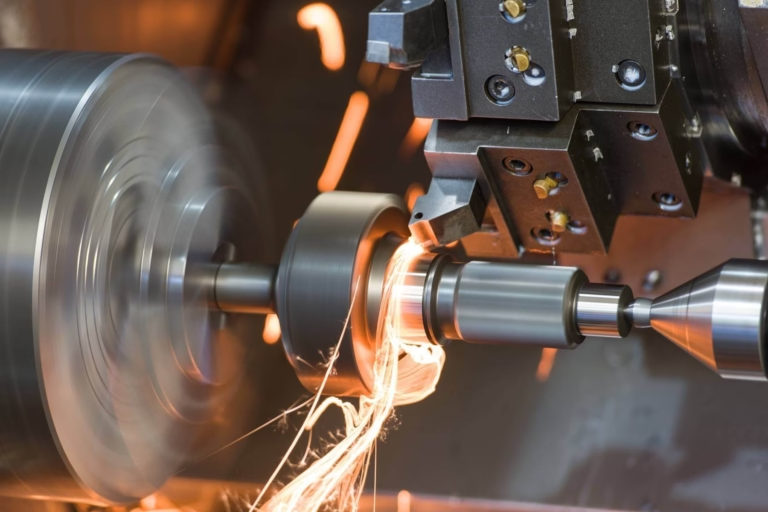
What is CNC laser machine control actually doing
A laser cutter is two systems bolted together. The first is a resonator that produces a narrow, coherent beam. The second is a CNC motion platform that carries the cutting head along X, Y and usually Z. The controller reads G-code, drives the axes, and fires the beam only where the toolpath says so. The computer does not cut anything; it decides where and when the light lands.
That split matters when you diagnose a problem. Bad geometry is usually a motion or programming issue. Bad edge quality is usually a beam, gas or focus issue. Keeping the two apart saves hours of guessing.
The beam itself is invisible in the infrared range. What you see at the nozzle is the plasma plume and the bright spot where metal vaporizes. For steel and stainless steel, cutting gas also drives the molten material out of the kerf. Laser cutting is a thermal process with a mechanical assist, not a mechanical process with a hot tool.
Fiber, CO₂ and Nd:YAG laser sources
Fiber lasers dominate metal fabrication. A doped glass fiber amplifies light near 1,070 nm, and the beam can be delivered through a flexible cable to a moving head. Wall-plug efficiency is high, maintenance is low, and the short wavelength couples well into steel, stainless and aluminium. Sheet thickness from 0.5 mm to about 20 mm is routine on a mid-power fiber machine.
CO₂ lasers emit near 10,600 nm and couple better into non-metals. Wood, acrylic, fabric, MDF and some ceramics cut cleanly with a CO₂ source. On thin metal the CO₂ beam reflects and loses efficiency, so fiber has largely replaced it there. Nd:YAG is an older solid-state design still found in welding and drilling cells, but it is rare on new flat-bed cutting machines.
The practical question is material, not branding. If the part is metal and under 20 mm, fiber is the default. If it is acrylic or plywood, CO₂ still wins.
- 1FiberBest for steel, stainless, aluminium, copper and brass
- 2CO₂Best for acrylic, wood, MDF, fabric and some ceramics
- 3Nd:YAGNiche use in welding and drilling, rarely seen in new cutting cells
From CAD file to cut part
The workflow starts in CAD. The designer exports a 2D profile or a flat pattern, then CAM software assigns lead-ins, kerf offset and cut order. Kerf is the width of material the beam removes, typically 0.1–0.3 mm on thin sheet and wider on thick plate. If you ignore kerf, every hole comes out undersize and every outer profile comes out oversize.
The post-processor writes G-code. On the machine, the operator loads the sheet, sets focus, selects the gas and confirms the program. Piercing happens before cutting: the beam dwells at one point until it burns through, then the axes start moving. Thick plate needs a longer pierce and often a higher-pressure assist gas.
Nesting software then packs as many parts as possible onto one sheet. This is not cosmetic. On a 4,000 mm sheet, good nesting can move material utilization from 65% to over 80%, which changes the quoted price more than a small change in cut speed.
Where laser cutting stops and milling takes over
Laser cutting is a 2D process with a thermal edge. It cannot produce a true 3D contour, an internal thread, a counterbore or a sharp internal corner. The kerf is a rounded slot, so every inside corner carries a radius of roughly half the kerf width. If the drawing calls for a square internal corner, the part is not a laser part.
The heat-affected zone is the second limit. On thin sheet the HAZ is a few tens of microns and rarely matters. On 12 mm stainless it can reach 0.2–0.5 mm, and the cut face carries a thin oxide layer. For a structural bracket that is fine. For a sealing face or a fatigue-critical aerospace part, it is not.
Tolerance is the third limit. A typical fiber laser holds ±0.1 mm on thin sheet and ±0.2 mm on thick plate. That is far looser than the ±0.005 mm we hold on our 5-axis machining centers. A laser-cut blank fed into a CNC mill is a common and sensible pairing: fast profiling first, then precision finishing on the features that matter.
- 1Good fitFlat brackets, panels, gaskets, enclosures, prototypes
- 2Poor fitThreaded holes, deep pockets, true 3D contours, tight bores
What the cut edge tells you about the process
Look at a laser-cut edge under magnification and you see striations. These are the marks left as the beam advances and the melt front oscillates. Finer striations mean a stable cut; coarse or irregular striations mean speed, focus or gas pressure is off. A dross-free bottom edge on mild steel is a sign the oxygen balance is right.
On stainless and aluminium, nitrogen is the usual assist gas. It produces a clean, oxide-free edge but needs higher pressure. On mild steel, oxygen is common because the exothermic reaction adds cutting energy and allows faster speeds on thicker plate. The trade-off is a slightly oxidized edge that may need a secondary operation before welding or painting.
Laser marking is the same machine doing a different job. Instead of cutting through, the beam alters the surface. We offer laser marking and engraving with a minimum character height of 1.5 mm, which is a practical floor for legible part numbers and logos.
Laser cutting vs CNC milling: quick comparison
Use this table to pick the process before you request a quote.
| Factor | CNC laser cutting | CNC milling |
|---|---|---|
| Geometry | 2D profiles and holes | 3D contours, pockets, threads |
| Typical tolerance | ±0.1 mm thin sheet | ±0.005 mm |
| Edge finish | Ra 3–12 μm, striated | Ra 0.8–1.6 μm typical |
| Heat effect | Thin HAZ, oxidized edge | None from cutting |
| Internal corners | Radius ≈ half kerf | Sharp, tool-limited |
| Threads and bores | Not possible | Standard capability |
| Setup speed | Fast for flat parts | Faster for complex 3D |
| Best volume | One-off to high volume | One-off to 10,000+ parts |
Pick the process, not the machine
If the part is flat, has no threads and tolerances are looser than ±0.1 mm, laser cutting is the cheaper route. If it has 3D features, tight bores or a sealing face, go straight to CNC milling. Many production parts use both: laser for the blank, milling for the critical features.
Common questions
Can a CNC laser machine cut through metal?
Yes. A fiber laser melts and vaporizes metal along the toolpath, and assist gas blows the molten material out of the kerf.
On a mid-power fiber machine, mild steel and stainless up to roughly 20 mm are routine. Beyond that, cut speed drops sharply and the edge quality becomes harder to control.
Is laser cutting accurate enough for mating parts?
For most sheet metal assemblies, yes. A fiber laser holds about ±0.1 mm on thin sheet and ±0.2 mm on thick plate.
If two parts must mate on a precision bore or a sealing face, laser alone is not enough. Combine laser profiling with CNC milling on the critical features.
What materials should not be laser cut?
PVC and other chlorine-containing plastics release corrosive fumes and should be avoided. Polyurethane foams and some composites also cut poorly.
Highly reflective metals such as copper and brass can damage the optics on lower-power machines. Higher-power fiber sources handle them, but the process window is narrower.
Does laser cutting leave a heat-affected zone?
Yes, every thermal cut leaves a HAZ. On thin sheet it is a few tens of microns and rarely matters.
On 12 mm stainless it can reach 0.2–0.5 mm, and the edge carries a thin oxide layer. If that edge will be welded or fatigue-loaded, plan a secondary machining or finishing step.
How does GreatLight use laser processes alongside CNC machining?
We run 127 high-precision CNC machines across 3 wholly-owned plants, including 16 simultaneous 5-axis centers, and we pair laser profiling with milling where a part needs both fast flat geometry and tight 3D features.
Uploads are secure and confidential, and an NDA is available on request. Quotation and free DFM analysis come back within 12 hours.
Send us the drawing and we will tell you which process fits
Quotation and free DFM analysis within 12 hours, no minimum order quantity, and 100% inspection before shipment.
12-hour quote100% inspectionNo MOQ
More from GreatLight
We publish setup notes, tooling trials and inspection data from the factory floor.











