
What Is CNC Machine in Urdu? A Working Guide
This page explains what a CNC machine is, in the plainest English we can write, in the same order we explain it to new operators. You will see how the tool moves, what the controller actually reads, and when a part is worth cutting on a CNC machine.
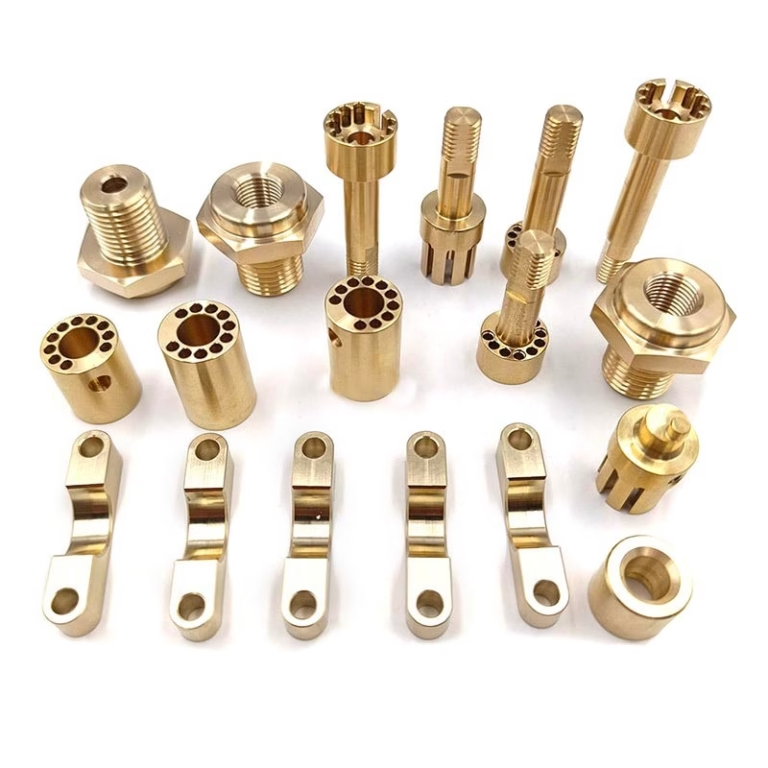
What a CNC machine actually is
A CNC machine is a machine tool that cuts metal or plastic under the control of a computer, not under the hand of an operator. The operator still sets up the job, but the axis motion during cutting comes from a program. That is the whole idea. The letters stand for computer numerical control. In older machine shops, a machinist turned handwheels and read dials. On a CNC machine, those handwheel positions become numbers in a file, and the control reads the numbers and drives the motors.
The program is written in G-code. G-code is a list of commands, one per line: move here, spin the spindle at this speed, feed at this rate, change to this tool. Each line describes one small piece of the path. The control reads the list from top to bottom and executes it, thousands of times per second. This is why the same file can produce the same part in Dongguan or in Ohio.
The machine does not know what the part is. It only knows positions, speeds and feeds. A boring operation and a facing operation look identical to the control. The meaning comes from the drawing and from the person who wrote the program. If the drawing is wrong, the machine will cut the wrong part very accurately.
So a CNC machine is best understood as a very obedient, very stiff, very repeatable hand. It has no judgment. Setup, tool choice, and inspection are still human work.
How the tool moves: axes, spindles and coordinates
Most CNC work happens in three linear axes: X, Y and Z. X and Y move the table or the head across the work; Z moves the tool up and down toward the part. A three-axis machine can cut pockets, slots, holes and flat faces. It cannot easily reach the underside of a feature without the part being turned over and re-fixtured.
Add a rotary axis and you get four axes. Add two rotary axes that work together and you get five. Five-axis machines tilt the tool or the part while cutting, so the tool can approach a surface from an angle instead of straight down. That matters for impellers, engine housings, and any part with holes on several faces. It also lets a short, stiff tool reach deep features.
Feeds and speeds come from the material, not from habit. Aluminium 6061 runs fast, often 3,000 to 10,000 rpm on small tools. Stainless 316 and titanium TC4 run slower because they work-harden and hold heat at the cutting edge. If the feed is too light, the tool rubs instead of cutting. If it is too heavy, the tool breaks.
Coordinates are measured from a zero point the operator sets on the part. Move that zero and every feature shifts. That is why first-article inspection matters more than operator confidence.
Tolerance, finish and what drives cost
Tolerance is the allowed size range on a dimension. On our machines, a well-set job holds ±0.005 mm. That is not the same as saying every dimension on every part will hit it. Deep bores, thin walls and long parts flex, and the tolerance has to loosen to stay manufacturable.
Surface finish is separate from tolerance. A part can be dead on size and still fail because the surface is torn. As-machined finish usually lands around Ra 1.6–3.2 μm. With a finer stepover and a sharp tool, we reach Ra 0.8–1.6 μm. Polished or lapped surfaces go lower, but that is a second operation, not a milling trick.
Cost climbs fast when you tighten two things at once: a tight tolerance on a large part, and a fine finish on a hard material. Both push the shop into slower passes, more tool changes and more inspection time. A 200 mm aluminium bracket is cheap to hold at ±0.05 mm. The same bracket in Inconel at ±0.01 mm is not.
The practical question is never "how accurate can you be". It is "which dimensions on this drawing actually need to be tight". Mark those, let the rest run loose, and the price drops without the part getting worse.
When CNC is the right process, and when it is not
CNC cutting wins when the part has tight features, hard material, or a shape that has to survive real load. It also wins in the middle of a project: 50 brackets today, 500 next month, same drawing. There is no tooling to cut, so the first part and the five-hundredth part come off the same program.
CNC is a poor fit when the part is a thin shell with no critical dimensions, or when you need 100,000 identical simple pieces. Die casting or stamping will beat it on unit price once tooling is paid off. We run both processes in house, so we can say this without bias.
It is also a poor fit when the geometry is organic and internal, with lattice or hollow channels that a cutter cannot reach. That is additive territory. Many real programs mix the two: print the complex core, machine the sealing faces and bores.
One more boundary. CNC needs a fixturing surface. If the part has no flat face, no boss and no stock to hold, the first operation becomes a fight. Adding a small tab that gets cut off later often saves more money than any tool-path work.
What happens between your file and a finished part
A job starts with a model and a drawing. We read the drawing, check that every critical dimension is reachable, and send back a DFM note if something cannot be cut as drawn. Quotation and that DFM analysis come back within 12 hours. We do this before any metal is ordered, because a two-line drawing change can remove a whole operation.
Then programming. The CAM engineer picks tools, sets stepover, and decides the order of operations. A part with six faces may need three setups or one five-axis setup. On a five-axis machine with a Ø400 mm rotary table, we often finish five sides in one clamping, which protects the alignment between features.
Setup and first article come next. The operator sets zero, cuts the first part, and inspects it against the drawing. If the first part is good, production can start within 24 hours. Every part is inspected before shipment, with raw material checks, in-process monitoring and a final inspection. Reports go out on request.
Our three plants run 127 high-precision CNC machines, including 16 simultaneous five-axis centers and 16 mill-turn centers. Maximum processing size is 4,000 mm. We hold ISO 9001:2015, IATF 16949:2016, ISO 13485:2016 and ISO 27001:2022. Uploads stay confidential and an NDA is available.
CNC process compared with common alternatives
Read this as a first filter, not a rule.
| Process | Best fit | Typical lead time | Watch out for |
|---|---|---|---|
| 3-axis CNC | Flat plates, pockets, drilled holes | 3–5 days after setup | Undercuts need a second setup |
| 5-axis CNC | Angled faces, impellers, housings | 3–5 days after setup | Higher hourly rate; needs good CAM |
| CNC turning | Round parts, shafts, bushings | 3–5 days after setup | Off-center holes add a second op |
| Die casting | High volume simple metal parts | Tooling weeks, then fast | Tooling cost; porosity risk |
| 3D printing | Lattices, hollow internal channels | Fast first article | Weaker material, rough surface |
| Sheet metal | Enclosures, brackets, panels | Fast, low tooling | Limited to constant thickness |
The short answer
If your part has tight features, hard material, or a shape that must survive load, cut it on a CNC machine and keep the critical dimensions tight. If it is a simple high-volume shell, move it to casting or stamping and use CNC only for the faces that mate.
Questions engineers ask next
Is a CNC machine the same as a machining center?
Not quite. A machining center is one type of CNC machine, usually a mill with a tool changer and an enclosed work area.
CNC lathes, routers, grinders and EDMs are also CNC machines. They share the controller and the program, not the geometry.
Can one program run on any CNC machine?
No. G-code is close to universal, but tool numbers, work offsets and machine travel differ. A program written for a 500 × 500 × 450 mm machine may not fit a smaller one.
Shops repost programs for each machine. That is normal, not a sign of a problem.
Why does a tight tolerance cost so much more?
Tight tolerance forces slower passes, more tool changes, temperature control and more inspection. All of that is time.
Mark only the dimensions that carry function. The rest can run at shop standard and the price falls.
What materials can a CNC machine cut?
Most metals and many plastics. We machine aluminium 6061, 7075 and ADC12, stainless 303, 304, 316L and 17-4PH, steels such as 1045 and 4140, copper alloys, titanium TC4, Inconel, magnesium, plus POM, PEEK, PC and carbon fibre.
Harder and gummier materials cut slower and wear tools faster, which shows up in the price.
What file format do you need for a quote?
STEP and IGES cover most parts. Native files from SolidWorks, Creo or NX also work, and a 2D PDF or DXF helps for sheet metal.
Send the drawing with tolerances marked. Without them we have to guess, and guessing adds cost.
How do you handle confidentiality?
Uploads are secure and confidential. We sign an NDA on request before files are shared with the shop floor.
Access to customer files is limited to the programmers and machinists on that job.
Send a drawing and get a real answer
Upload your model and drawing. We reply with a quote and a free DFM analysis within 12 hours, then ship in 3–5 days.
12-hour quoteNo MOQ100% inspection
More from the shop floor
We publish setup notes, tooling trials and inspection data from the factory floor.











