
What Is CNC Machine Tools?
A CNC machine tool is a cutting machine whose axes, spindle, and tool changes are driven by a program instead of a handwheel. This page breaks the system into its three parts, shows what each machine type can hold, and gives engineers a way to judge whether a part belongs on one. Written for design and sourcing teams who need to read a machine list and know what it means.
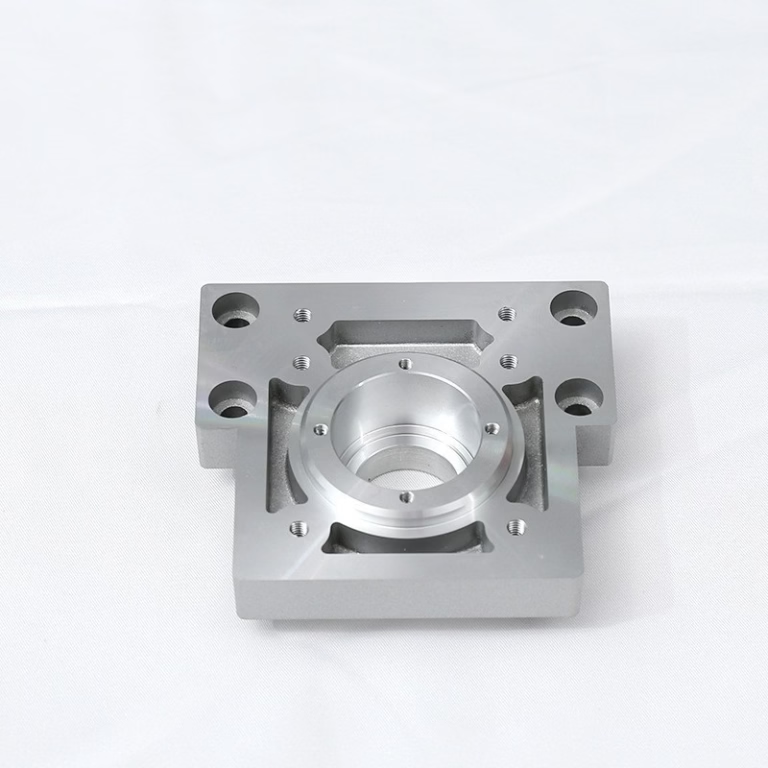
What is CNC machine tools? The three parts of the system
Every machine tool is a machine, a control, and a set of tooling. The machine is the frame, the axes, and the spindle. The control reads a program and tells the drives where to move. The tooling is what actually cuts. Change any one of the three and the parts you can make change with it.
The machine sets the size limit. A 3-axis vertical mill with 750 × 1,150 × 550 mm of travel holds a part roughly the size of a small gearbox housing. A mill-turn center with a Ø400 mm rotary table holds round parts that need turning and milling in one setup. When a print is larger than the travels, no amount of programming fixes it.
The control sets the accuracy you can hold. Servo drives with glass scales and thermal compensation hold ±0.005 mm on aluminum and brass. Older stepper controls on a warm shop floor may drift to ±0.05 mm over a long run. Ask what control and feedback system sits on the machine before you quote a tolerance.
The tooling sets the surface and the cycle time. A sharp 3-flute carbide end mill in 6061 aluminum cuts cleanly at 8,000–12,000 rpm. The same cutter in 316 stainless needs slower speeds and more coolant, or the edge breaks down and the finish turns rough. Tool choice is a per-material decision, not a machine decision.
How 3-axis, 4-axis, and 5-axis machine tools differ
A 3-axis machine moves the tool in X, Y, and Z. The part stays still after clamping. It is the fastest and cheapest way to cut flat plates, pockets, and drilled holes. Most brackets, covers, and heat sinks never need more than three axes.
A 4-axis machine adds a rotary table that turns the part around one axis. This lets you cut four sides of a block without re-fixturing. It is the right call for a part with features on two or three faces and a positional tolerance between them.
A 5-axis machine moves the tool or the table in two extra rotary axes at the same time. The tool can approach a curved surface from the correct angle instead of dragging across it. Impellers, turbine blades, and complex organic housings are the classic cases. Setup count drops, which matters when a part has six features on five faces.
Five axes are not free. Simultaneous motion is slower than a 3-axis cut, and programming takes longer. If a part is a flat plate with a few holes, a 5-axis machine is the wrong tool. Use it when the geometry or the setup count demands it.
What machine tools do to different materials
Aluminum is the easy case. 6061, 7075, and 2024 cut fast with carbide tooling and hold tight tolerances well. Surface finish lands at Ra 0.8–1.6 μm without special effort. The main risk is thin walls moving after the cut because the material releases stress.
Stainless is slower. 303 and 304 work-harden if the cutter rubs instead of cutting, so feeds stay heavy and speeds stay moderate. 316L and 17-4PH are common in medical and food-contact parts, and both need sharp tooling and steady coolant to hold a finish.
Titanium and Inconel are the hard cases. TC4 (Ti-6Al-4V) conducts heat poorly, so the heat goes into the cutter. Speeds drop, tool life drops, and cycle times climb. Inconel is worse. Plan for more passes and more inspection on these parts.
Plastics and composites behave differently again. POM and PEEK cut cleanly but can chip at the edge if the feed is too light. Carbon fiber wears tooling fast and needs dust control. The machine is the same; the parameters and the tool coating change.
When a CNC machine tool is the wrong answer
CNC cutting is subtractive. It removes material from a solid block. That is efficient for one part or a thousand, but wasteful when the part is a thin shell that could be formed or molded. A stamped bracket at 100,000 pieces costs a fraction of a milled one.
Very small features hit a wall too. A cutter has a diameter, and a pocket narrower than that cutter cannot be cut. Deep pockets need long, thin tools that deflect, so the practical depth-to-diameter ratio stays around 3:1 for tight tolerances and 5:1 for looser ones.
Sharp internal corners are another limit. A round cutter leaves a radius equal to its radius. If the print calls for a square corner, either the design changes to add a relief or the corner is finished by EDM, which is a different process.
Finally, hardness matters. A machined part can be heat-treated after cutting, but a part already at 60 HRC is ground, not milled. If the print specifies a hardened tool steel block, the process route changes.
Which machine tool for which part
Match the part geometry to the machine before you quote. The wrong choice adds setups, cost, and error.
| Part feature | Machine type | Why |
|---|---|---|
| Flat plate, holes, pockets | 3-axis | Single setup, fastest cycle |
| Features on 3–4 faces | 4-axis | Rotary table cuts faces without re-clamping |
| Curved surfaces, impellers | 5-axis simultaneous | Tool follows the surface angle |
| Long shaft with flats | Mill-turn | Turning and milling in one setup |
| Part over 4,000 mm | Not on our list | Beyond machine travel |
| Titanium deep pockets | 5-axis + high-pressure coolant | Heat and chip evacuation control |
The short answer
Choose a 3-axis machine tool for flat parts and simple holes, a 4-axis for multi-face features, and a 5-axis only when the surface geometry or the setup count justifies the extra cost. If the part is a thin shell at high volume, subtractive machining is the wrong route.
Frequently asked questions
What is the difference between a CNC machine and a CNC machine tool?
A CNC machine is the whole system: frame, drives, control, and enclosure. A machine tool is the cutting machine inside it, the part that holds the spindle and the workpiece.
In everyday shop talk the two terms are used interchangeably. On a specification sheet, machine tool usually refers to the cutting platform itself.
How tight a tolerance can a CNC machine tool hold?
On a well-maintained machine with glass scales and temperature control, ±0.005 mm is achievable on aluminum, brass, and mild steel.
Tighter than that needs a temperature-controlled room and a specific metrology plan. Looser tolerances are cheaper and faster, so only tighten the print where the function needs it.
Do I need 5-axis for a part with a curved surface?
Not always. A shallow curve can be cut on a 3-axis machine with a ball nose cutter and a fine stepover. The finish takes longer but the part is correct.
Five-axis becomes necessary when the surface is steep, when undercuts exist, or when the part has features on five faces and re-fixturing would stack error.
What materials can a CNC machine tool cut?
Aluminum, stainless steel, carbon steel, tool steel, copper, brass, titanium, Inconel, magnesium, and most engineering plastics.
Each material has its own speed, feed, and tooling. Hardened steel above roughly 45 HRC is normally ground rather than milled.
How do you check a part after machining?
We inspect 100% of parts before shipment. That covers a raw material check, in-process monitoring, and a final inspection.
Inspection reports are available on request. For tight features, CMM reports or first article inspection can be added to the order.
Can a CNC machine tool make one part?
Yes. There is no minimum order quantity. A single prototype and a 10,000-part run use the same machines.
For one part, the cost sits in programming and setup. For a large run, the cost sits in material and cycle time.
Send a drawing, get a machining plan
Upload a STEP file and we will return a quote and a free DFM analysis within 12 hours, with the machine type and tolerance route spelled out.
12-hour quote100% inspectionNo MOQNDA on request
More from the shop floor
We publish setup notes, tooling trials and inspection data from the factory floor.











