
What Is a CNC Multi Spindle Machine?
A CNC multi spindle machine runs several cutting spindles at the same time, either on one part or on several parts held in one fixture. This page explains the mechanism, the fixturing and tooling limits, and the part volumes where the extra spindles actually pay off.
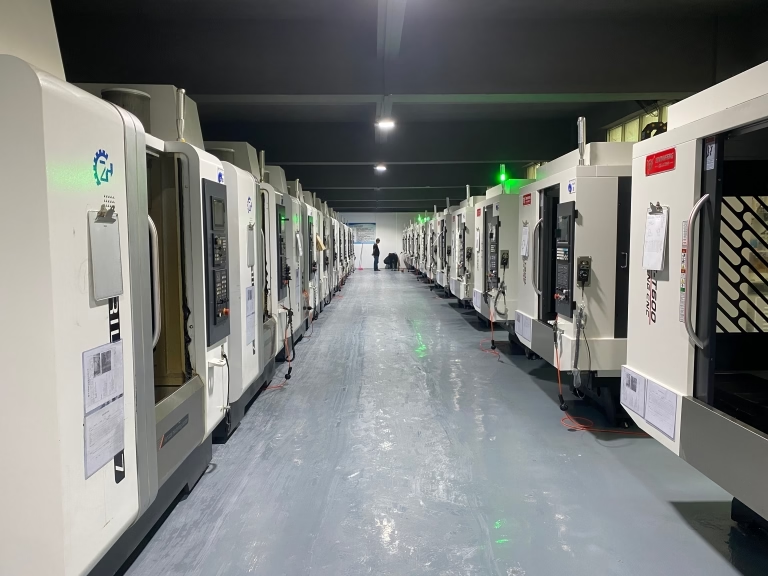
How a CNC Multi Spindle Machine Cuts
Strip the marketing away and a cnc multi spindle machine is a machine frame that carries more than one spindle, each with its own tool and its own axis motion. A controller coordinates them. On a lathe-style machine, four to eight spindles sit around a common axis and each one takes a different operation, such as face turning, drilling, or grooving, on a bar fed through the center. On a mill-style machine, two or three spindle heads move over one or more work zones at the same time.
The gain does not come from spinning faster. It comes from overlapping cuts that a single spindle has to run one after another. If a part needs a face, a bore, and a cross hole, one spindle spends three tool-change intervals and three approach moves. Four spindles can finish the same part in roughly the time of the longest single cut, plus indexing. That is the whole idea in one sentence.
Every spindle still needs its own tool holder, its own offset, and its own thermal path. When the machine is new, the spindle-to-spindle alignment holds. After a few thousand hours, the alignment drifts. A small drift shows up as a step between operations, often 0.01 mm or more. On a part with a ±0.005 mm tolerance, that step is scrap. This is why multi spindle work usually lands on parts with wider tolerances than the tightest single-spindle jobs.
The controller matters as much as the iron. Synchronized motion keeps the spindles from colliding and keeps the work zones in step. Older cam-driven multi spindle machines used a fixed cam cycle, so a design change meant a new cam. A CNC multi spindle machine stores the cycle as a program, so a revision is a new file. That difference decides how fast a shop can quote a design change.
- 1Spindles overlap cutsCycle time approaches the longest single operation, not the sum.
- 2Alignment driftsSpindle-to-spindle offset needs periodic checking and reset.
- 3Cycles live in softwareDesign revisions are program edits, not new cams.
Fixtures, Bar Feed, and How Parts Are Held
Multi spindle machines earn their money through fixturing, not through spindle count alone. A lathe-style machine feeds bar stock through a guide bushing, and each spindle indexes to a station. The bar diameter sets the work envelope, typically up to 32 mm on the common sizes and larger on heavy machines. If the part starts as a casting or a forging, the machine needs a chuck or a collet at every station, and the stations must all grip the same datum.
Two work zones on a mill-style machine let one spindle cut while the operator loads the other zone. The spindle never waits for a person. That is the real benefit for low-volume work, where the machine runs unattended for short stretches. The trade-off is fixture cost. Two zones mean two sets of vises, two sets of soft jaws, and two probing routines.
For parts under 50 mm with two or more operations on different faces, a multi spindle layout often beats a single spindle with a tombstone. For parts with one dominant feature, such as a long bore, a single spindle is simpler and cheaper to set up. Fixture complexity is the hidden cost that kills the business case.
- 1Bar feed sets sizeGuide bushings cover small diameters; chucks cover castings.
- 2Two zones hide load timeOne spindle cuts while the other zone is loaded.
- 3One dominant featureA single spindle usually wins on setup cost.
Tolerance, Surface Finish, and Where It Breaks Down
Accuracy on a cnc multi spindle machine is a stack of errors, not one number. Each spindle has its own runout, each station has its own thermal growth, and the transfer between stations adds position error. On a well-maintained machine, spindle-to-spindle position holds within about 0.01 mm, and the part tolerance that follows is usually ±0.02 mm or wider. Claiming ±0.005 mm across four spindles at once is not realistic without probing and re-cutting.
Surface finish follows the same logic. A single spindle cutting one continuous profile can hold Ra 0.8–1.6 μm without much fuss, and a finishing pass can reach Ra 0.2–0.8 μm. Split that profile across three spindles and each seam shows up as a mark. If the print calls for Ra 0.8 μm on a full circumference, keep that feature on one spindle.
Thermal drift is the slow killer. Four spindles put roughly four times the heat into a small frame. The first hour of a shift cuts differently from the fifth. Shops that run tight work on multi spindle machines warm up the machine, probe a master part, and re-probe every few hours. Without that routine, the morning parts and the afternoon parts do not match.
Some features simply belong elsewhere. A deep bore with a 20:1 depth-to-diameter ratio needs a single spindle with through-coolant and a long tool. A thin wall under 1 mm deflects from the second spindle's cutting force. A part with a true position callout under 0.02 mm between two bores is easier on a five-axis machine with one spindle and one setup.
- 1±0.02 mm is realisticTighter than that needs probing and a single spindle.
- 2Seams showSplit profiles leave witness marks at spindle boundaries.
- 3Warm-up mattersProbe a master part at start and mid-shift.
Single Spindle vs Multi Spindle: Which Fits the Job
Read the part, not the machine brochure.
| Job condition | Single spindle | Multi spindle |
|---|---|---|
| Annual volume | 1 to 500 parts | 5,000 parts and up |
| Operation count per part | One or two operations | Three or more operations |
| Part envelope | Up to 4,000 mm | Usually under 100 mm |
| Tolerance callout | ±0.005 mm achievable | ±0.02 mm typical |
| Surface finish target | Ra 0.2–0.8 μm on full profile | Ra 1.6–3.2 μm as machined |
| Setup time | Short, one fixture | Long, fixture per station |
| Design revision cost | Program edit | Program edit plus re-trim |
| Best fit | Prototypes, large parts | Small turned parts in volume |
The Short Answer
Pick a multi spindle machine when the part is small, needs three or more operations, and the annual volume runs into the thousands; pick a single spindle machine, including a five-axis center, when the tolerance is tighter than ±0.02 mm, the part is large, or the volume is a few hundred pieces.
Common Questions
Does a CNC multi spindle machine cut faster than a five-axis center?
For small turned parts with several operations, yes. Four spindles overlap cuts that a single spindle runs one after another, so cycle time drops toward the longest single operation rather than the sum.
For a large part with one complex profile, no. A five-axis center with one spindle finishes the profile in one continuous pass, and it holds tighter position between features.
How many spindles are typical?
Lathe-style machines commonly carry four to eight spindles around a common axis. Mill-style machines usually carry two or three heads over one or two work zones. More spindles means more stations, more tooling, and a longer setup.
Beyond six spindles, the setup and maintenance cost usually only pays off on parts that run year-round.
Can a multi spindle machine hold ±0.005 mm?
Not across all spindles at once, under normal production. Each spindle adds runout and thermal drift, so the stacked error is larger than a single spindle on a stable frame.
If a feature needs ±0.005 mm, cut it on one spindle and use probing to verify it. Keep the other spindles on the wider-tolerance features.
What materials run well on these machines?
Free-machining and medium-carbon steels, brass, aluminium, and stainless grades such as 303 and 304 run well. Bar feed suits these because the stock is uniform and the chips break cleanly.
Titanium and Inconel generate more heat per spindle, and four spindles in a small frame can push the thermal drift past the tolerance. Those jobs usually stay on single-spindle machines with high-pressure coolant.
Is a multi spindle machine worth it for a 500-part run?
Rarely. The fixture and tooling cost per station is the deciding number, and a 500-part run may not absorb it before the design changes.
A single spindle with a tombstone fixture or a bar feeder often finishes 500 parts at a lower total cost, and it is faster to set up when the revision arrives.
What should we check before buying one?
Check the spindle-to-spindle alignment record, the thermal warm-up routine, and the bar feed capacity against your largest diameter. Ask how the machine handles a mid-run tool change on one station.
Then run your own part. A machine that holds tolerance on a demo aluminium part may behave differently on your 316 stainless job.
Send Us the Part and the Volume
Upload a drawing or a 3D file and we will tell you which machine fits, plus a quote and a DFM analysis within 12 hours.
12-hour quote100% inspectionNDA on request
More Machining Notes
We publish setup notes, tooling trials and inspection data from the factory floor.











