
What Is a CNC Router Machine?
A CNC router machine cuts large, mostly flat parts with a spinning tool that travels over a stationary workpiece. This page explains the mechanism, the accuracy limits that follow from it, and how to tell whether routing or milling is the right call for your part.
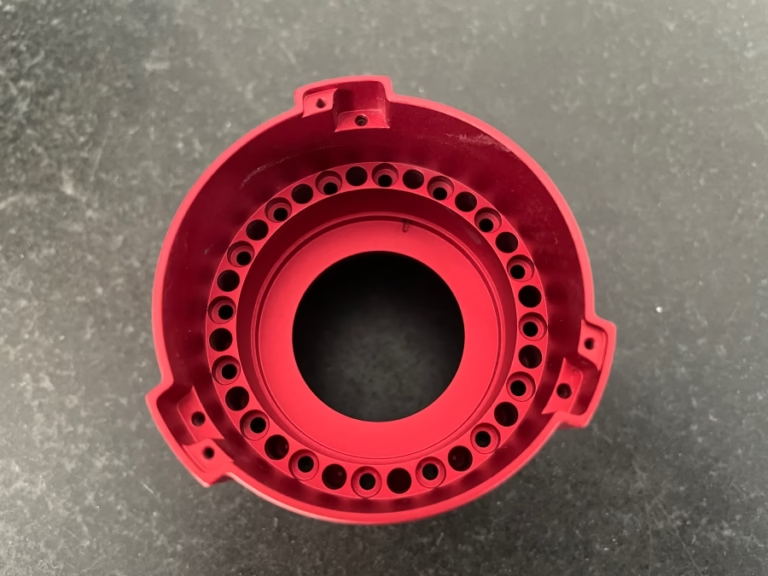
How a CNC Router Machine Removes Material
A router is a subtractive machine built around one idea: the cutting tool moves, the workpiece stays put. G-code drives a spindle along X, Y and Z, following toolpaths generated from a CAD model. The spindle holds an end mill, a router bit, or a specialty cutter and spins it while the axes feed the tool through the stock.
That layout sounds trivial, but it drives everything downstream. Because the table is fixed and the gantry carries the spindle, the machine can be made very long in X and Y without moving the mass of the part. It also means the stiffness of the gantry, not the table, sets the floor on accuracy.
Routers are not mills with a different badge. On a mill, the spindle sits on a rigid column and the table moves the part. On a router, the gantry bridges the whole work envelope, so any flex in that bridge shows up in the cut. A 2,000 mm gantry with a 100 mm cross-section deflects under load in a way a 500 mm column never does.
The practical result: routers are excellent at covering distance and weak at resisting side load. Feed rates stay lower, depth of cut stays shallower, and tool runout matters more. If your part is small and the tolerance is tight, the gantry is dead weight you are paying for.
Toolholding follows the same logic. Routers often run collet holders up to ER32 or ER40, while mills use shrink-fit or hydraulic holders for high-speed work. Collets are cheaper and flexible, but runout of 0.01–0.02 mm at the tool tip is normal. On a finishing pass that shows up directly in the wall.
So the mechanism answers the first question quickly. A router converts a CAD file into a large flat part efficiently. It does not convert it into a small, mirror-finished, tight-tolerance part efficiently. Those are two different machines, and buying the wrong one costs months.
Axis Configurations and What Each One Buys You
Three-axis routing is the baseline. X and Y move the tool across the table, Z sets depth. Every face you cannot reach from the top needs a second setup, which means a second fixture, a second origin, and a second chance for stack-up error.
Four-axis adds rotation, usually a rotary table around the Y axis. That lets you cut on multiple sides of a long part without re-fixturing. It is the right choice for shafts, brackets, and any part with features on two or three faces arranged around one axis.
Five-axis adds a second rotary axis, so the tool can approach the part from nearly any direction. The payoff is not just reach. It is tool orientation: a stubby tool held at an angle is far stiffer than a long tool held straight down. That is where five-axis holds tolerance on deep pockets and contoured walls.
Not every five-axis job needs simultaneous motion. Positional five-axis, also called 3+2, indexes the part to an angle and then cuts in three axes. It gets you the reach and the shorter tool, but not the continuous motion, and it costs less time to program. Ask which one the shop is quoting before you compare prices.
Rotary capacity matters too. A Ø400 mm rotary table sets the ceiling on part diameter for four-axis work. Beyond that, shops often switch to a mill-turn center or a different process entirely. If your part is a 600 mm diameter ring with axial features, say so early.
The axis count also changes setup time. On a five-axis machine, features on five faces can come off in one cycle, which removes three or four fixtures from the job. On a three-axis machine, each of those faces is a separate operation, and each one adds handling time and a chance for a scrapped part.
Which Materials Suit Routing, and Which Do Not
Aluminium is the sweet spot. Grades like 6061, 7075, 5083 and ADC12 cut cleanly at 8,000–18,000 rpm with two- or three-flute carbide tools, and the gantry loads stay manageable. Wall thickness down to 0.8 mm is routine on a well-fixtured part.
Plastics behave differently. ABS, POM, PMMA and PC machine easily but move with heat. A router pushing a 6 mm cutter through POM at high feed will rub rather than cut, and the part grows. Air blast and conservative chipload fix most of it. PEEK and carbon fibre need sharper tools and more attention to dust control.
Stainless and tool steel are where routing gets hard. Grades 304, 316, 17-4PH and 4140 work-harden under a rubbing tool, and the gantry flex that tolerates aluminium will chatter on steel. Feeds drop, depths drop, and the process becomes slow. It is doable on a rigid machine with the right coolant, but it is not the router's best day.
Titanium and nickel alloys are the boundary. Ti-6Al-4V and Inconel generate high cutting forces and poor heat conduction, so the tool takes the heat. Routing them is possible only on a heavy machine with through-spindle coolant and a rigid setup. If your part is Inconel, a fixed-frame five-axis mill is the honest answer.
Thin sheet is a different problem. A 1 mm aluminium panel will vibrate unless it is vacuum-chucked or tabbed in place. Sheet metal fabrication with laser or punch is often cheaper and flatter for parts under 3 mm thick. Routing wins once the part needs 3D contour, pockets, or a thick section.
How to Judge a Router Job Before You Quote It
Start with the largest dimension and the tightest tolerance. If the part is 1,500 mm long with a ±0.05 mm bore, that bore probably needs a separate operation on a smaller machine. Splitting the process is normal and usually cheaper than forcing one setup.
Next, look at aspect ratio. A pocket 80 mm deep and 10 mm wide needs a tool 8× longer than it is wide. Any machine will struggle there, and a gantry machine struggles sooner. If the design allows, open the pocket or split the part.
Then check the datum structure. A part machined on five faces in one cycle holds better relationships between those faces than the same part made in four setups. If your drawing calls out position between features on different faces, count the setups before you count the price.
Finally, ask what the shop measures and how. A ±0.005 mm claim means nothing without a CMM report or a documented inspection step. GreatLight inspects 100% of parts before shipment, with raw material check, in-process monitoring and final inspection, and reports on request.
One more habit worth building: send the 3D model, not just a 2D drawing. Toolpath decisions depend on geometry that drawings flatten away. A shop that quotes off a PDF is guessing at your radii.
Where Routing Fits in a Real Production Chain
Routing rarely stands alone. A typical part might be routed to near-net shape, then finished on a three-axis machine for the tight bores, then anodized or bead blasted. Each step adds a setup but removes risk from the next one.
Prototyping is the clearest case. With no minimum order quantity, a shop can route one panel, check the fit, and cut the next revision the following week. That loop is faster than waiting for a die or a casting pattern.
For low-volume runs of large parts, routing beats casting on both cost and lead time. A 10-part run of 800 mm aluminium housings does not justify tooling. Routing them is straightforward. A 10,000-part run is a different conversation, and die casting usually wins.
Surface finishing is often the last routing-adjacent decision. Anodizing, powder coating, black oxide and bead blasting all change dimensions slightly, and masking matters on mating faces. Tell the finisher which surfaces are functional.
The honest summary: routing is a flexible, large-envelope process that fits between sheet metal and heavy milling. It covers ground that neither of those handles well. Treat it as one station in a chain, not a universal answer.
Axis Count Against the Work It Handles
Match the part to the axis count before quoting.
| Axis setup | Best for | Typical limit | Setup count |
|---|---|---|---|
| 3-axis | Flat plates, pockets, simple profiles | One face per setup | 1 per face |
| 4-axis | Shafts, brackets, features around one axis | Ø400 mm rotary table | 1–2 |
| 5-axis positional | Angled faces, deep pockets | Indexed, then cut in 3 axes | 1 |
| 5-axis simultaneous | Contoured walls, turbine and joint parts | Continuous tool orientation | 1 |
| Mill-turn | Round parts with milled features | Combines turning and milling | 1 |
When Routing Is the Right Call
Choose a CNC router machine when the part is large, mostly flat, and tolerances sit at ±0.01 mm or looser. Choose a fixed-frame 5-axis mill when the part is small, has features on many faces, or needs ±0.005 mm with a fine Ra 0.2–0.8 μm finish. Splitting the part across both processes is often the cheapest route.
Common Questions
Is a CNC router the same as a CNC mill?
No. On a router the gantry moves the spindle over a fixed table, which allows a very large work envelope. On a mill the spindle sits on a fixed column and the table moves the part, which gives higher stiffness and better tolerance.
The two overlap in the middle of the size range. Below roughly 500 mm, a mill is usually the better choice. Above 1,000 mm with moderate tolerance, a router often is.
What tolerance can a router realistically hold?
On aluminium with a rigid gantry and a good fixture, ±0.01 mm is realistic as a routine figure. On a well-maintained machine, ±0.005 mm is achievable on specific features with careful setup and temperature control.
On steel or titanium the number loosens. Cutting forces rise, tool deflection grows, and ±0.02–0.05 mm becomes a fair expectation unless the machine is very heavy.
Can a router cut steel?
Yes, but slowly. Grades like 1018, 1045 and 4140 can be routed with carbide tools, low feed per tooth and flood coolant. The gantry flex that is harmless in aluminium causes chatter in steel.
For production volumes in steel, a fixed-frame mill is almost always the better process. Routing steel makes sense for one-off brackets and repairs, not for a 500-part run.
Why does my part move during routing?
Usually because the holding force is too low for the side load. Vacuum tables lose grip on small parts; clamps lose grip on thin panels. Add tabs, use a fixture plate, or reduce depth of cut.
A second cause is thermal. A long cut heats the part and the fixture, and the part grows away from its datum. Let it cool before the finishing pass and check the origin again.
How do I know if my part needs 5-axis?
Count the faces with functional features. If the drawing ties features on three or more faces together with a position tolerance, one-cycle five-axis work will hold it more reliably than several three-axis setups.
If the features sit on one face and the tolerance is loose, a three-axis machine is cheaper and just as capable.
Send Us the Model and the Tolerance
Upload a STEP file and a tolerance callout. We reply with a quotation and a free DFM analysis within 12 hours, and parts ship in 3–5 days.
12-hour quote100% inspectionNo minimum order quantity
More Machining Notes
We publish setup notes, tooling trials and inspection data from the factory floor.











