
What Is CNC Swiss Machining?
Swiss machining turns a bar through a guide bushing while the tools move, not the part. That single change is why Ø3 mm shafts can hold ±0.005 mm over long lengths. This page explains the mechanism, the boundaries, and how to tell when the process fits your part.
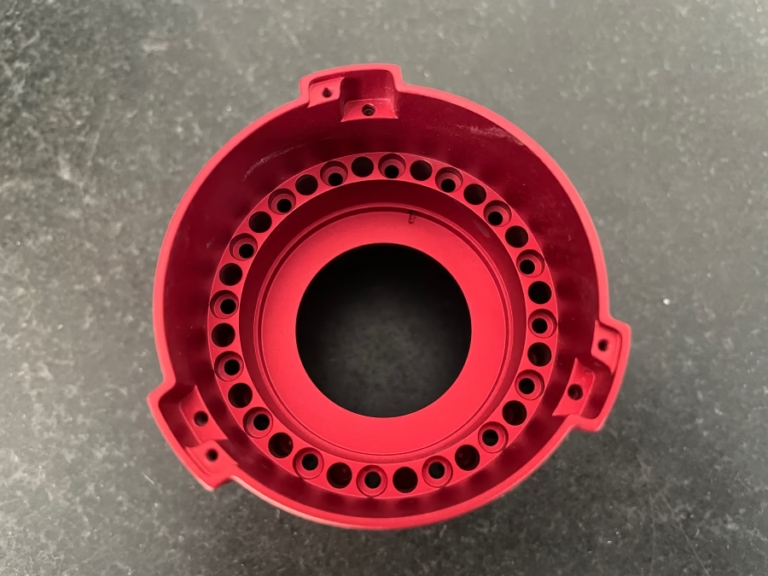
What Is CNC Swiss Machining? The Sliding Headstock Mechanism
On a conventional CNC lathe the bar sits in a chuck and spins. The turret travels to the work. On a Swiss-type machine that relationship flips: the bar slides forward through a guide bushing and the cutting tools move in X and Y only. The bushing supports the bar within a few millimeters of the tool tip, so the workpiece barely deflects.
That short unsupported length is the whole point. Cutting force acts on a stub of material instead of a slender shaft hanging out of a chuck. Deflection scales with the cube of the overhang, so shrinking the overhang from 60 mm to 5 mm changes stiffness by more than two orders of magnitude. This is why a Swiss machine holds ±0.005 mm on a Ø3 mm pin that would chatter on a lathe.
The headstock indexes the bar forward by the part length after each cut-off. The machine then repeats the cycle. Because the bar never leaves the bushing, diameter stays consistent from the first part to the ten-thousandth.
Tooling sits on a gang slide rather than a turret. A typical gang carries 5 to 8 turning tools, and live stations on the sub-spindle handle cross-drilling, slotting, and milling. On our mill-turn and Swiss cells we run bar diameters from Ø1 mm to Ø32 mm, with some models reaching Ø38 mm.
- 1Guide bushingSupports the bar, typically within 3–5 mm of the cut
- 2Gang slideTools move in X and Y; the bar advances in Z only
- 3Sub-spindlePicks off the part and machines the back side in the same cycle
Swiss Turning vs Conventional CNC Turning
A conventional lathe wins on diameter range and chucking versatility. It can hold a Ø200 mm flange, a casting, or a forged blank. A Swiss machine cannot. It feeds bar stock through a bushing, so it wants round, straight, consistent material.
Where a Swiss machine pulls ahead is length-to-diameter ratio. Consider a Ø4 mm spool valve stem, 80 mm long. On a lathe, even with a tailstock, you fight deflection and taper. On a Swiss machine the same part runs in one pass at ±0.005 mm, often with a milled flat and a cross-hole added without a second setup.
Cycle time also differs. A Swiss machine cuts continuously because the bar advances while tools re-engage. A lathe spends time indexing the turret and opening the chuck. For high-volume small parts, that gap compounds into a real cost difference.
The trade-off is material form. If your part starts as a forging or a casting, Swiss machining is not the answer. If it starts as bar, and it is small and long, it usually is.
Where Swiss Machining Stops Making Sense
Every process has a boundary. Swiss machining gets expensive when the part is short. A Ø10 mm collar that is 6 mm long leaves most of the bar in the bushing and wastes material as a stub. A lathe or a screw machine handles it cheaper.
Material matters too. Free-machining grades like 303 stainless, 12L14, and C36000 brass run clean and hold tolerance. Sticky grades such as 316L, 17-4PH in the H900 condition, and uncoated titanium TA2 work-harden and can pull the bar. We run them, but with slower surface speeds, higher coolant pressure, and more frequent tool changes.
Feature geometry sets another limit. Deep axial holes below Ø1 mm, threads finer than M1.6, and slots narrower than 0.5 mm all push tool life down. They are possible, but the cost per part climbs because of broken tooling and inspection time.
Volume is the last boundary. Swiss machines are efficient at 500 to 100,000 parts per year. Below roughly 200 pieces, setup time dominates. Above that, the per-part cost drops quickly.
- 1Good fitLong, slender, round parts with cross-features, Ø1–32 mm
- 2Poor fitShort collars, castings, forgings, or parts over Ø40 mm
- 3Work-hardening alloysRun slower, expect shorter tool life and tighter process control
Designing Parts for a Swiss Machine
Design for the process before you send the drawing. Keep the part round where the bushing grips. A hex or square bar works, but the bushing must match, and that adds cost and lead time.
Avoid sharp internal corners on milled pockets. A Swiss machine uses small end mills, often Ø2 mm or less. A 0.5 mm corner radius is easy; a zero-radius corner is not. Put a small fillet on the drawing and say so explicitly.
Threads and knurls are fine, but specify the class. A 6g thread on a Ø5 mm stud is routine. A 4h thread on the same stud needs gauging and slows the cycle. If the thread is only for retention, relax the class.
Surface finish follows the same logic. Ra 0.8–1.6 μm comes off the machine on most alloys. Ra 0.2–0.8 μm needs a finishing pass or a secondary operation, and that changes the price. If your drawing calls for Ra 0.4 μm, say which face actually needs it.
Tolerances, Inspection, and What to Expect
A well-maintained Swiss machine holds ±0.005 mm (±0.0002 in) on diameter in steady production. That is the number we publish, and it assumes clean bar stock and a stable thermal environment. Push below that and you are in grinding territory.
Inspection is the other half of the promise. We check incoming bar, monitor in-process, and run a final inspection before shipment. Reports are available on request. For medical and automotive programs, that paper trail matters as much as the number on the drawing.
Material certificates ship with the parts when specified. Our plants hold ISO 9001:2015, IATF 16949:2016, ISO 13485:2016, and ISO 27001:2022. Uploads stay confidential, and we sign an NDA when a program needs one.
Lead time starts with a quote and a free DFM review within 12 hours. Production can start within 24 hours of approval, and parts typically ship in 3–5 days. We do not promise a delivery date we cannot hold.
Which Process Fits Your Part?
Use this table as a first filter. It is not a rulebook, but it catches the common mismatches before you send an RFQ.
| Part characteristic | Swiss machining | Conventional lathe | Better choice |
|---|---|---|---|
| Length-to-diameter ratio > 5:1 | Easy, guide bushing supports the bar | Needs tailstock, still deflects | Swiss |
| Diameter over Ø40 mm | Not possible on standard bar feeders | Standard workholding | Lathe |
| Part length under 2× diameter | Material waste, high cycle cost | Efficient, low waste | Lathe |
| Cross-holes and milled flats | Live tooling, one setup | Second op or live tooling | Swiss |
| Castings or forgings as input | Cannot feed non-bar stock | Chuck or fixture holds the blank | Lathe |
| Annual volume 500–100,000 | Low per-part cost after setup | Setup amortized slowly | Swiss |
| Free-machining brass or 303 | Excellent finish, long tool life | Good, but slower cycles | Swiss |
| Titanium Ti-6Al-4V | Runs, but slower and tool-hungry | Runs with more rigidity options | Depends on geometry |
The Short Answer
If your part is round, starts as bar stock, and has a length-to-diameter ratio above 3:1, Swiss machining is almost always the cheaper path. If it is short, wide, or starts as a casting, use a conventional lathe or a mill-turn center instead.
Frequently Asked Questions
What is CNC Swiss machining used for?
It is used for small, long, round parts that need tight tolerance and several features in one setup. Typical examples include hydraulic valve spools, dental implant screws, connector pins, and sensor housings.
Any part that starts as bar stock and has a length-to-diameter ratio above roughly 3:1 is a candidate. Below that ratio, a lathe is usually cheaper.
How does a guide bushing differ from a collet?
A collet grips the bar at one point and the bar rotates with it. A guide bushing surrounds the bar and lets it slide through while the tools cut. The bushing stays within a few millimeters of the tool tip, so the unsupported length never grows.
That is why a Swiss machine can hold tolerance on a slender part that a collet-chucking lathe cannot.
Can a Swiss machine mill and drill, or only turn?
It can do both. Live tooling on the gang slide and the sub-spindle handles cross-drilling, slotting, and light milling. Many parts come off the machine complete, with no second operation.
The limit is tool size. A Swiss machine uses small end mills, often Ø2 mm or less, so deep pockets and large flat faces are better suited to a machining center.
What bar diameter range can Swiss machining handle?
Most Swiss machines cover Ø1 mm to Ø32 mm. Some models reach Ø38 mm. Above that, bar feeders and guide bushings become impractical and a lathe is the better choice.
The lower end is where Swiss machining is strongest. Parts below Ø10 mm are hard to hold in a chuck without distorting them.
Is Swiss machining more expensive than turning?
Per part, it is usually cheaper once volume passes a few hundred pieces, because cycle times are short and features are finished in one setup. Setup cost is higher, so small runs can cost more.
The break-even point depends on part complexity. A simple Ø6 mm pin breaks even later than a part with three cross-holes and a milled flat.
What materials run well on a Swiss machine?
Free-machining grades run best: 303 and 304 stainless, 12L14 and 1045 steel, C36000 brass, and 6061 aluminium. They produce short chips and hold tolerance with normal tool life.
Work-hardening alloys such as 316L, 17-4PH, and Ti-6Al-4V run too, but with slower speeds, higher coolant pressure, and more frequent tool changes. Budget for that in the quote.
Send Us the Drawing, Get a Process Answer
We review your part for Swiss suitability and return a quote with a free DFM analysis within 12 hours. No minimum order quantity, from one prototype to 10,000+ part runs.
12-hour quoteFree DFM analysis100% inspectionNDA on request
More Process Notes
We publish setup notes, tooling trials and inspection data from the factory floor.











