
What Is a CNC Swiss Machine?
A Swiss machine is a lathe that feeds the bar stock through a guide bushing instead of sliding a tool along a spinning part. That single difference explains why it holds tight tolerances on long, thin parts. This page covers the mechanism, the size and tolerance window, and when a Swiss-type lathe is the wrong choice.
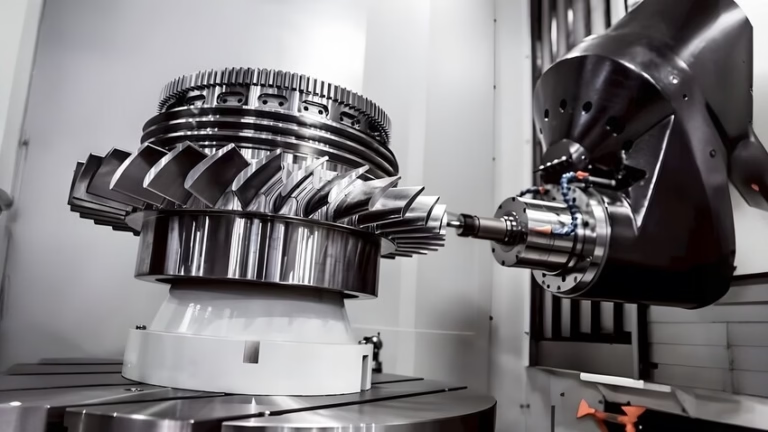
What Is a CNC Swiss Machine? Sliding Headstock and Guide Bushing
A conventional CNC lathe holds the bar in a chuck and moves the tool along Z. A CNC Swiss machine inverts that. The bar stock feeds forward through a carbide guide bushing, and the headstock slides the bar along Z while the tools stay close to the bushing face. Cutting happens right at the bushing exit, so the workpiece is supported within a few tenths of a millimeter of the cut.
That support is the whole point. On a long, slender part, cutting force pushes the material away from the tool and the part deflects. A Swiss machine removes that deflection path because the unsupported length is only the short distance between bushing face and tool edge. The result is diameter control that a chucking lathe struggles to match on the same geometry.
The headstock also indexes in Z, so the same program can turn, mill, drill, and tap without reclamping. Tools sit on a gang slide or a turret, and most machines carry a subspindle for back-side work. A part can come off complete: front profile, cross holes, threads, and a parted-off face machined on the second spindle.
Why Swiss Turning Holds ±0.005 mm on Small Parts
Tolerance is where the mechanism pays off. Because the cut happens at the bushing, the material is supported on both sides of the tool edge. Deflection is bounded by a very short free length, so diameter variation stays small. In production, we hold ±0.005 mm (±0.0002 in) on diameters in the right size window.
The window matters. Below roughly Ø1 mm, the bar itself is flexible and the bushing clearance becomes a large share of the diameter tolerance. Above roughly Ø32 mm, you need a larger spindle and the machine footprint grows past the point where Swiss turning beats a mill-turn center. Between those limits, Swiss machines are efficient and repeatable.
Surface finish follows the same logic. Light, stable cuts with small depth of cut produce Ra 0.8–1.6 μm as a normal result, and Ra 0.2–0.8 μm when the tool, coolant, and feed are dialed in for finishing. A part that deflects cannot reach those numbers no matter how slow you run it.
Thermal drift is the other half of the story. Swiss machines run at high spindle speeds on small bars, and the headstock and bushing heat up. Warm-up cycles and in-process measurement keep the first hundred parts and the ten-thousandth part in the same band.
Which Parts Belong on a CNC Swiss Machine
Swiss work is defined by length-to-diameter ratio. Once a turned feature runs past roughly 3:1, a chucking lathe starts to chatter and taper. A Swiss machine cuts a 10:1 or even 20:1 feature cleanly because the guide bushing never lets the bar whip. Medical bone screws, connector pins, fuel injector bodies, and sensor housings all sit in that category.
Small cross features fit the same setup. Cross holes, flats, slots, and threaded ports can be milled while the part is still in the bushing, so position tolerances between the turned diameter and the milled feature stay tight. Each reclamping adds error. Swiss machines remove most of those operations.
Materials matter less than people assume. The process runs 303, 304, 316L, 17-4PH, 6061, 7075, brass C36000, titanium TC4, and PEEK on the same platform. Harder alloys push tool life down and cycle time up, but the guide bushing still does its job.
Swiss machines also suit volume, not just geometry. Bar feeders run unattended for hours, so a 10,000-piece run is normal. A single prototype is also possible, because no minimum order quantity is required and the program is the same either way.
When a Swiss Machine Is the Wrong Choice, and What to Use Instead
If the part starts as a casting or a plate, a Swiss machine cannot help. The process needs bar stock that fits through the bushing. A part with a large flange, an off-axis boss, or a body wider than Ø32 mm belongs on a 5-axis machining center or a mill-turn center, where the workpiece can be clamped from multiple sides.
Deep cavities and complex 3D surfaces are also a poor fit. Swiss tools are short and radial. A mold insert with a curved pocket needs long reach and simultaneous axes. The correct answer is a 5-axis mill, not a lathe of any kind.
Setup economics decide the rest. Swiss machines win when a part has many small features and runs in quantity, because one setup replaces three or four operations. For one or two simple turned parts with loose tolerances, a conventional lathe is faster to program and cheaper per part.
The short version: geometry and volume pick the machine. Long and thin with many features means Swiss. Wide, deep, or plate-like means milling. Simple and low quantity means a standard lathe.
Swiss Machine vs Chucking Lathe vs 5-Axis Mill
Match the machine to the part, not the other way around.
| Criterion | CNC Swiss machine | Chucking lathe | 5-axis mill |
|---|---|---|---|
| Bar stock size | Ø1–32 mm through bushing | Ø20–250 mm chuck | Plate or block, any shape |
| Typical tolerance | ±0.005 mm | ±0.01–0.025 mm | ±0.005–0.01 mm |
| Best length-to-diameter | 5:1 to 20:1 | Up to about 3:1 | Not a turning metric |
| Cross features | Milled in the same setup | Second op on a mill | All faces in one setup |
| Volume fit | 1 to 10,000+ pieces | Low to medium volume | Prototypes and complex parts |
| Weak point | Needs bar stock, small diameter | Slender parts deflect | Slow cycle on simple round parts |
Pick the Process by Geometry First
Long, thin, and feature-dense parts under Ø32 mm go to a CNC Swiss machine; wide, deep, or plate-like parts go to a 5-axis mill; simple round parts in low quantity stay on a chucking lathe.
Swiss Turning Questions Engineers Ask
Does a Swiss machine need a guide bushing for every job?
No. Some machines can run in guide-bushing mode or in a chucking mode where the bushing is replaced by a collet. Bushing mode gives the best support on long, thin parts. Collet mode allows shorter, larger-diameter parts and removes the small step that bushing clearance can leave.
The choice is made per part. If the length-to-diameter ratio is under roughly 3:1, collet mode is usually simpler and the cycle is faster. Above that, keep the bushing.
What surface finish can Swiss turning reach?
As-machined results typically land at Ra 1.6–3.2 μm on most alloys. With a finishing pass, sharp tooling, and controlled coolant, Ra 0.8–1.6 μm is routine, and Ra 0.2–0.8 μm is possible on stable diameters.
Finish depends on the material as much as the machine. Aluminium 6061 finishes more easily than 316L stainless, and titanium TC4 needs slower speeds and more attention to tool wear.
Can a Swiss machine make a part with no turned features at all?
It can mill and drill, but it is a poor use of the machine. If most of the geometry is prismatic, a 3-axis or 5-axis mill is faster to program and cheaper to run. Swiss machines earn their cost on parts that are dominated by turned diameters.
How long does it take to get parts from a Swiss job?
Quotation and a free DFM analysis come back within 12 hours. Production can start within 24 hours after approval, and parts ship in 3–5 days for standard work.
Those numbers assume the drawing is final and the material is in stock. A change to the bar diameter or the tolerance band restarts the tooling check.
Is Swiss turning suitable for medical and automotive parts?
Yes. Both sectors use it heavily for small, high-feature parts such as bone screws, connector pins, and injector components. Quality systems matter here as much as the machine, so check the supplier's certifications against the part's end use.
We hold ISO 9001:2015, IATF 16949:2016, ISO 13485:2016, and ISO 27001:2022, and every part is inspected before shipment.
What happens to the bar end?
The remnant, or bar end, is too short to grip and gets discarded. It is a small material loss per bar, and it is the reason very short runs carry a higher effective material cost than long runs.
On expensive alloys, the remnant is quoted into the price so there is no surprise later.
Send the Drawing, Get a Swiss Turning Quote
Upload the part and we will confirm whether Swiss turning is the right process, then quote it with a free DFM analysis.
12-hour quote±0.005 mm toleranceNo minimum order quantity100% inspection
More Machining Notes
We publish setup notes, tooling trials and inspection data from the factory floor.











