
What Is DNC for CNC Machines?
DNC (distributed numerical control) links machine controllers to a central server so programs are stored once and streamed on demand. This page explains the mechanism, the hardware, and the shop conditions where it actually pays off.
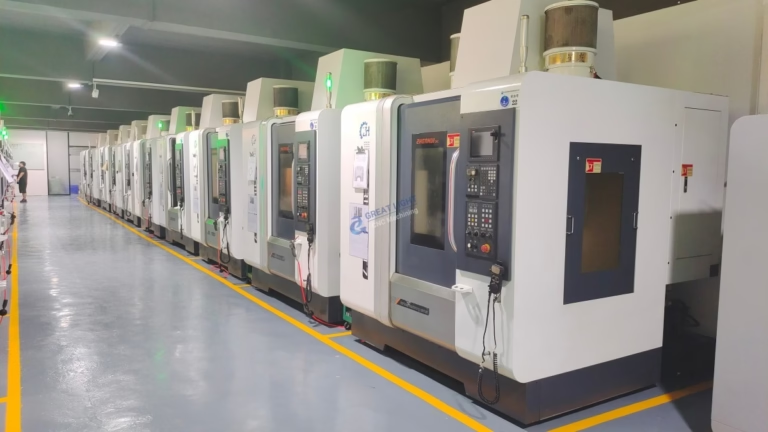
How DNC for CNC Machines Actually Works
DNC stands for distributed numerical control, sometimes called direct numerical control. The idea is simple: instead of walking a file to a machine on a USB stick, you keep every NC program on a server and feed it to the controller over a network cable. The machine no longer owns the program. It borrows it.
The link itself is usually RS-232 serial, Ethernet, or a fieldbus gateway. Older Fanuc, Mazak and Siemens controllers often only speak serial, so a small box converts TCP/IP to RS-232 and handles handshaking. Newer controllers with a network port talk directly to the server. Either way, the operator sees the same thing on the pendant: a program number, a file name, and a start button.
The critical distinction is between transfer and drip-feeding. Transfer moves a whole file into the controller's memory before the cycle starts, so memory size sets the ceiling. Drip-feeding, also called DNC streaming, sends the program block by block while the tool is cutting. Memory is no longer the limit. A 5-axis aerospace part with tens of thousands of blocks runs the same way as a simple bracket.
That last point matters most on long cycles. When a program is drip-fed, the server must keep up with the controller's read rate. If the serial buffer starves, the machine pauses mid-cut and you get a witness mark on the surface. A stable DNC setup is really a timing problem, not a file-storage problem.
Core Components and the Data Path
A practical DNC system has four parts: a server that stores programs, a network that carries them, a gateway or adapter at each machine, and software that manages the queue. The server can be a shop-floor PC or a virtual machine in the office. It holds the master copy of every program, plus revision history.
The gateway is where most installations get messy. A single serial port reaches one machine, so a 20-machine shop needs 20 ports or 20 network adapters. Cable runs over 15 m on RS-232 are unreliable unless you use proper shielded cable and low baud rates. Ethernet gateways avoid that limit but add latency if the network is shared with office traffic.
Software is the part engineers underestimate. Beyond sending files, the DNC layer has to name programs consistently, lock a file while it is running, and log who changed what. Without revision control, two operators can run two versions of the same part number on the same day. That is a scrap event waiting to happen.
At GreatLight we run 127 high-precision CNC machines across three wholly-owned plants, including 16 simultaneous 5-axis centers and 16 mill-turn centers. Program management at that scale is a network problem before it is a machining problem.
What a Modern DNC System Does Beyond Sending Files
Central program storage is the base function. One master file, one revision number, one place to look. When a programmer posts a new version for a titanium or Inconel job, every assigned machine pulls the same file. The old habit of editing at the controller disappears, and so does the question of which copy is correct.
Machine monitoring is the second function. The DNC layer can read cycle status, spindle load, feed override and alarm codes back from the controller. That data tells you which machine is actually cutting and which one has been sitting idle since the morning shift. It is not a full MES, but it answers the first question a planner asks.
Data logging is the third. Every program download, start and stop can be timestamped against a job number. For medical and automotive work under ISO 13485:2016 or IATF 16949:2016, that traceability is the point. You can show which program revision produced which batch, months later.
Some systems also push tool life data and maintenance counters. That edges into predictive maintenance, and it only works if the controller exposes the registers. Many older machines do not. Check that before you buy software that promises it.
When DNC Is Worth It and When It Is Not
DNC earns its cost when programs are long, part numbers repeat, or several machines run the same job. If a program exceeds controller memory, drip-feeding is the only clean answer short of buying a new controller. If two shifts run the same part, central storage removes a whole class of mistakes.
It also earns its cost when the audit trail matters. Medical implants, aerospace brackets and automotive safety parts usually need to show which revision ran when. A DNC log gives you that without a separate paper system.
It does not earn its cost in a small shop with three machines and short cycles. A USB stick and a disciplined folder structure work fine there. Adding a server, gateways and software support to that setup is overhead with no measurable return.
The middle case is the awkward one. A shop with 8 to 12 machines, mixed ages, some with network ports and some without. Here the decision usually comes down to how often programs are edited. Frequent edits push you toward DNC. Stable, rarely-changed programs do not.
Limits, Failure Modes and Engineering Boundaries
The most common failure is buffer starvation during drip-feeding. Symptoms: the feed stops for a fraction of a second, the spindle keeps turning, and a faint mark appears on the finish. Fixes include lowering the baud rate, shortening the block length in CAM, or moving to a dedicated network segment. Do not simply raise the baud rate and hope; line quality sets the real ceiling.
The second failure is a dropped connection mid-cycle. A serial cable that works for file transfer may not survive hours of streaming. Shielded cable, proper grounding and a UPS on the gateway all reduce the risk. A drip-fed cycle should never depend on an office switch that someone might reboot.
The third is version drift. If the DNC software allows an operator to edit locally, you have reintroduced the problem you were solving. Lock the file while it runs. Require a checkout for edits. Log the change.
Finally, DNC does not improve accuracy by itself. It removes a source of error. A machine that holds ±0.005 mm holds it because of the machine, the tooling and the process, not because the program arrived over Ethernet.
DNC vs USB Transfer vs Full MES
Three ways to move a program to a machine, and the trade-offs of each.
| Method | Program size limit | Version control | Typical fit |
|---|---|---|---|
| USB / CF card | Controller memory only | Manual, easy to overwrite | 1–5 machines, short cycles |
| Basic DNC transfer | Controller memory only | Central server, revision log | Job shops with repeat part numbers |
| DNC drip-feeding | No practical limit | Central server, file locked | 5-axis, long-cycle, complex geometry |
| DNC + monitoring | No practical limit | Central server plus audit trail | Regulated work, 20+ machines |
| Full MES | No practical limit | Full scheduling and traceability | High-mix plants, ERP integration |
The straight answer
If your programs fit in controller memory and rarely change, skip DNC and spend the money on tooling. If programs overflow memory, repeat across machines, or need an audit trail, DNC pays for itself quickly.
Frequently Asked Questions
Does DNC work with older CNC controllers?
Yes, but usually through a serial gateway rather than a direct network connection. Older Fanuc, Mazak and Siemens controllers often only expose RS-232.
The gateway converts TCP/IP to serial and handles handshaking. Expect lower throughput and shorter cable runs than a native Ethernet controller.
Is drip-feeding the same as DNC?
No. Drip-feeding is one function of a DNC system. DNC also covers central program storage, revision control and machine monitoring.
You can run DNC without drip-feeding, and you can drip-feed without a full DNC server, though the second case is rare in production.
How long does it take to set up DNC for a new project?
For an existing DNC installation, adding a new part number is a matter of posting the program and assigning it to machines. That is minutes.
Building the network from scratch is a project measured in weeks, because cable runs, gateways and controller compatibility have to be verified machine by machine.
Can DNC integrate with CAD/CAM and 3D printing workflows?
The CAM side is straightforward. Most CAM packages post directly into a watched folder that the DNC server picks up.
For additive work, the file formats differ, but the same revision-control principle applies. Keep one master file and log every change.
How is program data secured in a DNC system?
Access control, encrypted transfer and an audit log cover most requirements. The server should sit behind the same controls as other engineering data.
At GreatLight, uploads are secure and confidential, an NDA is available on request, and our data handling follows ISO 27001:2022.
Does DNC improve machining precision?
Not directly. DNC removes a class of human error: wrong revision, wrong file, truncated program.
Actual tolerance is set by the machine, the fixturing and the cutting process. A 5-axis center holding ±0.005 mm does so on its own merits.
Send us your drawing and we will tell you how we would run it
Upload a STEP file and get a quotation with free DFM analysis within 12 hours.
12-hour quote100% inspectionNo minimum order quantity
More machining notes
We publish setup notes, tooling trials and inspection data from the factory floor.











