
What Is Machine Home CNC?
Machine home CNC describes a shop that runs the whole job inside its own walls: programming, machining, inspection and finishing under one management system. This page explains how that setup works, where it breaks down, and how to tell whether a part belongs in-house or with an outside vendor.
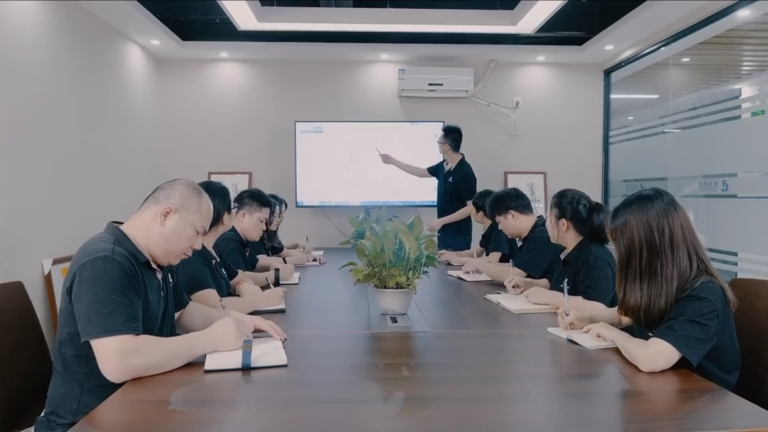
What Machine Home CNC Actually Means
Machine home CNC is not a machine model or a control brand. It describes where the work happens. A shop with this capability takes a part from raw stock to finished, inspected component without handing the job to a second or third company. The programmer, the machinist, the inspector and the person who runs the anodizing line all sit under one roof and report to one production plan.
The term comes from the machining world's idea of a machine "home" position: a known reference point the control returns to so every operation starts from the same place. Applied to a business, it means the same thing. Every process returns to one known reference, so a dimension change on the drawing does not get lost between vendors.
That single reference point is why the phrase shows up in sourcing conversations. When a drawing revision lands at 4 pm, an in-house shop can stop the current setup, re-post the program and restart the same night. A chain of outside vendors needs each link to acknowledge the change first.
So the definition has two halves. Physically, it means the equipment and the people are on one site. Contractually, it means one company owns the result. Miss either half and you are back to chasing status updates across suppliers.
- 1One siteMachining, turning, finishing and inspection share a floor and a schedule.
- 2One ownerA single quote, a single quality report, a single point of contact.
- 3One referenceDrawing revisions reach every operation at the same time.
How In-House Machining Changes the Process
The mechanical side is familiar: a spindle rotates a cutter, a control moves the axes along programmed paths, and metal leaves the stock as chips. What changes with machine home CNC is the loop around that cut. Programming, fixturing, first-article inspection and process correction happen within talking distance, not across time zones.
Take a bracket that needs two faces milled, four holes drilled and tapped, and a hardcoat anodized finish. In a split supply chain the part travels three times and gets re-fixtured at each stop. Any locating error stacks. In-house, the same operator holds the datum from the first op to the last, so the positional tolerance stays tied to one setup.
Programming is where the loop pays off fastest. A CAM programmer sitting ten meters from the machine can walk over, watch the first cut, and change feed or stepover before the second part runs. That feedback cycle is measured in minutes. Sent to an outside shop, the same change turns into an email thread, a new setup sheet and a day of waiting.
Inspection closes the loop. When a CMM or a vision system reports a dimension drifting toward the limit, the shop can adjust the offset on the next part instead of scrapping the batch and filing a claim. That is the practical meaning of process control: correction before escape.
The Equipment Behind a Machine Home Shop
Machining capability rests on the machine mix, not the machine count. A shop with 127 high-precision CNC machines can cover a wide range of geometry, but only if the axes and travels match the parts coming in. Prismatic plates, cylindrical shafts and free-form surfaces need different machines.
Three-axis vertical mills handle flat plates, housings and fixtures. They give the tightest repeatability per dollar and are the right call for parts with features on one or two faces. Four-axis mills add a rotary table, which lets the tool reach around a cylinder in one setup. Camshafts, manifolds and round housings benefit most.
Five-axis machining centers tilt the tool or the table so the cutter reaches undercuts and compound angles without re-fixturing. Shops use them for impellers, medical instruments and aerospace brackets where each re-setup would add error. A simultaneous five-axis center is the difference between a part that needs four setups and a part that needs one.
Mill-turn centers combine turning and milling on one platform, which suits parts with a turned body and milled flats, such as valve bodies and connectors. On the large end, a 4,000 mm maximum processing size covers long rails and structural beams that will not fit a standard VMC.
- 13-axisPlates, housings, fixtures; best accuracy per cost.
- 24-axisCylindrical parts with features around the axis.
- 35-axisUndercuts, compound angles, one-setup complex parts.
- 4Mill-turnTurned bodies with milled flats in a single cycle.
Where Machine Home CNC Stops Making Sense
A machine home shop is not automatically the cheapest route. If your part is a simple turned spacer in 6061 aluminium at 50,000 pieces a year, a dedicated turning house or a die casting cell will beat a general machine shop on unit cost every time. Volume changes the math.
Heavy forgings and castings can also push past the practical envelope. A part that needs a 6,000 mm travel or a 20-tonne casting is outside what most job shops can hold, and pretending otherwise wastes weeks. Ask for the travel envelope before you send a model.
Then there is the question of special processes. Heat treat, plating and some surface treatments are often subcontracted even by shops that describe themselves as fully in-house, because the equipment is expensive and runs on its own schedule. The honest version of machine home CNC means the shop controls the process, not that it owns every tank and furnace.
Finally, certification matters more than geography. A shop without the right quality system cannot serve your program no matter how close it sits. Match the certification to the industry before you match the machine to the part.
In-House Machining vs. Split Outsourcing
Use this table to decide where a job should run.
| Factor | Machine Home CNC | Split Outsourcing |
|---|---|---|
| Setup count | One datum, one operator | Re-fixtured at each vendor |
| Drawing changes | Applied the same shift | Waits for each vendor to reply |
| Tolerance stack-up | Limited to one setup | Grows with every handoff |
| Lead time | Production in 3–5 days | Adds transit between stops |
| Data exposure | One NDA, one facility | Shared with each supplier |
| Unit cost at high volume | Competitive but not always lowest | Often lower for simple, high-run parts |
| Best fit | Complex, tight, low-to-mid volume | Simple geometry, very high volume |
When to Keep the Job In-House
Pick machine home CNC when the part is complex, the tolerance is tight, or the design is still moving. Pick a specialized high-volume vendor when the geometry is simple, the quantity is large, and the drawing is frozen.
Machine Home CNC Questions
Does machine home CNC mean every process happens on one site?
It means the shop owns and controls the process. Machining, turning, inspection and most finishing usually run on site. Heat treat, plating and a few special coatings are often subcontracted under the shop's own purchase order and quality plan.
Ask which steps leave the building and who signs off on them. That answer tells you more than the marketing wording on a website.
Which part features need five-axis rather than three-axis?
Undercuts, compound angles, deep pockets on multiple faces, and any feature the cutter cannot reach without the part being turned. A part that would need four or more three-axis setups is usually a five-axis candidate.
If the part is a flat plate with holes on one face, five-axis adds cost without benefit. Match the axis count to the geometry, not to the spec sheet.
How tight a tolerance can an in-house shop hold?
GreatLight works to ±0.005 mm (±0.0002 in) on qualifying features, with surface finish from Ra 0.2–0.8 μm on fine finishes. These numbers depend on material, feature size and how the part is held.
A thin wall in aluminium behaves differently from a solid block in 17-4PH. Send the drawing and the shop will confirm what is realistic before quoting.
What documents should I expect with the parts?
Inspection reports on request, covering raw material check, in-process monitoring and final inspection. Every part is inspected before shipment.
For regulated industries, material certificates and first-article reports can be added to the order. Say so at the quote stage so the paperwork travels with the job.
Does keeping work in one shop help with confidentiality?
Yes, in a practical sense. Fewer companies see the CAD data, and the file moves inside one facility instead of across several. GreatLight stores uploads securely and signs an NDA on request.
ISO 27001:2022 covers information security at the company level, which matters when your drawings describe an unreleased product.
Can a machine home shop handle both one prototype and a full run?
Yes. There is no minimum order quantity, so a single prototype and a 10,000+ part run use the same process and the same inspection standard.
Quotation and free DFM analysis come back within 12 hours, and production can start within 24 hours of approval.
Send a Drawing, Get a Real Answer
Upload your CAD file and get a quote with free DFM analysis within 12 hours. No minimum order quantity, and every part is inspected before it ships.
12-hour quote100% inspectionNo minimum order quantity
More Machining Notes
We publish setup notes, tooling trials and inspection data from the factory floor.











