
What Is Needed for a CNC Machine? A Complete Checklist
This guide covers what is needed for a cnc machine to run at its rated tolerance: power supply, a stable foundation, spindle and tooling, CAD/CAM, workholding, coolant and chip removal, and metrology. It is written for engineers and buyers who spec a machine, prepare a floor, or judge whether a supplier can hold ±0.005 mm.
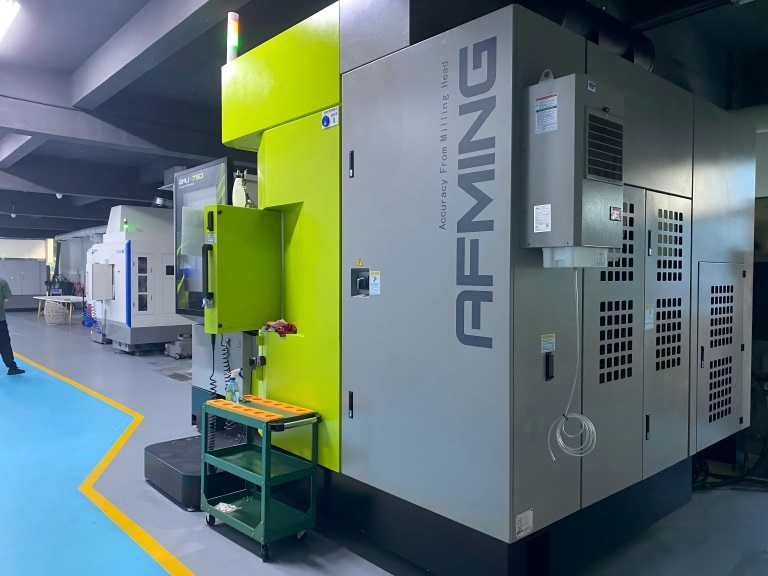
Power, Foundation and Spindle: What Is Needed for a CNC Machine to Hold Tolerance
A CNC machine is a servo system that pushes a spinning cutter through metal. Almost every accuracy problem traces back to one of three inputs: electrical supply, floor stiffness, and spindle condition. Get these wrong and no amount of CAM tuning recovers the tolerance.
Power first. A 5-axis machining center can draw 30 kW on a 380 V three-phase feed, and a mill-turn cell with a Ø400 mm rotary table draws more during simultaneous acceleration. Voltage sag during a rapid move shows up as servo following error, which lands on the part as a blend mark or a dimension that drifts mid-cut. Check the transformer rating and the distance from the panel before you buy.
Foundation second. A machine bolted to a 150 mm slab on grade behaves differently from one on a 300 mm isolated pad. Vibration from a nearby surface grinder or forklift traffic reaches the tool tip and leaves chatter on a Ra 0.8–1.6 μm finish. If the floor rings when you tap it with a wrench, you need a thicker pad or a separate isolation mount.
Spindle third. The spindle is the only component whose runout is copied directly onto the part surface. A spindle with 5 μm runout cannot produce a Ø20 mm bore to ±0.005 mm consistently, no matter how good the machine casting is. Ask for a runout reading taken at the tool taper, not the spindle nose.
- 1PowerMatch transformer kVA to peak spindle and axis draw, not average.
- 2FoundationRigid pad, isolated from grinders and traffic routes.
- 3SpindleTaper runout decides achievable roundness and finish.
CAD/CAM and Workholding: Turning a Model into a Machining Plan
A machine without CAM software is a very expensive drill press. The CAM side decides toolpath strategy, stepover, feed, and how the part is held while it is cut. This is where most shops either save or lose money on a job.
For a 5-axis part, the CAM system has to post the tool vector, not just X-Y-Z. A tilted tool lets a ball nose cutter reach a wall that a 3-axis machine would hit with the shank. That is the whole point of 5-axis work, and it only pays off if the post processor matches the machine kinematics. A generic post leaves stock in corners and forces hand blending.
Workholding is the quiet constraint. A thin aluminum 6061 bracket at 2 mm wall thickness will deflect under a 12 mm end mill no matter how rigid the machine is. Options: reduce radial engagement, add a sacrificial support, or move to a vacuum plate with a custom nest. Each choice changes the setup count and the tolerance stack.
The rule of thumb we use: if a feature can be reached in one setup with the part clamped on a flat face, do it that way. Every additional setup adds a re-clamp error of 5–20 μm. On a ±0.005 mm part, two setups already consume most of the budget.
- 1Post processorMust match machine kinematics or 5-axis gains evaporate.
- 2Thin wallsDeflection is a workholding problem before it is a cutting problem.
- 3Setup countEach re-clamp adds 5–20 μm of position error.
Coolant, Chip Removal and Metrology: Keeping the Process Repeatable
Heat is the enemy of tolerance. As a 7075 aluminum part warms from 20 °C to 35 °C during a long roughing pass, it grows about 0.02 mm per 100 mm of length. That is four times the tolerance before you even finish the part. Flood coolant, through-spindle coolant, or air blast on plastics all serve the same purpose: hold the part and the cutter at a stable temperature.
Chip removal matters as much as cooling. Recutting a chip in a deep pocket on 316 stainless work-hardens the surface and destroys the next pass. High-pressure through-tool coolant at 70 bar clears the pocket; a shop without it will peck, retract, and lose cycle time on every part. For titanium and Inconel, this is not optional.
Metrology closes the loop. A machine that cuts to ±0.005 mm needs a CMM or a laser scanner to verify it, plus a granite surface plate and calibrated micrometers for the shop floor. In-process probing on the machine catches thermal drift before the part is unclamped, which is far cheaper than scrapping it after inspection.
Finally, people. A 5-axis machine needs an operator who reads chip color, listens to the cut, and knows when a tool is dull. Software does not replace that judgment, and no certification does either. The shop that inspects 100% of parts before shipment is the shop that catches its own drift.
- 1Thermal control7075 grows roughly 0.02 mm per 100 mm at a 15 °C rise.
- 2Chip evacuationHigh-pressure coolant prevents recut and work hardening.
- 3VerificationCMM plus in-process probing catches drift before unclamping.
Machine Class vs. What It Needs to Hit Tolerance
Use this to gauge whether a shop's equipment matches the tolerance you are asking for.
| Machine class | Typical tolerance | Key requirement | Best-fit part |
|---|---|---|---|
| 3-axis mill | ±0.02 mm | Rigid vise, sharp tooling | Flat plates, simple pockets |
| 4-axis mill | ±0.01 mm | Indexer with low runout | Shafts, multi-face housings |
| 5-axis simultaneous | ±0.005 mm | Matched post, thermal control | Turbine blades, medical implants |
| Mill-turn | ±0.005 mm | Bar feed and Ø400 mm chuck | Turned parts with milled features |
| Large gantry / 4,000 mm | ±0.02 mm | Level pad, twin-drive sync | Long frames, EV battery trays |
| Prototype cell | ±0.01 mm | Fast CAM, no dedicated fixture | One-off brackets, enclosures |
The Verdict
If your part is flat and simple, a well-set 3-axis machine with good tooling is enough. If it has curved surfaces, deep pockets, or a ±0.005 mm callout, you need simultaneous 5-axis, a matched post processor, and thermal control — anything less and you will pay for it in rework.
Frequently Asked Questions
Do I need a 5-axis machine to hold ±0.005 mm?
No. A rigid 3-axis machine with a good spindle and a single setup can hold ±0.005 mm on a flat part with simple features. The limitation is reach, not accuracy.
You need 5-axis when a feature sits on a curved wall, under an overhang, or at an angle the 3-axis tool cannot reach without multiple re-clamps. Each re-clamp adds 5–20 μm of position error, which is how the tolerance budget disappears.
How much floor space does a CNC machine need?
Plan for the machine footprint plus service access on three sides, plus chip conveyor and coolant tank clearance. A compact 3-axis machine at 500 × 500 × 450 mm travel still occupies roughly 3 × 2.5 m of floor once you add access.
A large gantry machine with 4,000 mm travel needs a dedicated bay with a level pad. Do not put it next to a grinder or on a mezzanine; vibration and deflection will show up on the part.
What power supply does a CNC machining center need?
Most 5-axis centers run on 380–480 V three-phase and draw 20–40 kW at peak. Size the transformer for peak spindle and simultaneous axis acceleration, not the average cut.
Voltage sag during a rapid traverse causes servo following error, which appears on the part as a blend mark or a drifting dimension. If the panel is far from the machine, check the cable gauge before installation.
How do I know my CAM post processor is right for the machine?
Cut a test part with a known geometry: a hemisphere, a tapered wall, and a corner radius. Then measure it on a CMM. If the corner radius is over-cut or the wall has a blend line, the post does not match the machine kinematics.
A matched post is written for the specific machine model and control. A generic post will leave stock in corners and force hand blending, which adds cost and variability.
What materials affect what is needed for a CNC machine?
Aluminum 6061 and 7075 run well with flood coolant and standard carbide. Stainless 316 and 17-4PH need slower speeds, higher pressure coolant, and more rigid workholding to avoid chatter.
Titanium Ti-6Al-4V and Inconel need through-tool high-pressure coolant, reduced radial engagement, and a rigid setup. Plastics like PEEK and POM need sharp tooling and air blast, because coolant can cause dimensional swing.
How many setups should a part have?
As few as the geometry allows. One setup is ideal, two is common, three or more means you are stacking error. On a ±0.005 mm part, each re-clamp consumes part of the tolerance budget.
Design for one-setup machining where possible: add a flat clamping face, keep features reachable from one direction, and avoid deep pockets on opposite sides. This is a design decision, not just a shop decision.
Ready to Check Your Part Against the Machine?
Send us your drawing and we will tell you which machine class fits, what tolerance is realistic, and where the cost sits — with a quote and free DFM analysis within 12 hours.
12-hour quote100% inspectionNo minimum order quantity
More CNC Process Notes
We publish setup notes, tooling trials and inspection data from the factory floor.











