
What Is the Bit on a CNC Machine Called?
There is no single word. The answer depends on the machine and the cut. We explain the correct names for milling, turning and routing tools, and how to read a tool callout.
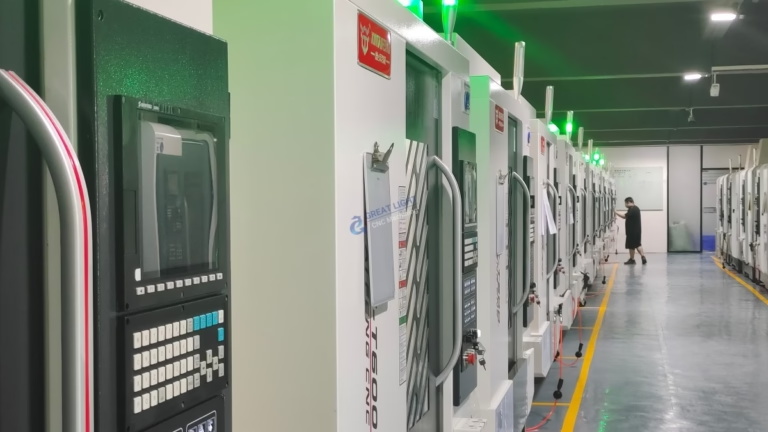
The bit on a cnc machine has several names
Ask what the bit on a cnc machine is called and you will get a different word from every trade. A machinist at a mill says end mill. A lathe hand says turning tool or insert. A sign shop says router bit. All three are cutting tools, but the geometry and the mounting are not interchangeable.
The reason is kinematics. On a mill, the tool spins and the workpiece is clamped. On a lathe, the workpiece spins and a single-point tool feeds into it. That difference in motion decides which tool you can hold, how you set it, and what tolerance you can reach.
So the honest answer is that "bit" is shop-floor shorthand. On a drawing or a tool list, nobody writes bit. They write end mill, drill, reamer, boring bar, or insert code. Learn those words and the shop floor gets a lot easier to follow.
For the rest of this page we use "bit" only as the informal umbrella term. Every technical claim is tied to a specific tool family, because mixing them up is how parts get scrapped.
Milling cutters: end mills and their relatives
On a machining center the bit is almost always an end mill. It cuts on the side and on the bottom, which lets it slot, profile, and face in one setup. Flute count is the first decision: 2 or 3 flutes clear chips fast in aluminium, 4 flutes suit steel and give a stronger core, 6 or more flutes finish hard materials at light feed.
Coating matters as much as geometry. Uncoated carbide is fine for aluminium, but it welds to the edge and builds up fast. TiAlN and AlTiN coatings hold up in steel and stainless because they stay hard when the edge gets hot. For titanium and Inconel, keep surface speed low and expect short tool life no matter the coating.
Around the end mill sit the hole-making tools. A drill starts the hole, a reamer brings it to size and finish, and a boring bar corrects position and diameter on a mill or lathe. A reamer does not fix a crooked hole; it follows the existing axis. If position matters, bore it or drill it on a rigid setup.
A face mill is the odd one out. It carries replaceable inserts on a body Ø50 to Ø160 mm and takes wide, shallow cuts. Use it to flatten a top face, not to cut a pocket. The inserts are indexed, so a dull edge is a rotation away, but the body needs a rigid spindle and plenty of coolant.
- 1Slotting2-3 flute end mill, full depth in light passes
- 2Finishing walls4-6 flute, high helix, light radial stepover
- 3Accurate holesDrill, then ream or bore to size
Turning tools: single-point geometry and inserts
On a lathe the bit is a turning tool, and most of the time it is an insert clamped in a holder. The insert is a coated carbide tip with a defined nose radius and a chipbreaker. Nose radius sets the trade-off: a small radius cuts fine detail and light cuts, a large radius leaves a smoother finish but pushes back harder and can chatter on slender parts.
Insert codes look cryptic but read left to right. CNMG 120408, for example: C is the shape, N the clearance, M the tolerance class, G the chipbreaker and mounting, then 12 for the inscribed circle in mm, 04 for thickness, and 08 for nose radius. Match the holder to the insert and the code stops being noise.
Grooving and threading tools are turning tools with a purpose. A grooving insert cuts O-ring seats, snap ring grooves, and reliefs in one plunge. A threading insert cuts a defined pitch and needs the right infeed method, otherwise the flank tears. Both are far more repeatable than a hand-ground tool, which is why job shops keep a drawer of them.
For aluminium and plastics, polished uncoated inserts run clean and sharp. For stainless and 17-4PH, expect to slow down and use plenty of coolant. Turning 316L at the same speed as 6061 is the fastest way to burn an edge and scrap a finish.
Router bits and why they are not end mills
A CNC router holds a bit in a collet and spins it fast, often 12,000 to 24,000 rpm. Router bits are built for that speed and for softer stock: wood, foam, ABS, acrylic, and sometimes aluminium plate. They usually have two flutes and a brazed or solid carbide tip, with an upcut or downcut spiral that controls which face chips out.
The collet is the weak link. A router collet grips over a short length, so runout grows with rpm and side load. Deep cuts in aluminium on a router will chatter, and the finish will show it. Light radial passes and a shorter bit fix more of that than a change in feed.
Router bits are also used in trimming and edge profiles, which is a shape job rather than a material-removal job. A flush-trim bit with a bearing copies one edge onto another. An end mill cannot do that, because the bearing is the whole point of the tool.
If a part needs ±0.005 mm and a fine finish, it belongs on a machining center, not a router. Routers are good at large flat panels; they are not built for tight metal tolerance.
How to read a tool callout on a drawing
A tool callout is the short line that tells the shop what to hold. It usually carries diameter, corner geometry, flute count, coating, and the reach. A callout like Ø10 mm, 4-flute, 30° helix, AlTiN, 40 mm reach tells a machinist almost everything without a phone call.
The reach number matters more than people think. A long tool deflects, and deflection shows up as taper in a wall or a hole that comes out undersize. If a feature is deep, ask whether a shorter tool with an extension can reach it, or whether the feature can be cut from both sides.
Corner geometry drives the finish in inside corners. A square corner leaves a sharp internal corner but concentrates stress. A bull nose with a 0.5 mm corner radius spreads load and lasts longer. A ball nose is for 3D surfaces and leaves a scallop that a finishing pass must remove.
Corner radius, reach, and coating are the three lines engineers most often leave off a drawing. Leaving them off does not save time; it moves the decision to the shop and adds a question cycle.
- 1DiameterNominal cut size, not shank size
- 2Flutes2-3 for aluminium, 4+ for steel
- 3CoatingUncoated for aluminium, AlTiN for steel
- 4ReachCutting length plus any neck
Which tool name applies to which machine
Match the cut to the tool family before you order anything.
| Machine | Common name | Typical stock | Best for |
|---|---|---|---|
| 3-axis mill | End mill | Aluminium, steel | Pockets, slots, profiles |
| 5-axis mill | Ball or bull nose end mill | Titanium, Inconel | Curved surfaces, impellers |
| CNC lathe | Turning tool / insert | Steel, stainless | Round parts, threads, grooves |
| Mill-turn center | End mill plus turning tool | Hard alloys | One-setup complex parts |
| CNC router | Router bit | Wood, plastic, aluminium | Panels, trimming, profiles |
| Drill press / mill | Twist drill | Most metals | Starting a hole |
| Mill or lathe | Reamer / boring bar | Steel, cast iron | Sizing and finishing holes |
When each name is the right one
If the tool spins and the part sits still, call it an end mill or router bit. If the part spins, call it a turning tool. If the job only needs a hole, call it a drill. Naming it right gets the right cutter, and the right cutter is most of the tolerance.
Questions we get about CNC cutting tools
Is a CNC bit the same as a drill bit?
No. A drill bit makes a hole and is judged by hole size and straightness. A milling cutter, usually an end mill, can move sideways and cut a pocket or a profile.
You can plunge an end mill to start a hole, but it is less efficient than a drill and harder on the tool center.
Why do machinists say insert instead of bit?
An insert is the replaceable cutting tip that sits in a holder. It is common on lathes and face mills, where the body is reused and only the tip is indexed or swapped.
Saying insert is more precise, because it separates the consumable edge from the tool body.
Can I run a router bit in a milling machine?
Mechanically you can clamp one, but the geometry is built for high rpm and light side load. A mill runs slower and pushes harder, so the bit will chatter and wear fast.
Use an end mill in a mill and a router bit in a router. The collet and the flute design are matched to each spindle.
What coating should I ask for?
Uncoated or ZrN for aluminium, so chips do not weld to the edge. AlTiN or TiAlN for steel, stainless and hardened stock.
For titanium and Inconel, coating helps but speed and coolant matter more. Expect shorter tool life either way.
How do I know if the tool is dull?
Listen and look. A dull cutter raises spindle load, changes the chip color, and leaves a brighter, torn finish. On a lathe the insert often squeals before it fails.
Change or index the edge at the first sign. Pushing a dull tool breaks the edge and can pull the part out of the vise.
Does tool naming affect the quote?
It affects how fast we can quote, not the price by itself. A drawing that names the tool, the corner radius and the reach removes a question cycle.
We return a quotation and a free DFM analysis within 12 hours, and production can start within 24 hours once the drawing is clear.
Send us the drawing and we will name the tool
Upload your part and our engineers will match the right cutter, tolerance and finish, then quote it.
12-hour quote100% inspectionNDA on request
More CNC tooling notes
We publish setup notes, tooling trials and inspection data from the factory floor.











