
What Is the Cost of a CNC Machine? A Complete Buyer's Guide
The cost of a CNC machine is only the first number. Loaded hourly rate, fixture cost and lot size decide what you actually pay per part. This guide is written for engineers and procurement teams comparing in-house machines against outsourced CNC work.
In this article
- 1
- 2
- 3
- 4
- 5
- 6
- 7
Key takeaways
Cost of CNC Machine vs Outsourced Machining: Which Fits?
Match the row to your real production profile before you sign a PO.
| Scenario | Better path | Why | Watch for |
|---|---|---|---|
| 1-50 prototype parts, tight deadline | Outsource | A machine purchase cannot amortize over 50 parts | Setup fees and minimum billing |
| 500-5,000 simple prismatic parts/yr | Outsource | Supplier utilization beats your single machine | Lot-to-lot tolerance drift |
| 20,000+ parts/yr, simple geometry | Buy 3-axis VMC | Cycle time pays back the capital in 12-24 months | Spindle hours and tooling budget |
| Complex 5-axis work, medical or aero | Buy only with a full order book | Machine cost is 30-40% of the real investment | CAM seats and skilled operators |
| One-off repair or legacy part | Outsource | No programming or fixture cost for you | Reverse engineering time |
| Design still changing weekly | Outsource | Rework on your own machine is dead capital | Change-order pricing |
The Verdict on the Cost of a CNC Machine
If you run fewer than 500 parts per year or your design is still changing, outsource the work. Buy a machine only when you have a stable, high-volume order book that keeps it running more than 4,000 hours a year.
What the Cost of a CNC Machine Actually Buys
A desktop router with a 300 x 300 mm bed and a 1 kW spindle sells for a few thousand dollars. It cuts wood, plastic and light aluminum. It will not hold ±0.005 mm, and it will not survive three shifts. That is the entry point, and it is not a production machine.
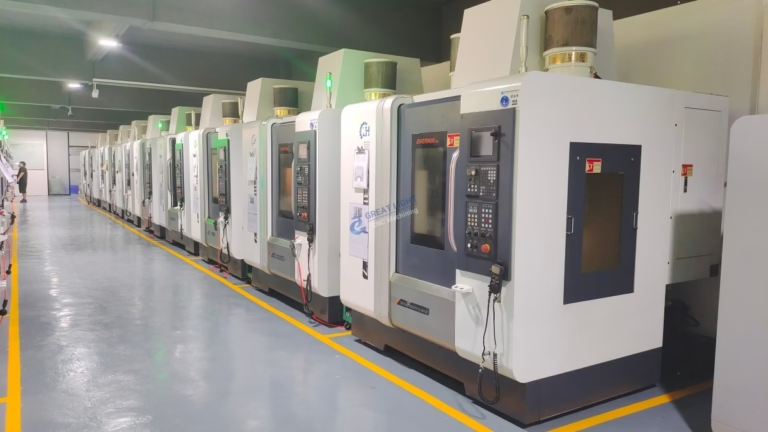
A 3-axis vertical machining center with a 600 x 600 x 600 mm envelope, a 12,000 rpm spindle and a 20-tool carousel sits in the mid five figures to low six figures. Add a 4th axis rotary table and the price climbs again. This is the workhorse for brackets, housings and plates.
A simultaneous 5-axis machining center with a Ø400 mm trunnion table and a 40-tool magazine moves into the high six figures and beyond. The cost of a CNC machine at this level is driven by the rotary axes, thermal compensation and the control system, not the frame casting.
The machine is roughly 40-60% of the total spend. Toolholders, a presetter, workholding, CAM software seats, coolant management, chip conveyors and installation take the rest. A $300,000 machine can easily become a $500,000 project before the first chip is cut.
- 1Entry levelDesktop router, light material, ±0.1 mm at best.
- 2Production 3-axis600 mm envelope, 12,000 rpm, ±0.01 mm typical.
- 3Simultaneous 5-axisTrunnion table, ±0.005 mm, complex geometry.
- 4Mill-turnRotational parts in one setup, fewer fixtures.
Six Factors That Drive the Cost of a CNC Machine
Geometry is the first driver. A part that can be reached from three directions needs a cheaper machine than a part with undercuts, deep pockets or blended surfaces. If you can redesign for 3-axis access, you remove a large chunk of the cost of a CNC machine and of the part itself.
Tolerance is the second. Going from ±0.05 mm to ±0.005 mm changes the machine, the fixturing, the temperature control and the inspection plan. In-process probing and a temperature-stable room add cost that never shows up on the machine quote. Tighten tolerance only where the function demands it.
Material is the third. Aluminum 6061 and 7075 cut fast and are forgiving. Stainless 316L and 17-4PH work-harden, so feeds and speeds must be dialed in. Titanium TC4 and Inconel eat tool life. The same part in Inconel can take three to five times the cycle time of the same part in aluminum.
Accuracy and repeatability are not the same thing. A machine rated at ±0.005 mm positioning accuracy may hold only ±0.01 mm in production once thermal drift and tool wear are included. Ask for a repeatability figure and a test-cut report, not just the positioning spec.
Automation is the fourth driver and the easiest to over-buy. A pallet changer, a robot loader and a tool presetter raise throughput but also raise the purchase price and the maintenance load. Buy automation only when you have the order volume to keep it fed.
Service and spares are the last driver. A machine from a supplier with no local service network can sit idle for weeks. That downtime often costs more than the price difference between two machines. Check the service response time and spares stock before you compare price.
- 1Geometry3-axis access is cheaper than 5-axis access.
- 2Tolerance±0.005 mm needs probing and thermal control.
- 3MaterialInconel can triple cycle time vs aluminum.
- 4ServiceDowntime often outweighs price difference.
The Loaded Hourly Rate Behind the Cost of a CNC Machine
Most buyers compare purchase price and stop there. The number that decides part cost is the loaded hourly rate: depreciation, labor, power, coolant, tooling, floor space and maintenance, divided by billable spindle hours. A machine that runs 2,000 hours a year carries a far higher rate than one that runs 6,000 hours.
A simple formula: annual cost divided by annual billable hours. If a $200,000 machine plus $80,000 of tooling and support is depreciated over seven years, that is about $40,000 per year. At 4,000 billable hours, the machine carries $10 per hour before labor and power. Add an operator at $25 per hour and power and consumables at $8 per hour, and the loaded rate lands near $43 per hour.
That is why two shops quote very different prices for the same drawing. The shop with a fuller order book spreads fixed cost over more hours. The shop with idle capacity cannot. When you compare the cost of a CNC machine against an outsourced quote, compare loaded rates, not machine stickers.
Tooling is the line item buyers forget. A 5-axis job may need custom workholding, a presetter and several special cutters. Those costs recur with every new part number. On low-volume or high-mix work, tooling can be 20-30% of the quoted part price.
- 1Utilization is kingDouble the billable hours and the hourly rate drops.
- 2Tooling recursNew part number means new workholding.
- 3Compare rates, not stickersLoaded rate is the only apples-to-apples figure.
When Outsourcing Beats Paying the Cost of a CNC Machine
Below roughly 200-500 parts per year, or whenever the design is still moving, outsourcing almost always wins. You avoid capital, programming, fixture design and the hiring problem. You pay per part and you keep the flexibility to change the design next month without writing off a machine.
Outsourcing also gives you access to capability you cannot justify buying. A shop with 16 simultaneous 5-axis centers and 127 high-precision machines can put your job on the right machine instead of the only machine you own. That matters for complex geometry, hard alloys and tight tolerance work.
Incoming inspection is the trade-off. When you outsource, you must verify what arrives. Ask for material certs, in-process records and a final inspection report. A supplier that will not share dimensional data is a risk, no matter how low the quote.
Lead time is the other trade-off. A capable supplier quotes within 12 hours and can start production within 24 hours, with parts shipping in 3-5 days on many jobs. That is often faster than buying a machine, installing it, programming the first part and proving the process.
Confidentiality is a real concern for new products. Sign an NDA before you release drawings. A supplier that offers an NDA on request and secure upload handling is set up for that conversation. If they hesitate, keep looking.
- 1Low volumeUnder 200-500 parts per year, outsource.
- 2Design churnOutsourcing keeps rework cost off your books.
- 3InspectionDemand dimensional reports with the parts.
- 4NDASign before releasing production drawings.
Step by Step: How to Compare a Machine Purchase Against a Quote
Run these six steps before you commit capital or place a production order.
- 1Count your real annual volumePull 12 months of usage, not the peak month. If the number is under 500 parts per year, stop and get three outsourcing quotes first.
- 2Classify the geometryMark every feature you can reach from three directions. If more than 80% of the part is 3-axis accessible, a 5-axis machine is hard to justify.
- 3List the true tolerancesSeparate function-critical dimensions from reference dimensions. Keep only the critical ones at ±0.005 mm; let the rest sit at ±0.05 mm or looser.
- 4Build the loaded rateTake machine price plus tooling, CAM, installation and service, divide by realistic billable hours. Compare that hourly number against supplier quotes.
- 5Test with a real jobSend one representative part to two or three suppliers. Compare the dimensional report, surface finish and lead time, not just the price.
- 6Check the exit costAsk what resale value the machine holds and what a spindle rebuild costs. A cheap machine with expensive spares is a trap.
Frequently Asked Questions
What is the cost of a CNC machine for a small shop?
A used 3-axis vertical machining center with a 500-600 mm envelope typically lands in the low to mid five figures, and a new one from a mainstream builder sits in the mid five figures to low six figures.
Add toolholders, a vise, CAM software and installation, and budget another 20-30% on top of the machine price. Do not forget power, compressed air and floor space.
Why do two shops quote very different prices for the same part?
The biggest reason is loaded hourly rate. A shop running three shifts spreads fixed cost over far more billable hours than a one-shift shop.
Tooling strategy, material purchasing power and inspection depth also move the number. A quote with a full dimensional report is not the same product as a quote with a spot check.
How many parts per year justify buying a machine?
There is no universal number, but for simple prismatic parts the break-even usually appears somewhere between 5,000 and 20,000 parts per year, assuming stable design and steady demand.
Below that range, outsourcing is almost always cheaper once you count programming, fixturing and the cost of idle capacity.
Does a 5-axis machine always cost more per part?
Not always. For parts with undercuts or complex blended surfaces, 5-axis machining can finish in one setup what would take three or four setups on a 3-axis machine.
Each setup carries its own fixture cost, load time and tolerance stack-up. When those are removed, the 5-axis rate can win on total cost even though the hourly rate is higher.
What should I check before signing an NDA with a supplier?
Confirm that the NDA covers drawings, CAD files, process data and production volumes, and that it survives the end of the commercial relationship.
Ask how uploads are stored and who inside the supplier can access them. A supplier with ISO 27001 certification has a documented information security process in place.
How tight a tolerance can outsourcing hold?
A capable shop can hold ±0.005 mm on critical features with in-process probing and temperature control.
Below that, cost rises sharply and the process needs to be qualified for the specific part. Ask for a first-article inspection report before committing to a tight-tolerance production run.
Get a Real Number for Your Part
Send your drawings and we will return a quotation and a free DFM analysis within 12 hours. No minimum order quantity, from one prototype to production runs.
12-hour quote100% inspectionNo MOQNDA on request
More from GreatLight
We publish setup notes, tooling trials and inspection data from the factory floor.











