
What Is the Definition of a CNC Machine?
A CNC machine is a machine tool whose slide movements and spindle are driven by a controller reading a part program, with position feedback closing the loop. This page explains the definition of a CNC machine in mechanical terms, the axis limits, and the point where CNC stops being the right process.
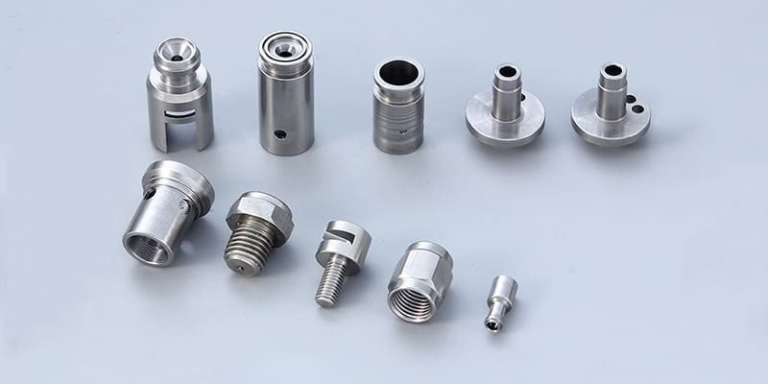
The definition of a CNC machine, part by part
The short definition of a CNC machine is a machine tool that executes a stored program instead of a hand on a crank. Computer numerical control means the controller reads G-code and M-code, converts each block into axis commands, and drives servomotors until the feedback device agrees with the commanded position. The operator loads the program and the fixture. The machine does the rest.
What separates CNC from a manual mill is not the motor, it is the loop. A ballscrew converts rotary motor motion into linear travel. A linear scale or encoder measures where the slide actually is. The controller subtracts measured from commanded position many times per second. Any error becomes a correction before the cutter moves again.
That correction cycle is the whole point of the definition of CNC machine work. Position, compare, correct, repeat. Because the loop runs in software, the same machine can cut a 200-piece bracket run and a single fixture plate without a new template, a new cam, or a new operator skill set.
Three subsystems have to hold up. The mechanical side covers the bed, rails, ballscrews, spindle and tool holder. The drive side covers servomotors and amplifiers. The control side covers the controller, the program, and the feedback devices. Weakness in any one of them shows up in the finished part, usually as chatter, drift, or a size that walks across the run.
What the definition does not cover: process limits
A definition of CNC machine capability is often written as a tolerance number, but the number depends on the setup. On our 5-axis centers we hold ±0.005 mm (±0.0002 in) on features that are reachable in one setup with rigid tooling. Deep bores, thin walls, and long overhangs need a real conversation, not a blanket claim.
Surface finish follows the same rule. Ra 0.8–1.6 μm is a normal machined result. Ra 0.2–0.8 μm needs finer stepovers, sharper tools, and often a separate finishing pass, which adds time. Ra 1.6–3.2 μm is fine for brackets and housings where the surface is not a sealing or sliding face.
Size is another boundary. Our largest travel is 4,000 × 400 × 150 mm, with medium platforms at 750 × 1,150 × 550 mm and 600 × 600 × 600 mm, and compact platforms at 500 × 500 × 450 mm and 500 × 310 × 200 mm. A part that fits the envelope but needs five sides cut may still need a larger machine or a different setup strategy.
Material matters less than people expect. Aluminium 6061, 7075 and 6082 cut fast and hold tight tolerances. Stainless 316L and 17-4PH work-harden, so feeds and speeds have to be right or the tool rubs. Titanium TC4 (Ti-6Al-4V) and Inconel move the cost curve hard. PEEK and carbon fibre machine cleanly but need dust control and the right cutters.
Where CNC machining earns its place
CNC wins when geometry is complex, quantities are low to medium, and the material is expensive or hard to form. A machined aluminium housing for a robotics joint can go from CAD to a finished, anodized part quickly because no tooling has to be cut. That flexibility is the reason the definition of CNC machine keeps coming up in prototyping conversations.
The process also wins on repeatability. Once the program is proven, the hundredth part should measure like the first. We inspect 100% of parts before shipment, with raw material checks, in-process monitoring, and final inspection reports available on request. That is what holds a qualification rate at 99.99% rather than a lucky first article.
CNC loses when the part is simple and the volume is huge. A stamped or die-cast part will beat it on unit cost once tooling is amortized. It also loses on very thin, very large sheet forms, where fabrication is faster. Knowing when not to quote a CNC process is part of quoting it well.
Our work splits across aerospace, automotive and EV, medical devices, robotics and automation, electronics, industrial machinery, and new energy. Aerospace and medical lean on tight tolerances and traceable inspection. Automotive and new energy lean on cycle time and consistency across runs. The machining method is the same; the documentation is not.
How a part actually moves through the shop
It starts with a file. We review the model, check wall thickness, tool reach, and datum strategy, and send back a DFM analysis with the quotation, usually within 12 hours. This step catches most of the expensive mistakes: a pocket too deep for the available tool, a tolerance tighter than the function needs, or a datum that cannot be reached in one setup.
Once the drawing is agreed, production can start within 24 hours. Fixtures and soft jaws are cut, the first article is measured against the model, and the program is adjusted if the numbers drift. For a five-axis part, most of the value is in getting all the critical features into one setup so the datums stay consistent.
Parts ship in 3–5 days for most jobs. No minimum order quantity applies, so a single prototype and a 10,000+ part run go through the same process. Uploads stay confidential, and we sign an NDA on request before any file changes hands.
The honest answer to whether CNC fits your part needs two numbers: the tightest tolerance that actually matters, and the annual quantity. Give us those and we can say yes or no quickly, and explain the trade-off either way.
3-axis, 4-axis and 5-axis: what each one buys you
Choose by feature access and setup count, not by machine prestige.
| Machine type | Axes | Best for | Watch out for |
|---|---|---|---|
| 3-axis | X, Y, Z linear | Flat plates, brackets, housings, pockets | Side features need a second setup |
| 4-axis | 3 linear + 1 rotary | Shafts, connectors, parts with features on four sides | Rotary workholding adds setup time |
| 5-axis indexed | 3 linear + 2 rotary, positioned | Angled holes, undercuts, fewer setups | Not simultaneous, so cycle time is longer |
| 5-axis simultaneous | 3 linear + 2 rotary, moving | Turbine blades, impellers, contoured surfaces | Programming and tooling cost is higher |
| Mill-turn | Turning + milling in one | Shafts with cross-holes and flats | Not for large prismatic parts |
Where the definition leads
If your part has complex geometry, tight tolerances, or low-to-medium volume, CNC is the right call. If it is a simple shape at very high volume, stamping or die casting will be cheaper.
Common questions about CNC machining
What is the main difference between manual machining and CNC machining?
A manual machine depends on the operator turning handles and reading dials in real time. A CNC machine reads a stored program and drives the axes with feedback, so the same program produces the same result on every part.
The trade-off is setup. Manual work can be faster for a one-off repair with no drawing. CNC needs a program and a fixture, but wins as soon as the geometry is complex or the quantity is above a handful.
Can CNC machines cut both metal and plastic?
Yes. The machine does not care about the material, only about feeds, speeds, and chip evacuation. We machine aluminium, stainless, steel, copper alloys, titanium, Inconel, magnesium, and plastics such as ABS, POM, PEEK, and carbon fibre.
Plastics need sharper tooling and lower cutting temperatures, and some grades need dust extraction. Titanium and Inconel need lower surface speeds and more rigid setups. The machine is the same; the cutting data is not.
How precise can a CNC machine hold, and why does it matter?
On our 5-axis centers we work to ±0.005 mm (±0.0002 in) on reachable features in a single setup. Finer than that is possible on specific features, but it should be driven by function, not habit.
Every extra decimal adds cost, inspection time, and scrap risk. If a bore locates a bearing, hold it tight. If a bore is a clearance hole, loosen it. That decision saves more money than any machine upgrade.
When should I choose 5-axis over 3-axis?
Choose 5-axis when the part has features on five sides, angled holes, contoured surfaces, or undercuts that a 3-axis machine cannot reach in one setup. Fewer setups mean fewer datum shifts and better position tolerance between features.
Stay with 3-axis when the part is essentially flat or prismatic and the features are all reachable from the top. It is faster to program, faster to cut, and cheaper to run.
Do you help with design changes before machining?
Yes. Every quotation includes a free DFM analysis. We flag thin walls, deep pockets, sharp internal corners, unreachable datums, and tolerances that add cost without adding function.
Most of these changes take minutes to make in CAD and save hours on the machine. It is cheaper to fix the model than to scrap the parts.
How is my design data handled?
Uploads are kept confidential, and we sign an NDA on request before files are exchanged. We hold ISO 27001:2022 for information security, alongside ISO 9001:2015, IATF 16949:2016, and ISO 13485:2016.
Access to customer files is limited to the engineers and programmers who need them for the job.
What is the turnaround time for custom CNC parts?
Quotation and DFM feedback come back within 12 hours. Production can start within 24 hours of approval, and most parts ship in 3–5 days.
Complex five-axis parts or parts needing special material may take longer. We will tell you the realistic date before you commit, not after.
Send us the part, get a real answer
Upload your model and we will return a quotation with DFM feedback within 12 hours, plus a clear statement of what the process can and cannot hold.
12-hour quote100% inspectionNo minimum order
More machining notes
We publish setup notes, tooling trials and inspection data from the factory floor.











