
CNC and NC Machining: What Actually Differs
NC reads a fixed set of instructions from tape. CNC stores the program in a computer that can be edited, offset and re-run without touching the tape. This page explains the mechanism, where each one still fits, and how to tell which process a drawing was written for.
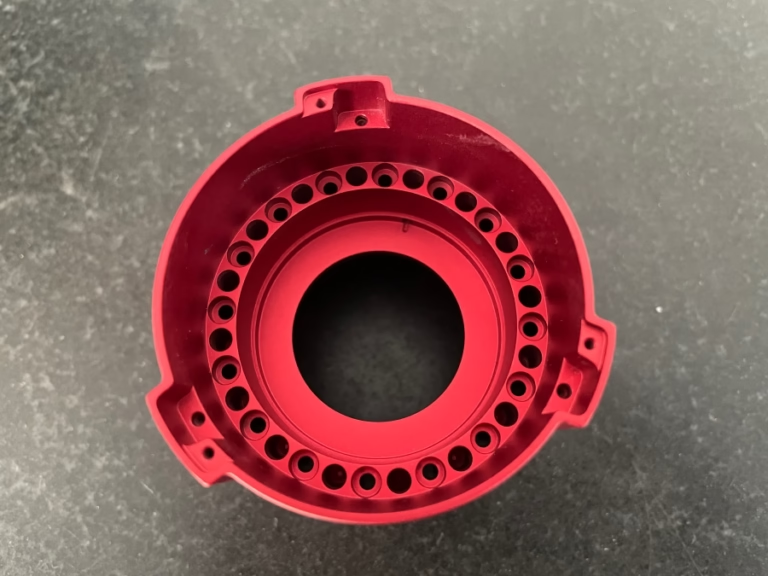
CNC and NC machining share a language, not a control architecture
Both machines cut metal from the same kind of coordinates. X, Y, Z, spindle speed, feed rate, tool number. That part has not changed since the 1950s. The difference between cnc and nc machining sits in how those coordinates get into the machine and what the machine can do with them while the spindle is turning.
NC, or numerical control, reads a program that was fixed before the part was loaded. Punched paper tape carried the blocks of G-code, and the reader stepped through them one at a time. If a dimension was wrong, you stopped the machine, punched a new tape, and started again from the top.
CNC adds a computer between the program and the drives. The controller holds the whole program in memory, applies cutter compensation and work offsets at run time, and lets an operator change a feed rate or a tool length without a new tape. That single change is what makes small batches and complex geometry practical.
So the two terms are not generations of the same knob. They describe two control architectures. One is hardwired to a fixed sequence. The other decides the sequence as it runs.
How the control loop differs on the shop floor
On an NC machine, the tape reader feeds one block, the axis moves, the reader feeds the next. There is no lookahead. The controller cannot see that a 90° corner is coming, so it cannot slow the feed before the direction change. You get dwell marks and a rougher finish on inside corners.
A CNC controller reads hundreds of blocks ahead. It plans acceleration and deceleration across the whole toolpath, so the tool enters a corner at a controlled feed instead of overshooting. On a 5-axis cut this matters more than on a flat face, because a rotary axis has to arrive at the same time as the linear axes.
Feedback is the second difference. NC systems typically ran open loop on stepper motors. The controller counted pulses and assumed the table followed. CNC systems close the loop with encoders or glass scales, so the axis reports where it actually is. That feedback is what allows a tolerance like ±0.005 mm to be held across a run.
Cutter compensation is the third. On NC, the toolpath was written for one specific cutter diameter. On CNC, the operator enters the actual diameter and the controller shifts the path. A resharpened end mill that measures 9.85 mm instead of 10 mm can still cut the same part.
- 1LookaheadCNC plans accel and decel across many blocks; NC moves one block at a time.
- 2FeedbackEncoders or glass scales report true axis position on CNC.
- 3CompensationCNC shifts the path for real tool diameter and length at run time.
- 4EditsNC needed a new tape; CNC lets the operator change an offset and re-run.
When NC still works and when it does not
NC is not a dead idea. It survives where the program never changes. A dedicated machine that drills the same hole pattern into the same casting for years does not need lookahead or on-machine editing. The tape, or a modern hardwired sequencer, is enough.
The problem starts at the first design change. On an NC setup, a revised hole position means a new tape and a full setup restart. On a CNC, it means editing a coordinate and pressing cycle start. For prototyping and low-volume work, that gap decides whether a project finishes in days or weeks.
Accuracy is the second boundary. Open-loop NC cannot correct for a dull cutter or thermal growth in the ballscrew. The part drifts across the run and nobody sees it until inspection. Closed-loop CNC corrects on every servo cycle, so the first part and the five-hundredth part stay in the same window.
There is also a geometry limit. An NC controller that reads one block at a time cannot coordinate three linear axes and two rotary axes through a continuous surface. That is why 5-axis work is CNC work by definition.
What this means for a quote and a process plan
When you send a drawing out for quote, the supplier will assume CNC unless you say otherwise. That assumption is usually correct. It lets the shop compensate for tool wear, run a first article, adjust, and then run the batch without a new program.
The practical consequences show up in three places. Setup time drops because offsets replace tape changes. First-article cost drops because you can dial in a dimension on the control. Rework risk drops because a single out-of-tolerance feature can be corrected without re-cutting the whole path.
For tight work, the machine selection matters more than the control label. A 5-axis machine with a Ø400 mm rotary table can reach features that a 3-axis machine cannot without a second setup. Every extra setup adds stack-up error, so the control and the kinematics have to be chosen together.
If a part is simple, flat and needed in the thousands, a 3-axis CNC still beats an NC line on total cost, because the program can be proven once and then run with live offsets. There is no tape to wear out and no reader to jam.
Technical differences at a glance
Values reflect typical machines built for each control type.
| Item | NC | CNC |
|---|---|---|
| Program input | Punched paper or magnetic tape | Computer memory, USB or network |
| Lookahead | None, one block at a time | Hundreds of blocks ahead |
| Feedback | Usually open loop, steppers | Closed loop, encoders or scales |
| Program edit | Re-punch the tape | Edit on the control, re-run |
| Tool compensation | Path written for one cutter | Cutter and length offset at run time |
| Typical tolerance | 0.05–0.1 mm | ±0.005 mm to ±0.05 mm |
| Best batch size | High volume, one fixed part | One prototype to 10,000+ parts |
| Geometry | Straight lines, simple arcs | 3D surfaces, 5-axis contours |
The verdict in one line
If the design is frozen and the volume is high, hardwired NC logic can still do the job. If the design can change, the tolerance is under 0.05 mm, or the geometry is 3D, choose CNC.
Common questions
Can an NC machine be upgraded to CNC?
Sometimes, but it is a retrofit, not a software update. You replace the control, the drives and usually the motors, then add encoders or scales to the axes.
The mechanical frame has to be stiff enough to benefit. On a worn machine the new control will hold position better, but the ways and ballscrews still set the real accuracy.
Is CNC machining more expensive than NC machining?
The machine hour rate is higher, because the control, drives and feedback hardware cost more. For a single fixed part run in high volume, the NC rate can look cheaper.
Once you count setup changes, first-article tuning and scrap from drifting dimensions, CNC usually lands lower on total cost for anything under a few thousand parts.
What tolerance can CNC hold compared with NC?
A closed-loop CNC with good thermal control holds ±0.005 mm on critical features, with surface finish from Ra 0.2–0.8 μm on fine work.
Open-loop NC typically sits around 0.05–0.1 mm, and it drifts as the cutter wears because nothing corrects the position.
Does the control type change the surface finish?
Yes. Lookahead lets the controller slow the feed into corners, which removes dwell marks and chatter on inside radii.
Spindle speed and feed still dominate the finish, but a control without lookahead will cap how good a complex contour can look.
How do I know which process a part was designed for?
Look at the drawing. Tolerances under 0.05 mm, 3D contoured surfaces, or notes about cutter compensation point to CNC.
A part with loose tolerances, straight features and a single fixed revision could have been cut on either, so ask the shop which control it will run on.
Send the drawing, get a process plan
We quote in 12 hours and start production within 24 hours of approval. Every part ships after full inspection.
12-hour quote±0.005 mm100% inspection
More from the shop floor
We publish setup notes, tooling trials and inspection data from the factory floor.











