
What Is the Recommended Temperature Climate for a CNC Machine?
The short answer for a thermally stable machine: hold the shop at 20 °C ± 2 °C and 40–60% relative humidity, and keep the change slower than 1 °C per hour. This page explains why that range exists, how much error you lose when you leave it, and which parts need tighter control than the rest.
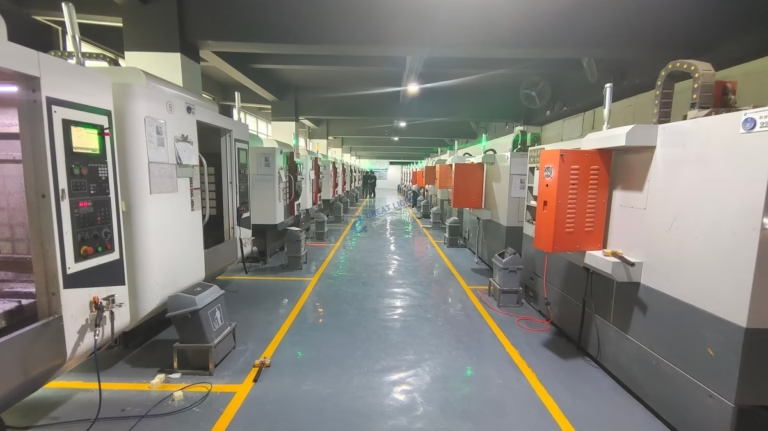
Temperature climate for a CNC machine: where the numbers come from
A CNC machine is a stack of metals with different thermal expansion coefficients. Cast iron columns, steel ballscrews, aluminum covers and the part on the table all grow at different rates. A 10 °C swing across a 500 mm steel ballscrew adds roughly 0.06 mm of length before the control ever moves an axis. That number alone can exceed a ±0.005 mm drawing tolerance.
The 20 °C figure is not magic. It is the reference temperature at which most machine tools are calibrated and at which most metrology labs write their reports. Work at that temperature and the scale you bought is the scale you get. Work 8 °C above it and every linear dimension you cut carries a hidden offset that no probe will catch.
Humidity matters just as much as heat. Below 40% RH, chips and dust stop clinging and start flying, and fine aluminum dust becomes a static and fire concern. Above 60% RH, condensation forms on cold ballscrews and ground surfaces after a weekend shutdown, and rust shows up in the linear guideways before the first cut.
So the practical target is a band, not a point: 20 °C ± 2 °C, 40–60% RH, and a rate of change under 1 °C per hour. The band is what most builders write into the installation manual for a machine sold into a general job shop.
How much accuracy you lose outside the band
Take a 6061 aluminum bracket, 300 mm long, machined at 28 °C and measured in a 20 °C inspection room. Aluminum expands about 23 μm per meter per °C. Over 300 mm and 8 °C that is roughly 0.055 mm of shrinkage between the cut and the check. The part was right on the machine and wrong on the granite.
Steel behaves better and cast iron better still, but the machine itself is the bigger problem. A vertical machining center can see 20–30 μm of spindle growth in the first two hours from a cold start, purely from spindle and bearing heat. That is why warm-up programs exist, and why the first part of a Monday morning shift is usually the worst part of the week.
Titanium and Inconel make it worse from the other side. Cutting forces and low thermal conductivity push heat into the tool and the workpiece instead of the chip. A Ti-6Al-4V pocket can climb 40–60 °C locally while the room sits at 20 °C. Local heat, not room heat, drives the final size.
The takeaway for an engineer is simple: room climate sets your baseline, and the machine and the cut add their own thermal load on top. Control the room and you remove one variable. You still have to warm the spindle and watch the part.
Which materials and features need a tighter climate
Long parts feel temperature first. Anything over 500 mm in aluminum or 800 mm in steel will move enough to matter when the shop swings a few degrees. On our 4,000 mm maximum processing size machines, the part and the machine bed expand together over that length, so long rail and frame work is scheduled in the stable part of the day.
Thin walls and tight bores come next. A 0.05 mm wall on an aluminum housing has almost no thermal mass, so it follows the room within minutes. A Ø20 H7 bore ground at 24 °C will not gauge the same at 20 °C if the part is aluminum.
Composites and plastics ignore the rules in a different way. POM and PEEK absorb moisture and change dimension with humidity, not just heat. Carbon fibre parts hold length well but the resin softens near 60 °C, so coolant and clamping strategy matter more than the room.
Parts that do not care: short steel fittings, brackets under 100 mm, and anything with a ±0.1 mm tolerance. Chasing 20 °C for those parts costs money and buys nothing. We measure the risk before we quote the climate.
What a controlled shop actually looks like
A controlled shop is not one big air conditioner. It is a building with a thermal envelope. Doors stay closed, dock levelers are sealed, and the machine room is separated from the warehouse. Sun on a west wall in the afternoon is enough to move a small shop 3 °C, so blinds and insulation come before bigger chillers.
Cooling is delivered where the heat is. Spindle chillers, ballscrew cooling and oil coolers pull heat out of the machine, while the room HVAC handles the ambient load. If the room unit is sized only for people, it will lose the fight against six machines running at 80% spindle load.
Air movement is a tool. Stratification puts warm air at the ceiling and cold air at the floor. Slow ceiling fans or ducted return mix the room and cut vertical gradients from 4 °C to under 1 °C without any extra refrigeration.
Then you measure. Log temperature and humidity at machine height, not at the wall thermostat. A 30-day log tells you whether the room drifts at night, whether the weekend costs you two hours of warm-up, and whether the second shift runs hotter than the first.
Climate targets by part type and tolerance
Use the row that matches the tightest tolerance on the drawing.
| Part or tolerance | Room target | Humidity | Notes |
|---|---|---|---|
| ±0.1 mm brackets, short steel | 18–26 °C | 30–65% RH | Standard shop HVAC is enough |
| ±0.02 mm aluminum, under 300 mm | 20 °C ± 3 °C | 40–60% RH | Let parts cool before inspection |
| ±0.005 mm, bores and fits | 20 °C ± 2 °C | 45–55% RH | Warm-up program before first cut |
| Long rails and frames, 4,000 mm | 20 °C ± 1 °C | 40–60% RH | Slow drift beats tight band |
| Ti-6Al-4V and Inconel pockets | 20 °C ± 2 °C | 40–60% RH | Control cutting heat, not just room |
| POM, PEEK, nylon parts | 20 °C ± 3 °C | 35–50% RH | Dry or condition the stock first |
| Medical and cleanroom work | 20 °C ± 2 °C | 45–55% RH | Positive pressure, filtered air |
The trade-off in one line
If your tightest tolerance is ±0.02 mm or looser, spend the money on warm-up routines and in-process gauging instead of a bigger chiller. If you hold ±0.005 mm on aluminum or long steel, buy the climate first, because no amount of skill compensates for a room that moves 5 °C between shifts.
Questions engineers ask next
What happens if the shop runs 5 °C above the recommended band?
Every linear dimension grows with the machine. On a 500 mm aluminum part, 5 °C adds roughly 0.058 mm between the cut and the 20 °C inspection room. The machine will hold size at the time of cutting and the part will fail on the granite.
Can standard air conditioning hold the band?
For ±0.05 mm work, usually yes. A properly sized split or packaged unit with a stable thermostat can hold 20 °C ± 2 °C in a sealed room.
For ±0.005 mm work, no. Office HVAC cycles on and off, and each cycle moves the room 1–2 °C. You need modulating control, ducted return and a log to prove the band holds at machine height.
How do I monitor temperature without buying a metrology system?
Two data loggers at machine height are enough to start. One at the spindle side, one at the far end of the room. Log every 15 minutes for 30 days.
Look at the overnight drop, the afternoon peak and the difference between the two loggers. That spread tells you more than any single reading on a wall thermostat.
Do we need to control humidity as tightly as temperature?
Temperature first, humidity second. Rust on guideways and condensation on cold ballscrews appear above 60% RH. Static and dust problems appear below 40% RH.
For most machine shops, holding 40–60% RH is enough. Cleanrooms and medical work often ask for 45–55% RH with positive pressure on top.
What temperature should the inspection room be?
Match the machine room at 20 °C ± 2 °C. If the inspection room is 4 °C cooler, every part you check will read small and you will chase a problem that is not there.
Let parts soak in the inspection room before measuring. A 300 mm aluminum part needs about 30–60 minutes to reach room temperature.
Does the climate matter for a 5-axis machine more than a 3-axis?
The room target is the same. What changes is the number of heat sources: rotary tables, tilting heads and extra servos all add heat inside the enclosure.
On a 5-axis machine, spindle and rotary cooling matter more, and the warm-up cycle is longer. Room control still sets the baseline.
Send the drawing, get a thermal plan
Tell us the tightest tolerance and the longest dimension, and we will tell you which climate band the part needs, what warm-up it takes, and how we hold it through final inspection.
Quotation and free DFM within 12 hours100% inspection before shipmentNDA on request
More from the shop floor
We publish setup notes, tooling trials and inspection data from the factory floor.











