
What Type of CNC Machines Are There?
Two things decide a machine class: how many axes move at once, and which cutting process removes material. This page covers eight classes, where each one stops working, and how to tell which class your part belongs on.
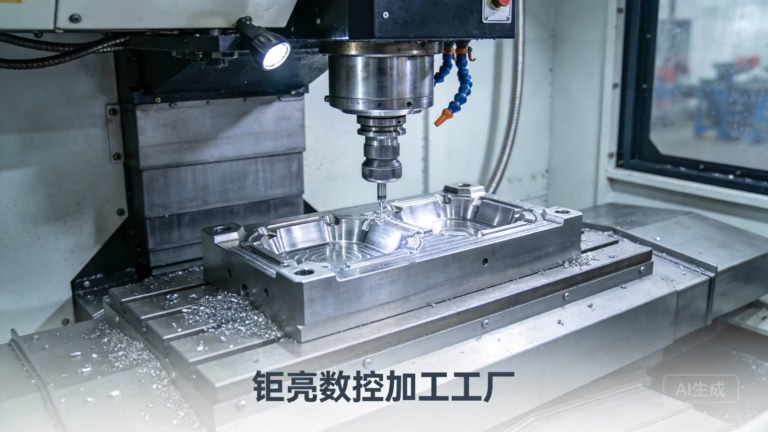
Milling: what each axis count actually buys you
Milling removes material with a rotating cutter while the workpiece stays clamped. Axis count tells you how many directions that relative motion can happen without a human re-fixturing the part. Three linear axes (X, Y, Z) cut a box-shaped envelope from one side. Everything above that is about reaching the other faces and keeping the tool at a workable angle to the surface.
On a 3-axis machine the cutter axis stays vertical. You get flat floors, straight walls, drilled holes, and pockets whose corner radius is set by the tool. Brackets, manifold blocks, enclosures and mounting plates usually need nothing more. Setup is simple and cycle time is short. For aluminum and most plastics this is the cheapest route to a good part.
A 4-axis machine adds one rotary axis, normally the A axis, so the part can index around the X axis. That removes several manual re-clamps on parts with features on multiple sides. A shaft with cross-drilled holes, a housing with ports on four faces, or a long extrusion with slots along its length all benefit. The cut is still positional: the table rotates, then locks, then cuts.
A 5-axis machine adds two rotary axes and can hold the tool normal to a curved surface while it moves. That is what makes impellers, turbine blades, deep contoured pockets and organic shapes possible in one setup. It also lets a short, stiff tool reach areas a long tool would have to chatter through. The trade is programming time and machine hourly rate.
Turning, EDM, grinding and hybrid classes
A CNC lathe, or turning center, spins the workpiece and feeds a single-point tool along it. This is the right process for anything round: shafts, bushings, fittings, connectors, valve bodies. A mill-turn center combines both, so a part that is mostly turned but needs a few milled flats or cross-holes can come off in one setup. Our shop runs 16 mill-turn centers and 16 simultaneous 5-axis machining centers.
Wire EDM cuts with a thin wire and a spark, not a cutter. Because there is no cutting force, it holds sharp internal corners and thin walls that milling would push around. It is the standard route for hardened tool steel, punch and die inserts, and any through-profile that must match a CAD outline exactly. Sinker EDM burns a shaped electrode into a cavity, which is how you cut a square-bottomed pocket in hardened steel.
Grinding removes a very small amount of material with an abrasive wheel. It is slow, and it is how you get below the tolerances milling can hold. Hardened shafts, bearing seats, gauge surfaces and mating faces that must sit flat within microns go to the grinder after heat treat. For softer parts it is usually the wrong choice: you pay grinding rates for accuracy a mill could have delivered.
Hybrid machines add a deposition head to a milling platform, laying down metal or polymer and then machining it back to size. They suit conformal cooling channels in a mold insert, or a repair on an expensive part. They are not a general production route. Tooling, surface finish and material properties still differ from wrought stock, so treat them as a problem-solver for geometry that cannot be cut or cast.
How to pick a machine class for a part
Start with geometry, not with the machine list. Ask which faces carry features that must be machined, and whether any surface is curved in more than one direction. If the answer is one or two flat faces, a 3-axis mill is enough. If it is four or five faces, a 4-axis or 5-axis machine saves setups and removes the stack-up error that comes from re-clamping.
Then look at aspect ratio and wall thickness. Deep cavities want a long tool, and a long tool deflects. A 5-axis machine can tilt the part so a shorter tool reaches the floor, which is often the difference between a clean floor and a tapered one. Thin walls behave the same way: less cutting force, less spring-back, tighter result.
Then look at tolerance and finish. Our standard machining tolerance is ±0.005 mm (±0.0002 in), with as-machined finish at Ra 1.6–3.2 μm and fine finish down to Ra 0.2–0.8 μm. If your drawing calls for a ground bearing seat or a hardened die insert, the routing includes grinding or EDM and the lead time reflects that.
Finally, weigh quantity. For one prototype, the setup cost of a 5-axis machine may not pay back. For a 10,000-part run, a fixture that lets a 3-axis machine cut four parts per cycle often beats a slower 5-axis cycle. We run no minimum order quantity, from one prototype to 10,000+ part runs, so the honest answer changes with volume.
Machine class, best fit and limit
Use this to shortlist a process before quoting.
| Machine class | Best fit | Practical limit |
|---|---|---|
| 3-axis mill | Plates, brackets, housings, flat pockets | Features on more than one face |
| 4-axis mill | Shafts, multi-face housings, long slots | Free-form curved surfaces |
| 5-axis mill | Impellers, blades, deep contoured pockets | Higher hourly rate and programming time |
| CNC lathe | Round shafts, bushings, fittings, connectors | Off-axis holes need a second op |
| Mill-turn center | Mostly round parts with milled flats | Very large or very complex prismatic parts |
| Wire EDM | Hardened steel profiles, sharp internal corners | Through-profiles only, slow removal |
| Sinker EDM | Square-bottom cavities in hardened steel | Needs a shaped electrode per feature |
| CNC grinder | Hardened shafts, bearing seats, flat faces | Slow, costly on soft material |
| Hybrid additive | Conformal cooling, part repair | Not a general production route |
The short answer
If the part is prismatic with features on one or two faces, pick a 3-axis mill. If it is round, pick a lathe. Only move to 4-axis, 5-axis, EDM or grinding when geometry, hardness or tolerance forces you there, because each step up costs cycle time and money.
Questions engineers ask next
Which machine class handles complex organic parts?
Simultaneous 5-axis machining is the usual answer. Two rotary axes keep the tool normal to a curved surface while it moves, so an impeller blade or a contoured pocket can be cut in one setup instead of several indexed ones.
If the part also has thin walls, the tilting motion lets a shorter, stiffer tool reach the floor, which reduces chatter and holds a better finish.
Can the same machine cut both metal and plastic?
Yes, with the right speeds, feeds and tooling. Aluminum 6061, 7075, stainless 303 and 316L, titanium TC4, and plastics such as POM, PEEK, ABS and PC all run on the same platforms.
The limits are thermal and clamping, not the machine class. Plastics cut fast but expand with heat, and soft stock needs lighter workholding so it does not deform.
How long does a CNC project take?
We return a quotation and free DFM analysis within 12 hours, and production can start within 24 hours. Parts typically ship in 3–5 days.
Grinding, EDM or a heat-treat step adds time to that window. Send the drawing early so the routing is decided before the material is cut.
How is quality controlled across these machine types?
Every part gets 100% inspection before shipment: raw material check, in-process monitoring, and final inspection, with reports on request.
Our plants hold ISO 9001:2015, IATF 16949:2016, ISO 13485:2016 and ISO 27001:2022, which is why the same inspection routine can serve aerospace, automotive and medical work.
Do I need a finished design before starting?
A STEP file and a 2D drawing with tolerances and critical dimensions are enough to begin. If some features are still open, our DFM analysis will flag them.
We can also start from a sketch for a prototype and tighten the drawing after the first article.
Which industries use these machine classes?
Aerospace, automotive and EV, medical devices, robotics and automation, electronics, industrial machinery, and new energy all run through our shop.
The machine mix changes by industry: medical leans on 5-axis and turning for small precise parts, while industrial machinery leans on larger 3-axis and mill-turn work.
Send the drawing, get a machine recommendation
We will review your part, name the machine class it belongs on, and quote it with a DFM note.
12-hour quote100% inspectionNo minimum order quantity
GreatLight on social
We publish setup notes, tooling trials and inspection data from the factory floor.











