
When Is It Better to Use a CNC Machine?
A practical decision guide for engineers and buyers. This article compares a CNC machine against casting, injection molding, sheet metal and 3D printing across tolerance, batch size, material and lead time. By the end you will know which process fits your part, and when a CNC machine is the wrong call.
In this article
- 1
- 2
- 3
- 4
- 5
- 6
- 7
- 8
A CNC Machine vs. Casting, Molding, Sheet Metal and 3D Printing
Read down the first column, then check which process matches your part.
| Decision Factor | CNC Machining | Injection Molding / Die Casting | 3D Printing / Sheet Metal |
|---|---|---|---|
| Typical tolerance | ±0.005 mm on metals | ±0.1 mm, then machined | ±0.1 mm FDM; ±0.2 mm sheet |
| Economic batch size | 1 to a few thousand parts | 5,000+ parts per tool | 1 to 50 parts, or flat panels |
| Tooling needed | Fixtures only, often none | Hard tool, weeks to cut | None |
| Wall thickness | Thin ribs and 0.5 mm walls | Needs draft and even walls | Print: fine; sheet: 0.5–6 mm |
| Material choice | Any machinable bar or plate | Limited to castable alloys | Print: resins; sheet: ductile metals |
| Surface finish | Ra 0.2–3.2 μm as machined | Ra 1.6–3.2 μm from tool | Print: layered; sheet: mill finish |
| Lead time, first part | 3–5 days after DFM | 6–12 weeks with tooling | Print: 1–3 days; sheet: 5–10 days |
| Per-part cost at 100 pcs | Low, no tooling amortized | High, tooling not amortized | Print: high; sheet: moderate |
Tight Tolerances and Mating Surfaces
If your drawing calls for ±0.01 mm on a bore, a shaft or a bearing seat, a CNC machine is usually the only process that holds it in production. Manual milling depends on the operator's feel; the cutter path drifts as the tool wears. On a CNC machine the path is fixed in code, and compensation for tool wear is applied between parts.
At GreatLight we hold ±0.005 mm (±0.0002 in) on metals, verified with in-house CMMs and optical scanners. That matters for parts that must interchange: a dowel pin pressed into a reamed hole, a spigot that centers a gearbox, a connector shell that snaps into a housing.
There is a limit. Tolerance tighter than the machine's thermal stability can hold is not free. A 300 mm aluminum part grows about 0.007 mm for every 1 °C rise, so ±0.005 mm across that length means temperature-controlled inspection, not just a good machine.
When accuracy is the driver, do not shop on spindle speed alone. Ask how the shop verifies the first article, and whether inspection reports come with the parts.
Complex Geometry That Needs Fewer Setups
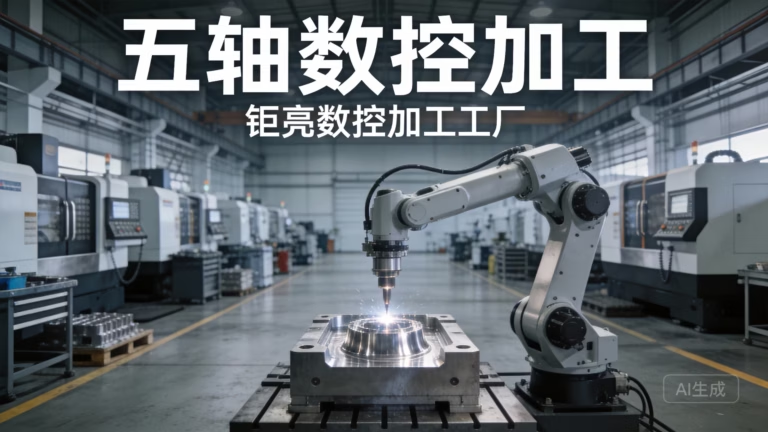
Undercuts, angled ports, curved slots, blended fillets. Shapes like these force a 3-axis machine into multiple fixtures, and every refixture adds stack-up error. A 5-axis machining center tilts the tool or the table so the cutter reaches the feature in one setup.
That is where a CNC machine pulls ahead of fabrication. A cast or welded assembly can make the same shape, but it needs a mold or a weld fixture first, and the joint lines stay visible. A 5-axis cut leaves one continuous surface.
Typical work in this category: impellers, orthopedic bone plates, robot joint housings, manifold blocks with intersecting drill paths. GreatLight runs 16 simultaneous 5-axis centers, with travels of 750 × 1,150 × 550 mm and a Ø400 mm rotary table for the smaller parts.
Watch the tool length. Deep pockets in a hard material need long, thin tools that chatter. If a feature is deeper than about four times the cutter diameter, expect the shop to slow down or split the cut, and expect the price to follow.
Low to Medium Volume Without Tooling
This is the most common reason to use a CNC machine. Below roughly 500 parts per year, tooling cost dominates the unit price. An injection mold or a die-casting tool can run into thousands of dollars and weeks of lead time, and it is not worth amortizing over a pilot run.
CNC needs fixtures, not a mold. A soft jaw or a vacuum plate is often enough, and the first part can ship in 3–5 days. When the design changes after the pilot, you edit the program. You do not cut a new tool.
Above a few thousand parts per year the math flips. Die casting and molding win on unit cost once the tool is paid off, especially for simple shapes in zinc, aluminum or commodity plastics.
A reasonable split: prototypes and bridge production on a CNC machine, then move the part to casting or molding once the design is frozen and volume is confirmed. Keep the CNC supplier in the loop for the features that still need machining after casting.
Hard, Abrasive and Specialty Materials
A CNC machine cuts from solid stock, so it does not care whether the alloy is easy to cast. 17-4PH stainless, 4140 steel, Ti-6Al-4V, Inconel and beryllium copper are all routine here. Casting these alloys is difficult or impossible; machining them is just a matter of the right insert and speed.
The trade-off is cycle time. Titanium cuts at roughly one-third the speed of aluminum 6061, and Inconel slower still. Tool life drops, so the price per part rises. Plan for that in the budget rather than being surprised by the quote.
GreatLight machines 6061-T6, 7075, 304 and 316L stainless, 17-4PH, TC4 titanium, Inconel and magnesium AZ31B, plus engineering plastics such as PEEK, POM and carbon fiber.
If your part is a simple shape in a hard alloy and the volume is high, ask whether near-net forging plus finish machining is cheaper than cutting from bar. Sometimes it is.
Repeatability Across a Production Run
One good part proves the program. Five hundred identical parts prove the process. A CNC machine repeats the same path until the tool wears out, and offset changes are logged and applied. That is why it suits parts where a mismatch stops the line: mating brackets, fixture plates, valve bodies.
Our historical late-delivery probability sits below 2%, and every shipment goes through 100% inspection with raw material checks, in-process monitoring and final inspection. Reports are available on request.
Repeatability also depends on the fixture. A part that moves 0.02 mm in the vise will show that error in every piece. Shops that machine thin, flexible parts put more effort into workholding than into spindle selection.
If your part is thin-walled, expect a discussion about support, sacrificial tabs and light finishing passes. That conversation is a good sign, not a delay.
Prototypes, Iteration and Bridge Production
During development, geometry changes weekly. A CNC machine absorbs those changes because the cost of a revision is programming time, not a new mold. That makes it the default for functional prototypes that must be tested in the real assembly, not just looked at.
Rapid prototyping with a CNC machine also gives you the final material. A printed prototype in resin tells you about fit; a machined prototype in 6061 or 316L tells you about fit, stiffness, thread strength and surface friction.
Our quotation and free DFM analysis come back within 12 hours, and production can start within 24 hours. That cadence supports a build-test-revise loop rather than a single shot.
Use the prototype phase to settle the features that drive cost: hole depth, corner radii, surface finish callouts, and which surfaces actually need to be tight.
When a CNC Machine Is the Wrong Choice
Very high volume in a simple shape. Above roughly 5,000–10,000 parts per year, casting or molding usually wins on unit price. Machining every part from bar wastes material and spindle time.
Parts that are mostly flat. A sheet metal enclosure with bends and punched holes is faster and cheaper than milling the same box from a billet, and it keeps the material's grain and coating intact.
Large, hollow, thin-wall forms. A housing with 1.5 mm walls over a 300 mm span is hard to hold without distortion on a CNC machine. Die casting or molding produces that shape in one shot.
Anything where hollow internal channels are the main feature. Additive manufacturing builds conformal cooling channels that a rotating cutter cannot reach. Use a CNC machine for the critical faces, then join or finish.
One more case: cosmetic parts with a grain or texture over the whole surface. Casting reproduces the texture in the tool. Machining it means cutting the pattern feature by feature.
The Short Answer
Choose a CNC machine when the part is tight, complex, hard to cast, or needed before tooling makes sense. Choose casting, molding, sheet metal or 3D printing when the shape is simple, the volume is high, or the walls are too thin to hold in a vise.
Common Questions
What batch size makes a CNC machine cheaper than molding?
Below roughly 500 parts per year, tooling cost dominates, so a CNC machine is usually cheaper per part.
Above about 5,000 parts per year in a simple shape, the mold or die pays for itself and the unit price drops below machining. Between those numbers, it depends on part size, material and how much finish machining the casting still needs.
Can a CNC machine hold ±0.005 mm on every material?
No. ±0.005 mm is achievable on metals under stable temperature and with the right workholding, but thin walls, long slender parts and soft plastics move.
On a 300 mm aluminum part, a 1 °C change moves the dimension by about 0.007 mm. Tighter callouts mean temperature-controlled inspection, not just a better machine.
How long does it take to get the first machined part?
Quotation and free DFM analysis come back within 12 hours, production can start within 24 hours, and parts typically ship in 3–5 days.
Complex 5-axis parts or ones needing a custom fixture take longer. Send the 3D model and the tolerance callouts early and the shop can flag the slow features before quoting.
Does a CNC machine work for plastic parts too?
Yes. ABS, PC, PMMA, POM, PA, PEEK, PP and HDPE are all machined here, along with carbon fiber composites.
Plastics cut faster than steel but deflect more, so feeds and speeds are set conservatively and finishing passes are kept light. A machined plastic part is fully dense, unlike a printed one.
What finishing options follow CNC machining?
Anodizing in clear, color, hardcoat and conductive types; electroless nickel, zinc, silver and gold plating; powder coating and black oxide; bead blasting, tumbling, brushing and polishing.
Laser marking and engraving are available down to a minimum character height of 1.5 mm.
Do I need to sign an NDA before sending drawings?
No, but we can sign one. Uploads are kept secure and confidential, and an NDA is available on request before you share the files.
If your drawings are controlled under an export or customer agreement, tell us at the start and we will route the files accordingly.
Send the Drawing, Get a Process Recommendation
Upload your 3D model and tolerance callouts. Within 12 hours you get a quote, a free DFM analysis, and a straight answer on whether a CNC machine is the right process for the volume you have.
12-hour quote100% inspectionNo minimum order quantity
More Machining Notes
We publish setup notes, tooling trials and inspection data from the factory floor.











